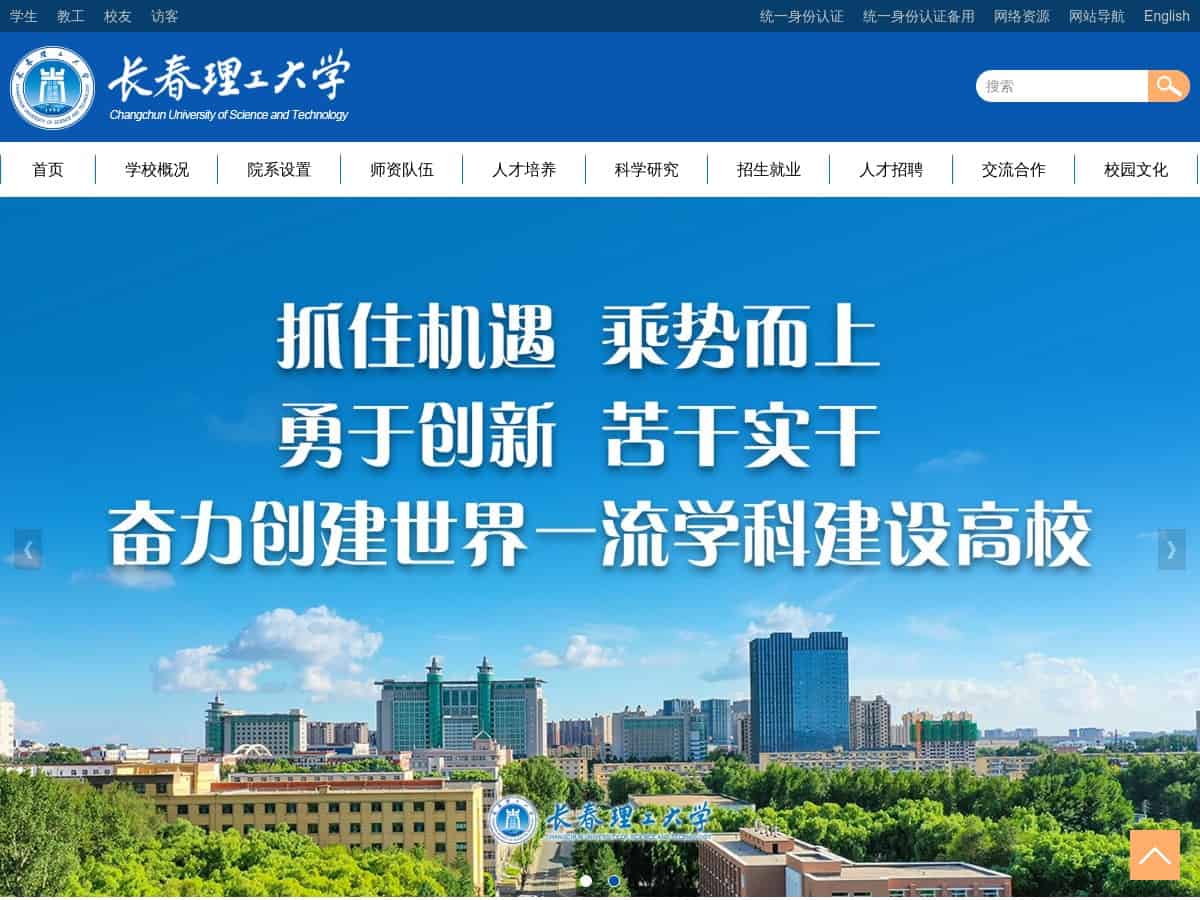
Changchun University of Science and Technology grew out of the Changchun Institute of Optics and Fine Mechanics, founded in 1958 under the scientist Wang Daheng. The university stands in Changchun, the capital of Jilin Province in northeast China, and keeps a close link with its optical roots: it is associated with the China Optical Science and Technology Museum in Changchun, and its official site features an exhibition hall dedicated to Wang Daheng.
Teaching is divided among schools that include Physics, Opto-electronic Engineering, Computer Science and Technology, Artificial Intelligence, Economics and Management, and Law. The university’s campuses are located in Changchun, and its official site lists several campus areas in the city. Beyond optics, programmes reach into computing, materials, economics and law.
The university reports nine doctoral first-level disciplines and nine postdoctoral research stations, and it holds one national key discipline. Research infrastructure includes one national-level key laboratory together with a number of provincial laboratories and engineering research centres. Enrolment figures differ between the sources, so current numbers are best taken from the university or the education authorities.
Domains taught:
AI and Machine Learning, Automation, Bioengineering, Chemistry, Computer Vision, Data Analytics, Ecology and Sustainability, Electrical and Electronics, Engineering, Fluid Dynamics, Industrial Design, Life Sciences, Manufacturing, Materials, Mathematics, Mechanical Engineering, Metrology, Microbiology and Genetics, Nanotechnologies, Optics, Physics, Process Control, Project Management, Robotics, Signal Processing, Software Engineering, Statistics, Structural Engineering, Telecommunications, Thermodynamics
Diplomas*:
Bachelor, Doctor, Master
Status:
Public
Partnerships:
Strong historical links with Changchun Institute of Optics, Fine Mechanics and Physics (CIOMP, CAS). Collaborations with optoelectronics industry.
Changchun Institute of Technology lies in the same city, Changchun, and is listed with civil engineering, electrical engineering and automation.
Beihang University in Beijing is recorded with aerospace engineering, instrument science and opto-electronics engineering.
In Wuhan, Huazhong University of Science and Technology lists mechanical engineering, optical engineering and computer science.
University of Shanghai for Science and Technology in Shanghai combines power engineering and thermal physics with optical-electrical engineering.
Beijing is also home to Beijing Institute of Technology, recorded for mechatronical engineering and control science.
Most Similar Schools Abroad
Institut d'Optique Graduate School, in Palaiseau, France, is recorded for optics, photonics and optical engineering.
In Jena, Germany, Friedrich-Schiller-Universität Jena lists optics and photonics, physics and materials science.
University of Rochester in Rochester, United States, is listed with optics, music and medicine.
ITMO University in St. Petersburg, Russia, is recorded with computer science, optics and photonics.
Utsunomiya, Japan, is home to Utsunomiya University, listed for optical engineering and mechanical systems engineering.
*our own picks (our criteria: a mix between domains, diploma delivered, reputation and size), but obviously too many criteria for an apple-to-apple ranking.
FAQ
When was Changchun University of Science and Technology founded?
It began in 1958 as the Changchun Institute of Optics and Fine Mechanics, associated with the academician Wang Daheng.
What is the university best known for?
Its roots are in optics and precision instruments, and optics remains central to its profile. The university is also linked with the China Optical Science and Technology Museum in Changchun.
How is it organised academically?
It has schools that include Physics, Opto-electronic Engineering, Computer Science and Technology, Artificial Intelligence, Economics and Management, and Law.
Where is the university located?
It is in Changchun, Jilin Province, northeast China, with several campus areas in the city.
What research qualifications does it hold?
It reports nine doctoral first-level disciplines, nine postdoctoral research stations and one national key discipline, plus one national-level key laboratory.
Where can international applicants find official information?
The university's website, cust.edu.cn, provides programme and admission information, with Chinese and English pages. Tuition and scholarship details are published by the international education office.
*: without any judgment of the quality, readers are strongly encouraged to check the official status of the exact diploma envisioned as many universities have a mix of recognized diplomas, not recognized, “co-delivered,” “equivalent to”, “some pathways” (…), can change over time, and can be named differently from one country to another.
**: international reputation: is based on some criteria that do not mean much in some domains or specialties (number of researchers, of scientific publications, on budget ….). Our approximate 1-4 scale:
known locally
known locally and internationally
is listed in some of the world university’s classifications
is listed among the 20 firsts in some of world university’s classifications
***: estimated numbers, based on online sources and/or feedbacks. The numbers can vary greatly depending on school organisation (ex.: school is part of a group, it employs internal staff or external consultants or has public staff without employing them …). Refer to all the links provided to have accurate and updated numbers.
Innovation.world is not affiliated with this school/university. We recommend to contact them directly on their website for any special request.
To complete or correct any information here or share your opinion, please comment below or > send us a direct message <.