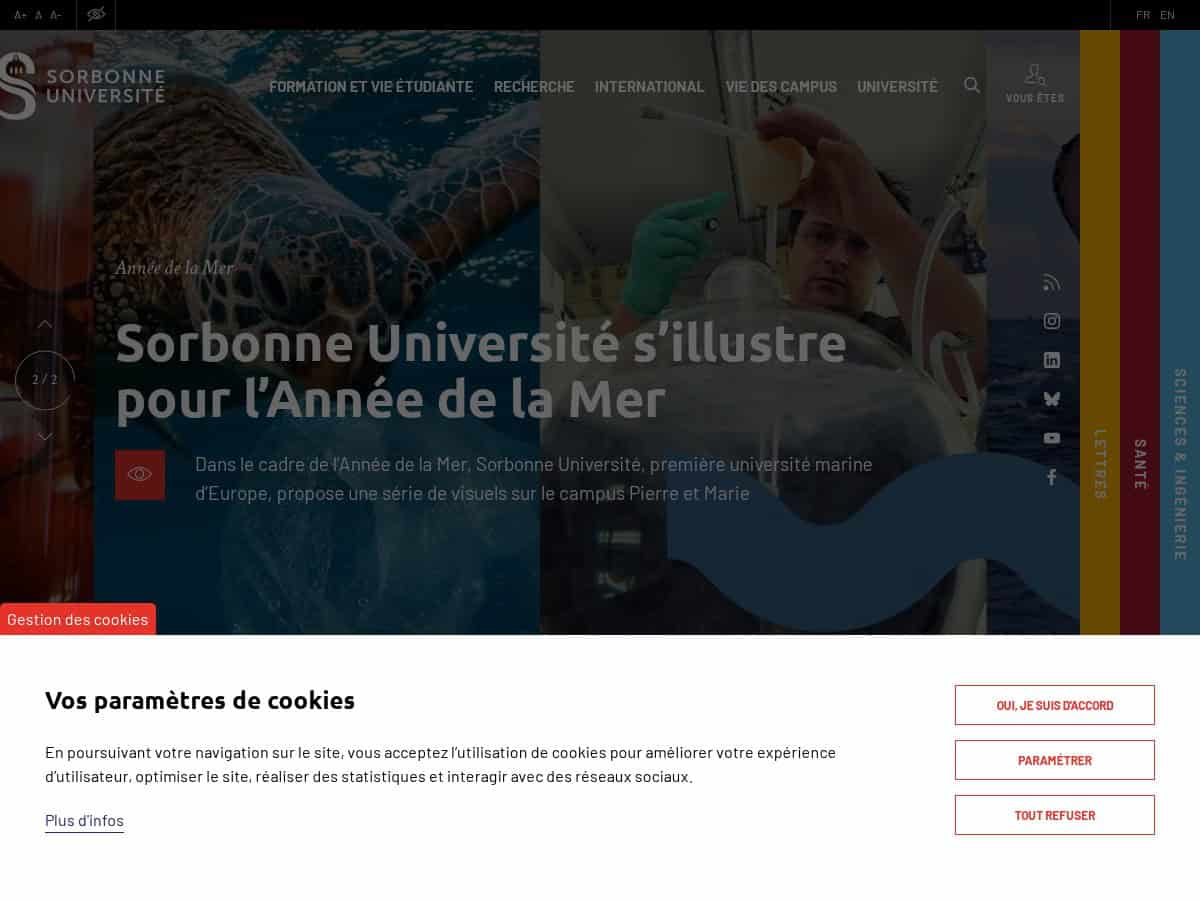
Sorbonne Université was established in 2018 by the merger of Paris-Sorbonne University and Pierre and Marie Curie University (UPMC). It is a leading public research university with comprehensive offerings in arts, humanities, medicine, science, and engineering.
Sorbonne Université was formed in 2018 by merging the Université Paris-Sorbonne, strong in the arts and humanities, and the Université Pierre-et-Marie-Curie, strong in sciences and medicine. It has about 55,000 students and 8,000 staff, and around one in five students comes from abroad. The university is spread across the Latin Quarter, the Jussieu campus beside the Seine and the medical campus around the Pitié-Salpêtrière hospital.
The name goes back to 1257, when Robert de Sorbon founded a college for poor theology students on the left bank. The buildings that carry the name today were largely rebuilt in the nineteenth century, and the chapel dates from the time of Richelieu. The Pierre-et-Marie-Curie side honours the two physicists, and Marie Curie herself took over Pierre’s chair at the Sorbonne in 1906, becoming the first woman to teach there.
Science, medicine and engineering are the core of the technical offer. Physics, chemistry, mathematics, biology, earth sciences, computer science and mechanical engineering are taught at Jussieu, and the engineering school Polytech Sorbonne is part of the university. Research units work with the CNRS, INSERM and the Paris Observatory, and medicine is linked with the Paris public hospitals. Partnerships include the 4EU+ alliance and the Sorbonne campus in Abu Dhabi.
Registration fees are set nationally and are low, at under three hundred euros for bachelor’s and master’s degrees. Non-EU students may pay higher differentiated fees, which the university can reduce through scholarships. Bachelor applicants use Parcoursup, master’s applicants use the national master portal, and international students apply through Campus France. Teaching is mostly in French, with many master’s degrees in English.
Housing in Paris is the main issue for students, but residences of the CROUS and the city, rent assistance from the housing allowance and student discounts on public transport reduce the cost. About a million visitors cross the Latin Quarter every month, but the libraries remain quiet working places for students.
Domains taught:
Aerospace, AI and Machine Learning, Astroscience, Automation, Bioengineering, Bioinformatics, Chemistry, Civil Engineering, Computer Vision, Data Analytics, Ecology and Sustainability, Electrical and Electronics, Engineering, Fluid Dynamics, Geotechnics, Life Sciences, Manufacturing, Marine Science, Materials, Mathematics, Mechanical Engineering, Microbiology and Genetics, Nanotechnologies, Optics, Physics, Process Control, Robotics, Software Engineering, Sound Engineering, Statistics, Structural Engineering, Telecommunications, Thermodynamics
Diplomas*:
Bachelor, Doctor, Master
Status:
Public
Partnerships:
Part of LERU, EUA, UNICA. Numerous international research collaborations and student exchange programs.
Research:
AI & Data Science, Climate & Environmental Science, Quantum Technologies, Health & Life Sciences, Materials Science, Cultural Heritage.
Famous Alumnis:
Marie Curie (UPMC legacy), Pierre Curie (UPMC legacy), Irène Joliot-Curie (UPMC legacy)
International recognition**:
Number of staff***:
8000
Current students***:
55000
Foreign students***:
20%
Cumulative former students***:
N/A
Pros
Leading research university, wide range of disciplines, strong in fundamental sciences, historic locations in Paris.
Cons
Very large and complex institution, can be bureaucratic, competition for resources and popular programs.
Best For
World-class multidisciplinary research university with strong emphasis on science and engineering.
Université de Lille takes a similar route through astroscience, aerospace and bioinformatics, and it is also a public institution, and teaches at the same levels, namely bachelor's, master's and doctoral.
Université Paris-Saclay shares the core fields of this institution, namely astroscience, aerospace and bioinformatics; it is also a public institution, and runs the same bachelor's, master's and doctoral programmes.
Among national alternatives, Université Grenoble Alpes stands out for its focus on sound engineering, astroscience and marine science, and it covers food science and transportations as well, and has almost the same size, at about 59,000 students.
Université de Strasbourg takes a similar route through astroscience, bioinformatics and geotechnics, and it is also a public institution, and runs the same bachelor's, master's and doctoral programmes.
Aix-Marseille Université overlaps with this institution on sound engineering, astroscience and marine science, so the two are easy to compare, and it is slightly larger, at about 78,000 students against roughly 55,000 here, and is also a public institution.
Most Similar Schools Abroad
Students considering a move abroad can look at Ludwig-Maximilians-Universität München in Germany, where astroscience, marine science and bioinformatics also form the core, and it covers signal processing as well, and has almost the same size, at about 52,000 students.
On content, University of Warsaw in Poland and this institution are close, as both teach astroscience, bioinformatics and geotechnics; it is also a public institution, and runs the same bachelor's, master's and doctoral programmes.
Freie Universität Berlin brings a Germany setting to the same core fields, astroscience, bioinformatics and geotechnics, and it is smaller, enrolling about 33,000 students against roughly 55,000 here, and is also a public institution.
On content, Università degli Studi di Bologna in Italy and this institution are close, as both teach astroscience, aerospace and bioinformatics; it covers agriculture and food science as well, and is larger, enrolling about 90,000 students against roughly 55,000 here.
Université de Genève in Switzerland pursues a similar profile in astroscience, marine science and bioinformatics, and it runs the same bachelor's, master's and doctoral programmes, and covers signal processing as well.
*our own picks (our criteria: a mix between domains, diploma delivered, reputation and size), but obviously too many criteria for an apple-to-apple ranking.
FAQ
Where is Sorbonne Université?
The administrative address is 21 rue de l'École de Médecine in Paris. The university has campuses in the Latin Quarter, Jussieu and the Pitié-Salpêtrière hospital area.
How large is it?
About 55,000 students and 8,000 staff.
How was it created?
In 2018, by merging the Université Paris-Sorbonne and the Université Pierre-et-Marie-Curie.
Where does the name Sorbonne come from?
From Robert de Sorbon, who founded a college for theology students on the left bank of the Seine in 1257.
What is it best known for?
Sciences, medicine, the humanities, mathematics and engineering.
Which engineering school belongs to it?
Polytech Sorbonne is part of the university.
What does it cost?
Registration fees are set nationally and are under three hundred euros for bachelor's and master's degrees. Non-EU students may pay higher differentiated fees.
In which language are courses taught?
Mostly in French, with many master's degrees in English.
Which alliance does it belong to?
The 4EU+ European University Alliance, among others.
Who taught there?
Marie Curie became the first woman to teach at the Sorbonne when she took over Pierre Curie's chair in 1906.
*: without any judgment of the quality, readers are strongly encouraged to check the official status of the exact diploma envisioned as many universities have a mix of recognized diplomas, not recognized, “co-delivered,” “equivalent to”, “some pathways” (…), can change over time, and can be named differently from one country to another.
**: international reputation: is based on some criteria that do not mean much in some domains or specialties (number of researchers, of scientific publications, on budget ….). Our approximate 1-4 scale:
known locally
known locally and internationally
is listed in some of the world university’s classifications
is listed among the 20 firsts in some of world university’s classifications
***: estimated numbers, based on online sources and/or feedbacks. The numbers can vary greatly depending on school organisation (ex.: school is part of a group, it employs internal staff or external consultants or has public staff without employing them …). Refer to all the links provided to have accurate and updated numbers.
Innovation.world is not affiliated with this school/university. We recommend to contact them directly on their website for any special request.
To complete or correct any information here or share your opinion, please comment below or > send us a direct message <.