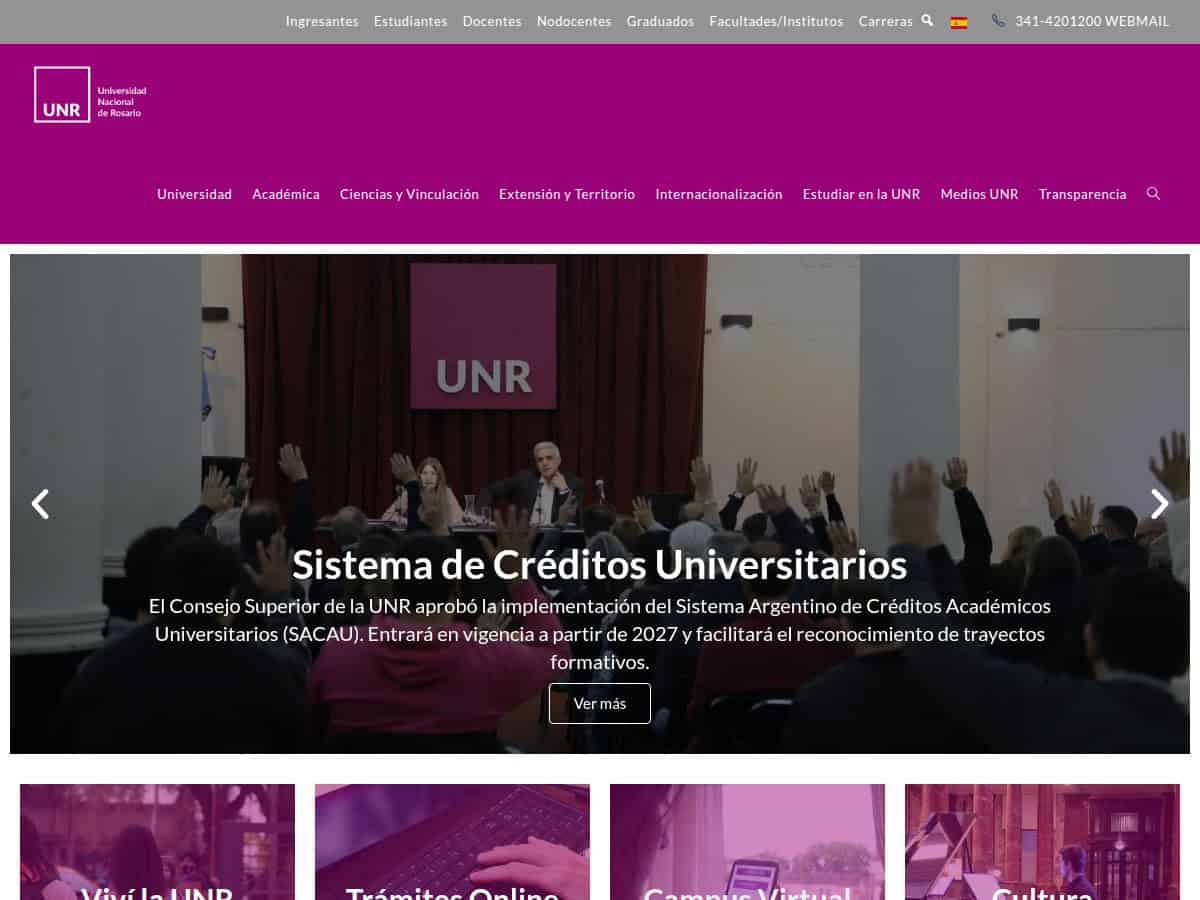
Established in 1968 by splitting from the National University of the Litoral, the National University of Rosario is a major public research university. It is organized into 12 faculties and is known for its contributions to science, engineering, and medicine.
The university operates out of Rosario, a port city on the Paraná River and the centre of Argentina’s agro-export industry. About 80,000 students and 10,000 staff give a ratio of roughly eight students per employee. The twelve faculties are spread through the city, with agricultural sciences based at a separate site in Zavalla, in the farm country outside Rosario.
Technical programmes are concentrated in the Faculty of Exact Sciences, Engineering and Surveying, which also hosts the Rosario Physics Institute shared with CONICET. Other research units cover molecular and cellular biology, systems and information science, in a joint French-Argentine centre, and agricultural biotechnology. The mix reflects a region where soybean processing, machinery manufacturing and food technology are the main employers.
Research is strongest in physics, chemistry, biotechnology and agronomy, and many of the institutes are operated jointly with CONICET. The university takes part in international networks and holds bilateral agreements for student and staff mobility with universities across Latin America and Europe. Close contact with the processing plants along the river gives engineering and chemistry students local industrial partners for projects and internships.
Undergraduate tuition is free and teaching is in Spanish. Each faculty sets its own entry procedure and introductory courses. Rosario is a mid-sized city, so living costs are generally lower than in Buenos Aires, and the river front, with its parks and cultural venues, is a short walk from the central faculties.
Rosario’s place in Argentine life also matters for students. The city is where the national flag was first raised in 1812 and the birthplace of Che Guevara and Lionel Messi, and its calendar of theatre, music and exhibitions is busy. About 300,000 people have graduated from the university, so alumni networks in local industry are dense and useful when looking for placements.
Actively participates in international networks and has numerous bilateral agreements for academic mobility and research with universities across Latin America, Europe, and beyond.
Research:
UNR is a significant research center, particularly in the fields of physics, chemistry, biotechnology, and agricultural sciences. It has several research institutes, many of which are jointly operated with CONICET.
Famous Alumnis:
N/A
International recognition**:
Number of staff***:
10000
Current students***:
80000
Foreign students***:
0%
Cumulative former students***:
300000
Pros
Strong programs in a wide range of fields, significant research output, active cultural life, free education.
Cons
Bureaucratic administration, some faculties are spread out geographically across the city, facilities can be inconsistent in quality.
Best For
Students wanting a comprehensive university experience in Argentina’s third-largest city, with strong options in both sciences and humanities.
In terms of fields, National University of Cuyo is the nearest neighbour, with agriculture, chemistry and physics again at the core; it covers food science and industrial design as well, and is smaller, enrolling about 45,000 students against roughly 80,000 here.
National University of Córdoba sits close to this university on agriculture, chemistry and physics; it is larger, enrolling about 136,000 students against roughly 80,000 here, and is also a public institution.
Think of National University of La Plata when chemistry, physics and engineering is the priority: it is slightly larger, at about 115,000 students against roughly 80,000 here, and is also a public institution.
Anyone who wants a second school in the same country with a similar spread of chemistry, physics and mathematics can consider National University of Buenos Aires, and it is also a public institution, and teaches at the same levels, namely bachelor's, master's and doctoral.
Also strong in engineering, National Technological University makes a sensible second look at home; it is also a public institution, and teaches at the same levels, namely bachelor's, master's and doctoral.
Most Similar Schools Abroad
Aarhus University brings a Denmark setting to the same core fields, agriculture, bioengineering and chemistry, and it is also a public institution, and runs the same bachelor's, master's and doctoral programmes.
For a study option in France with a comparable spread of chemistry, statistics and physics, Université Paris Cité is the reference point: it covers microbiology and genetics and life sciences as well, and is slightly smaller, at about 64,100 students against roughly 80,000 here.
Looking internationally, Cairo University in Egypt is where agriculture, chemistry and physics get a comparable treatment; it runs the same bachelor's, master's and doctoral programmes, and covers finance and civil engineering as well.
University of Turin, based in Italy, is built around agriculture, chemistry and statistics much like this university, and it is also a public institution, and teaches at the same levels, namely bachelor's, master's and doctoral.
On content, University of Milan in Italy and this institution are close, as both teach agriculture, chemistry and statistics; it covers food science and microbiology and genetics as well, and is slightly smaller, at about 64,878 students against roughly 80,000 here.
*our own picks (our criteria: a mix between domains, diploma delivered, reputation and size), but obviously too many criteria for an apple-to-apple ranking.
FAQ
Where is the National University of Rosario?
It is in Rosario, in Santa Fe province, with its main address at Córdoba 1814. The agricultural faculty is in nearby Zavalla.
How large is the university?
It has about 80,000 students and 10,000 staff, organised in 12 faculties.
Is the university free?
Undergraduate education at Argentine national universities has traditionally been free of tuition. Foreign applicants should check the current conditions.
Which faculty teaches engineering?
The Faculty of Exact Sciences, Engineering and Surveying teaches civil, electrical, mechanical, electronic and other engineering degrees, along with surveying and exact sciences.
What are the main research areas?
Physics, chemistry, biotechnology and agricultural sciences, supported by several institutes that are run jointly with CONICET.
Does the university have international programmes?
Yes. It takes part in international networks and has bilateral agreements for student and staff mobility with universities in Latin America, Europe and elsewhere.
In which language are courses taught?
Courses are taught in Spanish.
Are there industry links?
The Rosario area has large processing, machinery and food plants, and the university's engineering and chemistry programmes work with them on projects and internships.
How does admission work?
Each faculty defines its own requirements, and many degrees start with an introductory course. Check the faculty's current call before enrolling.
Is Rosario expensive for students?
Living costs are generally lower than in Buenos Aires, although rents near the central faculties vary by neighbourhood.
Agriculture, Bioinformatics, Biomedical Sensors, Chemistry, Engineering, Environmental Engineering, Research and Development, Sustainable Development
*: without any judgment of the quality, readers are strongly encouraged to check the official status of the exact diploma envisioned as many universities have a mix of recognized diplomas, not recognized, “co-delivered,” “equivalent to”, “some pathways” (…), can change over time, and can be named differently from one country to another.
**: international reputation: is based on some criteria that do not mean much in some domains or specialties (number of researchers, of scientific publications, on budget ….). Our approximate 1-4 scale:
known locally
known locally and internationally
is listed in some of the world university’s classifications
is listed among the 20 firsts in some of world university’s classifications
***: estimated numbers, based on online sources and/or feedbacks. The numbers can vary greatly depending on school organisation (ex.: school is part of a group, it employs internal staff or external consultants or has public staff without employing them …). Refer to all the links provided to have accurate and updated numbers.
Innovation.world is not affiliated with this school/university. We recommend to contact them directly on their website for any special request.
To complete or correct any information here or share your opinion, please comment below or > send us a direct message <.