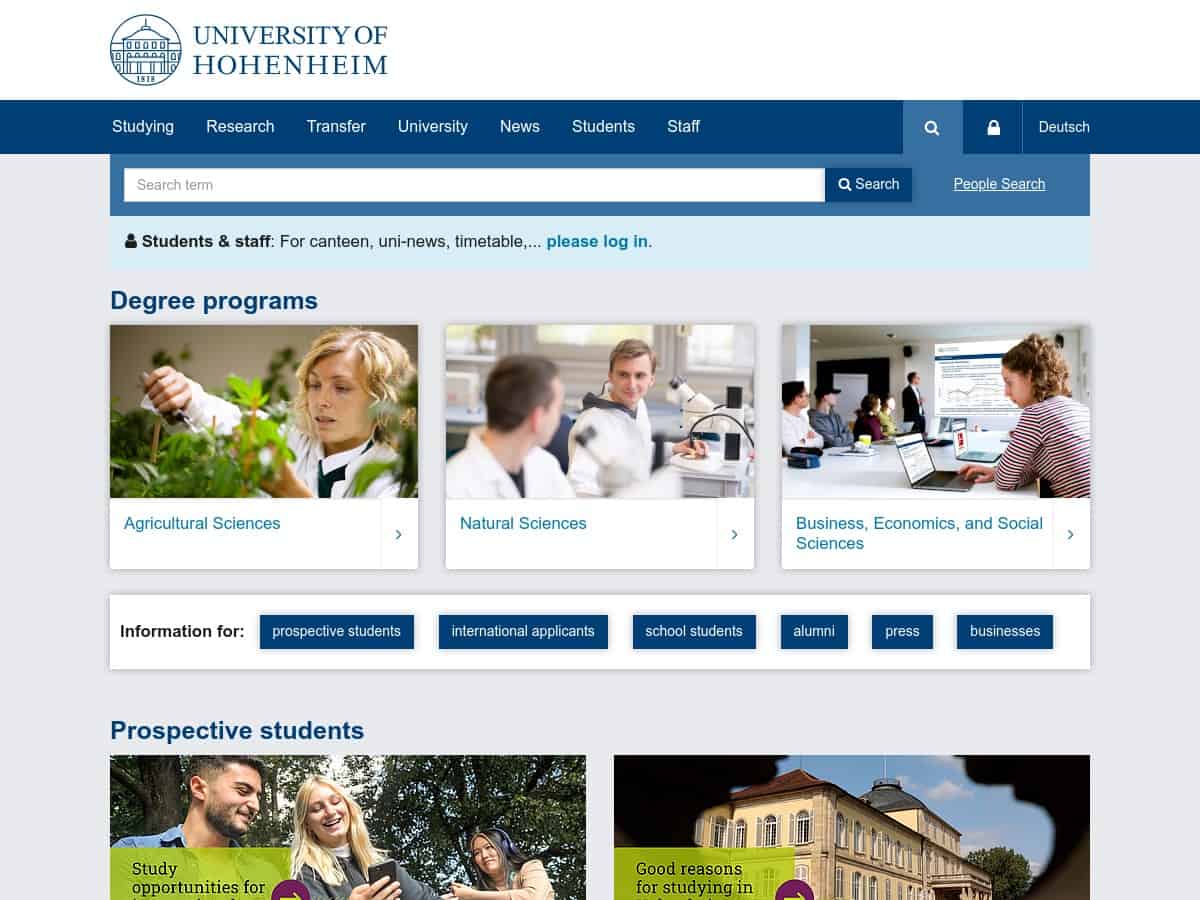
Schloss Hohenheim in Stuttgart, Baden-Württemberg, is the address of Universität Hohenheim. The institution began in 1818, when King William I of Württemberg founded an agricultural institute at Hohenheim. A royal decree of 1847 raised it to an agricultural academy.
After the First World War the agricultural college received the right to award doctorates and habilitations, in 1918 and 1919. In 1923 Margarete von Wrangell was appointed to a chair at Hohenheim, and she became the first woman to hold a full professorship at a German university. The institution therefore grew from an agricultural institute of the early nineteenth century into the university of today.
Its roots lie in agricultural science, and the university has widened its range of subjects since then. Anyone checking current student numbers, entry requirements or tuition rules should rely on the figures published on the university’s own pages for the latest academic year. Because the institution is located in Stuttgart, students can combine a historic address with the facilities of a large regional centre.
Domains taught:
Aerospace, Agriculture, AI and Machine Learning, Bioengineering, Bioinformatics, Chemistry, Computer Vision, Data Analytics, Ecology and Sustainability, Electrical and Electronics, Engineering, Fluid Dynamics, Food Science, Geotechnics, Life Sciences, Manufacturing, Materials, Mathematics, Mechanical Engineering, Microbiology and Genetics, Nanotechnologies, Optics, Physics, Process Control, Project Management, Robotics, Signal Processing, Software Engineering, Statistics, Structural Engineering, Telecommunications, Thermodynamics
Diplomas*:
Bachelor, Doctor, Master
Status:
Public
Partnerships:
Leading German university for agricultural sciences and food science. Strong focus on bioeconomy and sustainability.
Research:
Sustainable agriculture and food systems, Bio-based value chains and circular economy, Food chemistry and biotechnology, Climate change and environmental protection, Agricultural engineering and digitalization.
Famous Alumnis:
N/A
International recognition**:
Number of staff***:
1000
Current students***:
9000
Foreign students***:
10%
Cumulative former students***:
N/A
Pros
Excellence in agricultural and food sciences, strong research in bioeconomy, beautiful historic campus.
Cons
Highly specialized in agriculture and life sciences.
Best For
Leading university for agricultural sciences, food science, and bioeconomy.
Justus-Liebig-Universität Gießen records Agricultural & Environmental Sciences, Chemistry & Materials Science, Physics & Technology as main specialties.
Specialties at Hochschule Neubrandenburg include Agricultural Sciences & Food Technology, Geomatics & Landscape Architecture, Environmental Engineering.
Universität Bremen offers a profile built on Marine & Environmental Sciences, Materials Science & Production Engineering, Computer Science & Digital Media.
Universität Greifswald lists Physics & Material Science in its directory profile, with public status.
Philipps-Universität Marburg focuses on Chemistry & Materials Science, Physics & Nanoscience, Life Sciences & Biotechnology.
Most Similar Schools Abroad
AgroParisTech, based in France, records Agronomy & Environmental Sciences, Food Science & Engineering, Forestry & Natural Resource Management as main specialties.
In France, Institut Agro Montpellier is a public institution with Agronomy & Plant Sciences, Environmental Sciences & Water Management, Food Science & Technology in its profile.
Università degli Studi di Udine (Italy) covers Food Science & Technology, Information Engineering, Agricultural Sciences according to its directory profile.
Università degli Studi della Basilicata in Italy has a profile built on Agricultural Sciences, Environmental Engineering, Computer Science.
Université de Lausanne, found in Switzerland, concentrates on Life Sciences, Geosciences, Environmental Science.
*our own picks (our criteria: a mix between domains, diploma delivered, reputation and size), but obviously too many criteria for an apple-to-apple ranking.
FAQ
When was the institution at Hohenheim founded?
It was founded in 1818 by King William I of Württemberg as an agricultural institute. It was raised to the status of an agricultural academy by royal decree in 1847.
Who was Margarete von Wrangell?
She was appointed at Hohenheim in 1923 and became the first woman to hold a full professorship at a German university. Her appointment is one of the best-known episodes in the institution's history.
Where is the campus located?
The campus lies in Stuttgart, and the university's official address is Schloss Hohenheim. Hohenheim Palace was built under Duke Charles Eugene of Württemberg.
Which subjects is the university known for?
Its roots are in agricultural science, and its programmes have broadened over time. Prospective students can compare the degree programmes on the official study pages.
Can Hohenheim award doctorates?
Yes, the right to award doctorates dates back to 1918, with habilitation following in 1919. Doctoral candidates should contact their chosen institute for supervision rules.
Where can applicants find admission details?
Admission requirements, language rules and fees are published on the official university website for each degree programme. Applicants from abroad should also check recognition rules for their school-leaving certificates.
*: without any judgment of the quality, readers are strongly encouraged to check the official status of the exact diploma envisioned as many universities have a mix of recognized diplomas, not recognized, “co-delivered,” “equivalent to”, “some pathways” (…), can change over time, and can be named differently from one country to another.
**: international reputation: is based on some criteria that do not mean much in some domains or specialties (number of researchers, of scientific publications, on budget ….). Our approximate 1-4 scale:
known locally
known locally and internationally
is listed in some of the world university’s classifications
is listed among the 20 firsts in some of world university’s classifications
***: estimated numbers, based on online sources and/or feedbacks. The numbers can vary greatly depending on school organisation (ex.: school is part of a group, it employs internal staff or external consultants or has public staff without employing them …). Refer to all the links provided to have accurate and updated numbers.
Innovation.world is not affiliated with this school/university. We recommend to contact them directly on their website for any special request.
To complete or correct any information here or share your opinion, please comment below or > send us a direct message <.