Product Design, Manufacturing & Innovation Resources
Maison » Magnetic Dipole Moment

Magnetic Dipole Moment

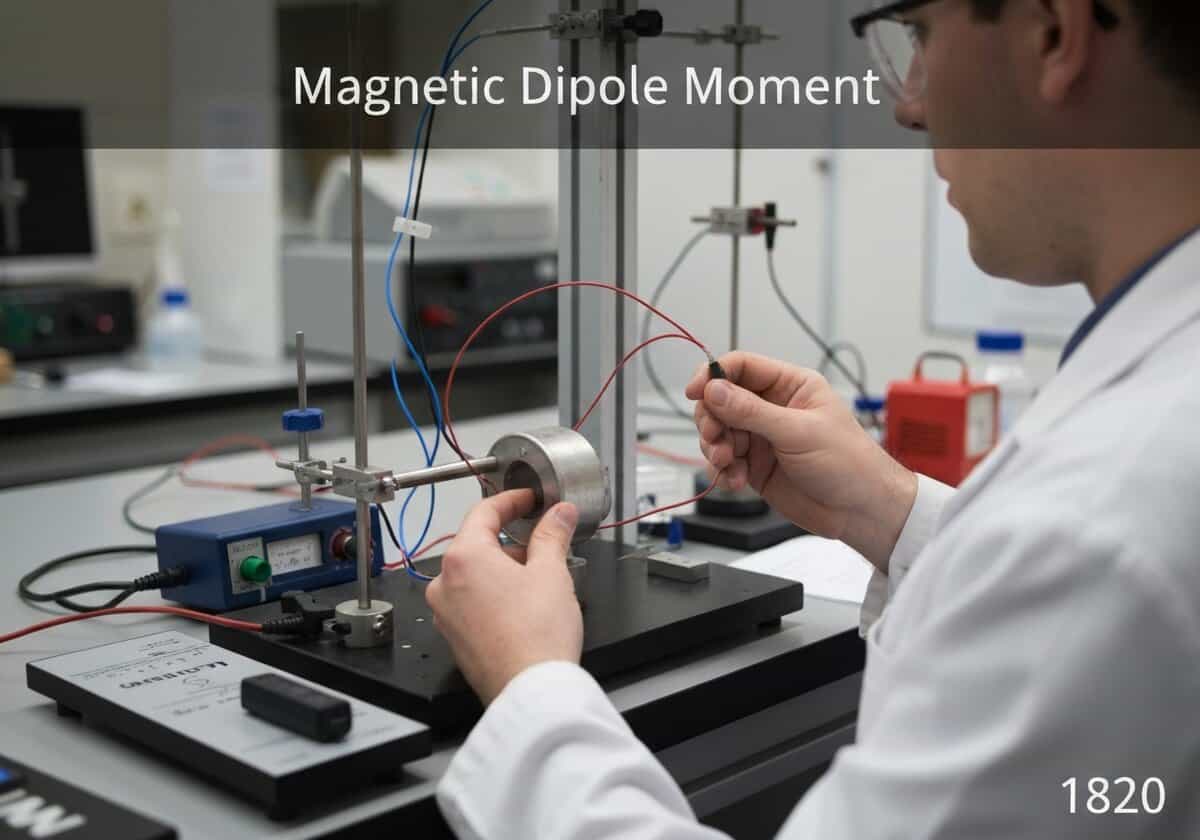
1820
Installation de laboratoire pour l'étude du moment dipolaire magnétique en électromagnétisme.

(Image générée à titre d'illustration uniquement)

Le moment magnétique d'un aimant est une quantité vectorielle qui caractérise ses propriétés magnétiques globales. Il peut être représenté comme un dipôle magnétique, une paire hypothétique de pôles nord et sud séparés par une certaine distance. Le moment magnétique pointe du pôle sud vers le pôle nord. Pour une boucle de courant, le moment magnétique [latex]\vec{\mu} = I \vec{A}[/latex], où I est le courant et A le vecteur surface.

The magnetic dipole moment is the fundamental quantity describing a magnetic source. In classical physics, it arises from electric currents. Ampère hypothesized that all magnetism is due to microscopic current loops, known as “Ampèrian currents,” within materials. This model explains why breaking a aimant in half creates two new magnets, each with its own north and south pole, rather than isolating the poles. The magnetic moment vector [latex]\vec{\mu}[/latex] is crucial for calculating the torque [latex]\vec{\tau} = \vec{\mu} \times \vec{B}[/latex] experienced by a magnet in an external magnetic field [latex]\vec{B}[/latex], and the potential energy [latex]U = -\vec{\mu} \cdot \vec{B}[/latex].

In quantum mechanics, the magnetic moment is an intrinsic property of elementary particles, like electrons, due to their spin. This intrinsic spin magnetic moment is a purely quantum effect and is not due to any physical spinning or current loop. The total magnetic moment of an atom is the vector sum of the orbital magnetic moments (from electrons orbiting the nucleus) and the intrinsic spin magnetic moments of its electrons and nucleus. In most materials, these moments are randomly oriented and cancel out. However, in magnetic materials, a significant number of these moments can align, creating a net macroscopic magnetic moment and thus a magnetic field.

UNESCO Nomenclature: 2212
- Electromagnétisme

Taper

Système abstrait

Perturbation

Fondamentaux

Usage

Utilisation généralisée

Précurseurs

  • discovery of the magnetic compass
  • observation of attraction and repulsion between lodestones
  • la découverte par øersted du lien entre l'électricité et le magnétisme
  • loi de force d'ampère

Applications

  • magnetic resonance imaging (mri)
  • accélérateurs de particules
  • data storage (hard drives)
  • electric motors and generators
  • compasses

Brevets:

NA

Idées d'innovations potentielles

  • spin-based quantum computing (spintronics)
  • ultra-sensitive magnetometers for interfaces cerveau-ordinateur
  • targeted drug delivery using magnetic nanoparticles
  • self-aligning modular robotics
  • magnetic levitation systems for friction-less transport
  • non-invasive cellular manipulation using localized magnetic fields
  • energy harvesting from ambient magnetic field fluctuations
  • advanced magnetic shielding for sensitive electronics
  • données cryptage using magnetic spin states
  • magnetically-actuated micro-valves for lab-on-a-chip devices
Voir aussi : moment magnétique, dipôle, courant ampérien, couple, énergie potentielle, spin quantique, vecteur, magnétisme, électromagnétisme, physique.

Contexte historique

Magnetic Dipole Moment

1811
1816-11-16
1820
1820
1821
1822
1827
1810
1816
1816-11-16
1820
1820
1822
1824
1827

(si la date est inconnue ou non pertinente, par exemple « mécanique des fluides », une estimation arrondie de son émergence notable est fournie)

10e année anniversaire

Les images en pleine résolution et les téléchargements sont uniquement disponibles, et 100% gratuits, pour les membres inscrits.