Address: 35 Route de Chartres, 91440 Bures-sur-Yvette, Île-de-France, France
Mathematics, Theoretical Physics
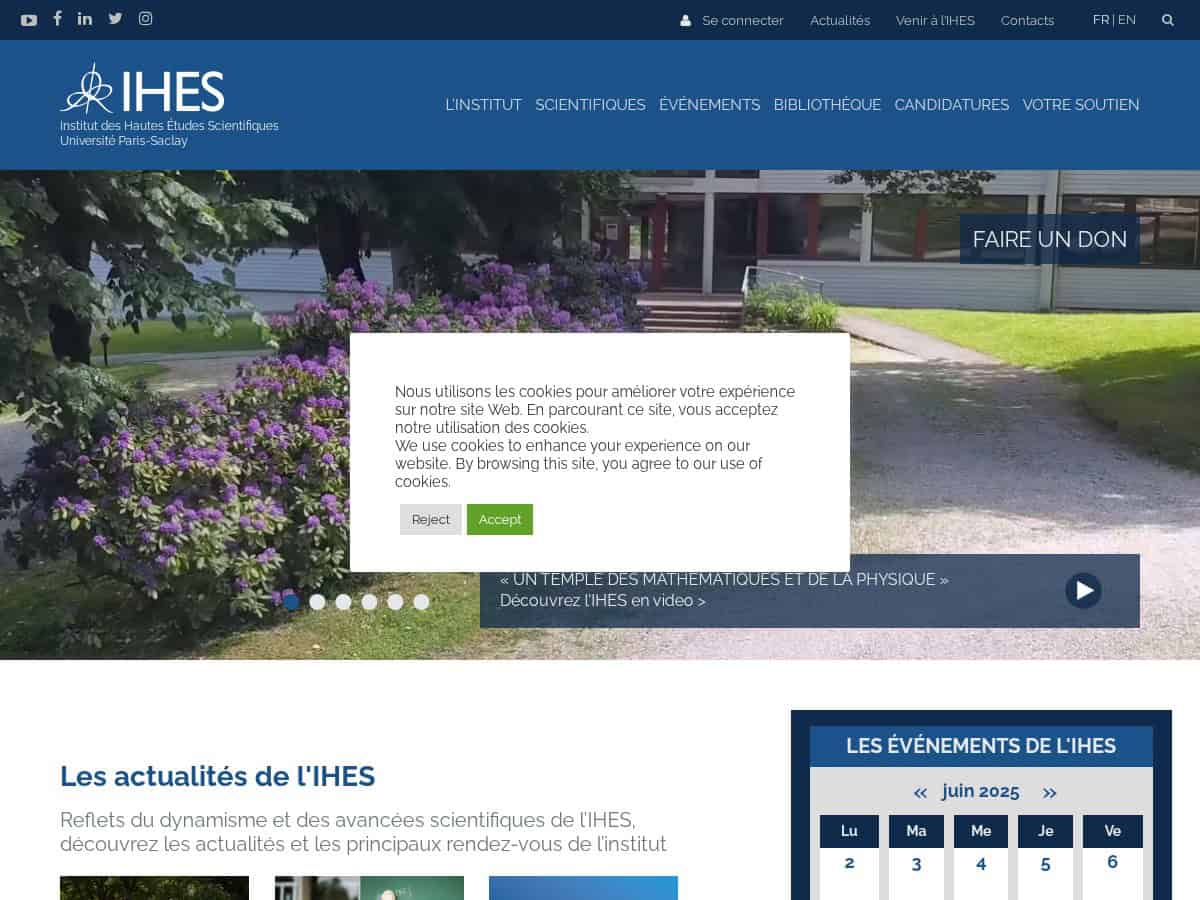
The Institut des Hautes Études Scientifiques was founded in 1958 at Bures-sur-Yvette, south of Paris, on the initiative of Léon Motchane. It was conceived as a European counterpart to the Institute for Advanced Study in Princeton, and Robert Oppenheimer, then director of that institute, joined its scientific committee from the start and stayed a member for life.
Its work centres on mathematics and theoretical physics, with further interest in interfaces such as the link between mathematics and biology. IHES operates as a foundation, has a limited number of permanent professors, and invites about 200 visiting researchers each year. It is also a CNRS laboratory, the Alexander Grothendieck Laboratory (UMR 9009), and a founding member of Université Paris-Saclay.
Eight Fields Medallists have been among its permanent mathematics professors: René Thom, Alexander Grothendieck, Pierre Deligne, Alain Connes, Jean Bourgain, Maxim Kontsevich, Laurent Lafforgue and Hugo Duminil-Copin. Alain Connes has held the Léon Motchane chair since 1979, and the institute has been directed by Motchane (1958-1971), Nicolaas Kuiper, Marcel Berger, Jean-Pierre Bourguignon (1994-2013) and, since 2013, Emmanuel Ullmo.
Domains taught:
Mathematics, Physics, Statistics
Diplomas*:
Doctor
Status:
Private
Partnerships:
Collaborates with CNRS, Université Paris-Saclay. Strong international links with leading research institutions.
Research:
Algebraic geometry, Number theory, Quantum field theory, String theory, Statistical physics.
Famous Alumnis:
Alexander Grothendieck, René Thom, Pierre Deligne, Alain Connes, Dennis Sullivan, Maxim Kontsevich, Laurent Lafforgue, Ngô Bảo Châu, Hugo Duminil-Copin
International recognition**:
Number of staff***:
100
Current students***:
50
Foreign students***:
80%
Cumulative former students***:
500
Pros
World-renowned research institute, attracts top scientists, exceptional environment for fundamental research.
Cons
Exclusively for advanced research and PhDs, very small number of positions, highly specialized.
Best For
Advanced fundamental research in mathematics and theoretical physics.
Université Paris-Saclay counts the institute among its founding members, and its fields include physics, mathematics and engineering.
École Normale Supérieure de Lyon, a public school in Lyon, lists mathematics and computer science along with physics and chemistry.
École Normale Supérieure Paris-Saclay at Gif-sur-Yvette is public and teaches engineering sciences together with physics and chemistry, in the same region as the institute.
X - École Polytechnique, public and based at Palaiseau, offers engineering and sciences such as physics, mathematics and computer science.
Université Paris Dauphine - PSL is a public university in Paris with applied mathematics, data science and computer science for organizations as fields.
Most Similar Schools Abroad
Scuola Internazionale Superiore di Studi Avanzati (Italy) is a public postgraduate school in Trieste with theoretical particle physics, condensed matter physics and neurobiology.
Instituto de Ciencias Matemáticas (Spain) is a mathematics research centre, comparable in its sharp focus on mathematical research.
Princeton University (United States) is private, with mathematics and physical sciences among its fields.
Rheinische Friedrich-Wilhelms-Universität Bonn (Germany), a public university in Bonn, lists mathematics and physics among its leading fields.
Moscow Institute of Physics and Technology (Russia) is a public institution near Moscow with theoretical physics and applied mathematics as fields.
*our own picks (our criteria: a mix between domains, diploma delivered, reputation and size), but obviously too many criteria for an apple-to-apple ranking.
FAQ
Who founded IHES and when?
Léon Motchane founded it in 1958. He modelled it on the Institute for Advanced Study in Princeton.
What subjects does the institute cover?
Its fields are mathematics and theoretical physics, together with related theoretical disciplines. Interfaces such as mathematics and biology also feature in its programme.
Which famous mathematicians have worked there?
Eight Fields Medallists have been among its permanent mathematics professors: Thom, Grothendieck, Deligne, Connes, Bourgain, Kontsevich, Lafforgue and Duminil-Copin. Grothendieck joined in 1958 and stayed until 1970.
How does the institute welcome researchers from abroad?
It invites about 200 visiting researchers every year. They work alongside a limited number of permanent professors.
How is IHES related to Paris-Saclay and the CNRS?
It is a founding member of Université Paris-Saclay. It also hosts the Alexander Grothendieck Laboratory, a joint unit with the CNRS.
Who directs the institute?
Emmanuel Ullmo has been director since 2013. His predecessors were Motchane, Nicolaas Kuiper, Marcel Berger and Jean-Pierre Bourguignon.
Where is IHES located?
It is at Le Bois-Marie in Bures-sur-Yvette, south of Paris. Visitors and applicants should consult ihes.fr for current programmes and calls.
Innovation, Mathematics, Research and Development, Sustainability
*: without any judgment of the quality, readers are strongly encouraged to check the official status of the exact diploma envisioned as many universities have a mix of recognized diplomas, not recognized, “co-delivered,” “equivalent to”, “some pathways” (…), can change over time, and can be named differently from one country to another.
**: international reputation: is based on some criteria that do not mean much in some domains or specialties (number of researchers, of scientific publications, on budget ….). Our approximate 1-4 scale:
known locally
known locally and internationally
is listed in some of the world university’s classifications
is listed among the 20 firsts in some of world university’s classifications
***: estimated numbers, based on online sources and/or feedbacks. The numbers can vary greatly depending on school organisation (ex.: school is part of a group, it employs internal staff or external consultants or has public staff without employing them …). Refer to all the links provided to have accurate and updated numbers.
Innovation.world is not affiliated with this school/university. We recommend to contact them directly on their website for any special request.
To complete or correct any information here or share your opinion, please comment below or > send us a direct message <.