Product Design, Manufacturing & Innovation Resources
Hogar » Disposición atómica en aleaciones

Disposición atómica en aleaciones

1910
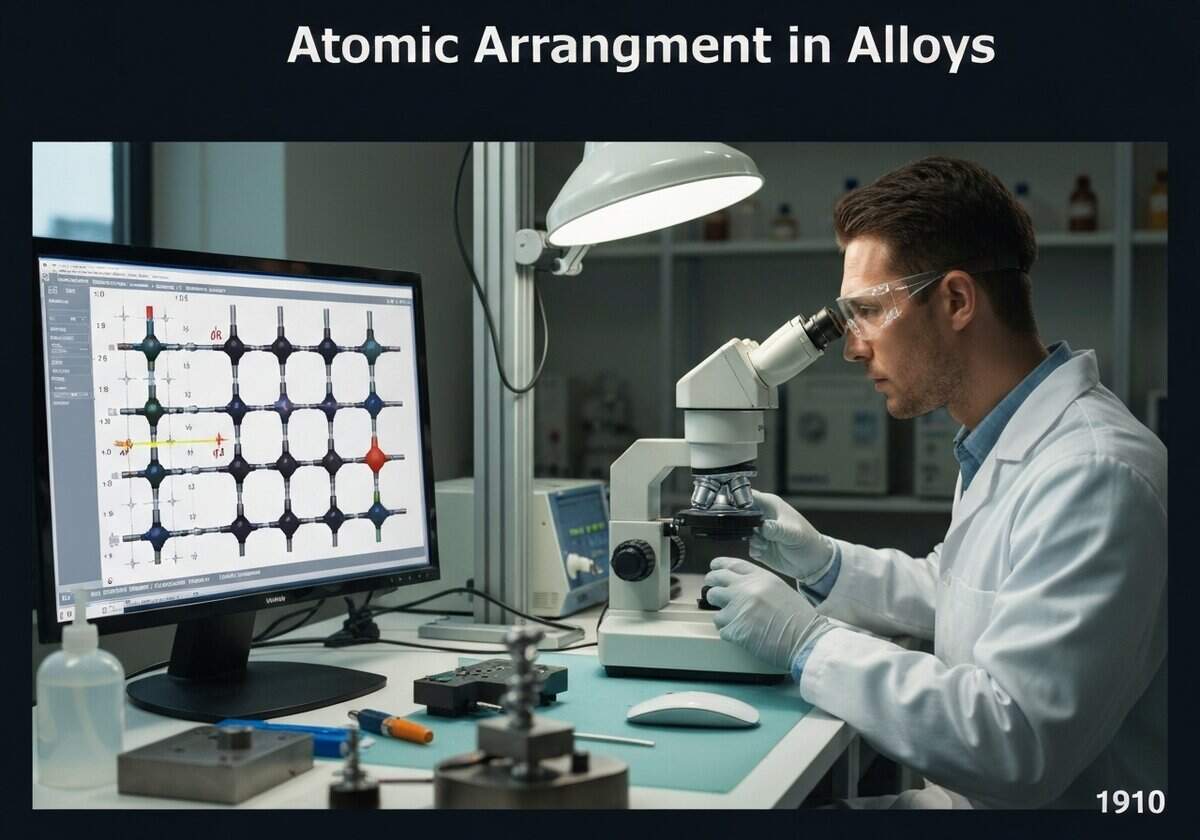
Metalúrgico analizando la disposición atómica en aleaciones bajo un microscopio en un laboratorio.

(Imagen generada únicamente con fines ilustrativos)

Alloys are classified based on atomic arrangement. In substitutional alloys, atoms of the solute element replace atoms of the solvent in the crystal lattice, common when atomic sizes are similar. In interstitial alloys, smaller solute atoms, like carbon in iron, fit into the spaces (interstices) between the larger solvent atoms. This structural difference fundamentally dictates the alloy’s mechanical properties.


The distinction between substitutional and interstitial solid solutions is fundamental to physical metallurgy and alloy design. The type of solid solution that forms is primarily governed by the relative sizes of the solute and solvent atoms. Substitutional alloys typically form when the atomic radii of the two elements are within about 15% of each other, a guideline known as the Hume-Rothery size-factor rule. When a solute atom replaces a solvent atom, it introduces localized lattice strain, which impedes dislocation motion and thus increases the material’s strength and hardness, but often reduces its ductilidad. Examples include brass (zinc in copper) and bronze (tin in copper).

Interstitial alloys, on the other hand, form when the solute atoms are significantly smaller than the solvent atoms, allowing them to occupy the interstitial sites within the crystal lattice without displacing a solvent atom. Common interstitial atoms are hidrógeno, boron, carbon, and nitrogen. The presence of these atoms causes significant lattice distortion, which provides a very effective mechanism for blocking dislocation movement, leading to a substantial increase in hardness and strength. The most prominent example is steel, where carbon atoms occupy interstitial sites in the iron lattice. The amount of carbon and its location, which can be controlled by heat treatment, determines the final properties of the steel, from ductile low-carbon steel to hard, brittle high-carbon steel.

UNESCO Nomenclature: 3308
- Metalurgia

Tipo

Principio físico

Ruptura

Fundacional

Uso

Uso generalizado

Precursores

  • John Dalton’s atomic theory
  • Descubrimiento de estructuras cristalinas mediante difracción de rayos X por William Henry Bragg y William Lawrence Bragg
  • Conceptos básicos de mezclas y soluciones químicas
  • primeros estudios metalográficos de microestructuras metálicas

Aplicaciones

  • Diseño de aceros de alta resistencia (carbono intersticial en hierro)
  • Creación de latón resistente a la corrosión (zinc sustitutivo en cobre)
  • Desarrollo de plata esterlina para mayor durabilidad (cobre sustitutivo en plata)
  • Formulación de elementos calefactores de nicromo (níquel y cromo sustitutivos)

Patentes:

NA

Ideas para posibles innovaciones

  • Aleaciones de gradiente con relaciones intersticiales a sustitucionales controladas en todo el material
  • Aleaciones autolubricantes con elementos intersticiales que se difunden a la superficie bajo tensión
  • Aleaciones con expansión térmica ajustable mediante la mezcla de solutos intersticiales y sustitucionales
  • ‘smart’ alloys where interstitial atoms can be moved by an electric field to change properties
  • Aleaciones intersticiales de alta entropía para aplicaciones de temperaturas extremas
  • Aleaciones biocompatibles con elementos intersticiales que promueven la integración ósea
  • Aleaciones con memoria de cambio de fase basadas en el movimiento intersticial de átomos
  • Materiales de almacenamiento de hidrógeno que utilizan metales con grandes sitios intersticiales.
  • catalytic alloys where interstitial atoms modify surface reactivity
  • Aleaciones resistentes a la radiación para reactores nucleares donde los átomos intersticiales atrapan defectos
Related to: substitutional alloy, interstitial alloy, crystal lattice, solid solution, solute, solvent, metallurgy, atomic arrangement, lattice strain, steel.

Contexto histórico

Disposición atómica en aleaciones

1900
1903-05-10
1910
1910
1910
1910
1920
1900
1903
1906
1910
1910
1910
1920
1920

(Si la fecha es desconocida o no es relevante, por ejemplo "mecánica de fluidos", se proporciona una estimación redondeada de su aparición notable)

décimo año aniversario

Las imágenes en tamaño completo y las descargas solo están disponibles, de forma totalmente gratuita, para los miembros registrados.

> Acceso <