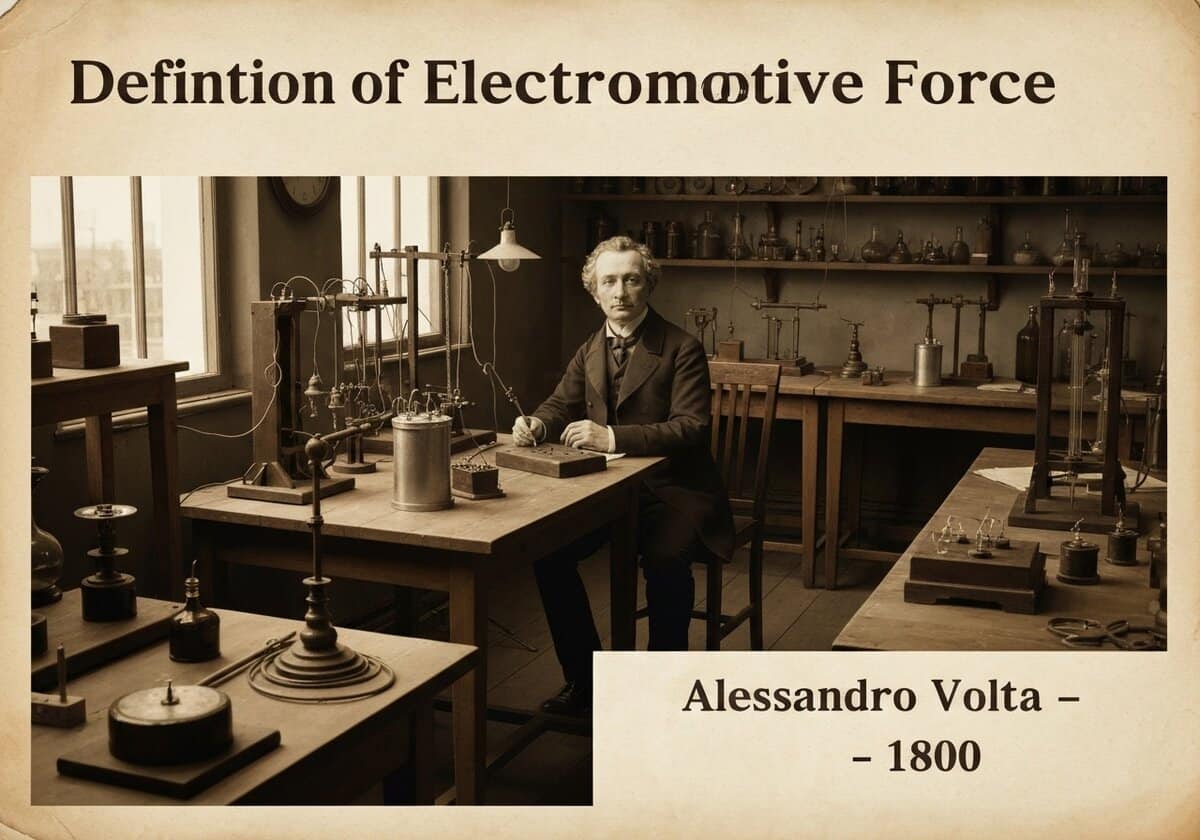
Definition der elektromotorischen Kraft (EMK)
Die elektromotorische Kraft ([latex]\mathcal{E}[/latex]) ist die Arbeit, die pro Einheit elektrischer Ladung von einer nicht-elektrischen Quelle wie einer Batterie oder einem Generator verrichtet wird. Trotz ihres Namens handelt es sich nicht um eine mechanische Kraft, sondern um ein elektrisches Potenzial, das in Volt gemessen wird. Sie stellt die Energie dar, die von einer anderen Form (chemisch, mechanisch) in elektrische Energie umgewandelt wird, während eine Ladung die Quelle durchquert.
Electromotive force, or EMF, is a fundamental concept in electromagnetism that quantifies the energy conversion process within a source. When a charge [latex]q[/latex] moves through a device that provides EMF, the work done [latex]W[/latex] on the charge is given by [latex]W = \mathcal{E}q[/latex]. This work is performed by a non-conservative field, often called an impressed field [latex]\mathbf{E}_{im}[/latex], which is distinct from the conservative electrostatic field generated by static charges. The EMF is formally defined as the line integral of this impressed field around a closed loop: [latex]\mathcal{E} = \oint \mathbf{E}_{im} \cdot d\mathbf{l}[/latex].
This distinction is crucial. An electrostatic field, described by Coulomb’s law, is conservative, meaning the work it does on a charge around any closed loop is zero. This is why a simple configuration of static charges cannot sustain a continuous current in a circuit. An EMF source, however, provides the “push” to drive charges against the electrostatic field’s potential gradient, maintaining a current. In a battery, this impressed field arises from chemical processes at the electrodes. In a generator, it’s due to a changing magnetic field (Faraday’s law) or the motion of a conductor in a magnetic field (motional EMF). The EMF represents the maximum potential difference the source can provide when no current is flowing, also known as the open-circuit voltage. When current flows, the terminal voltage across the source is typically lower than the EMF due to internal resistance within the source itself.
UNESCO Nomenclature: 2205
- Elektrizität und Magnetismus
Verwendung
Weitverbreitete Verwendung
Vorläufer
- Luigi Galvanis Entdeckung der „tierischen Elektrizität“
- Charles-Augustin de Coulombs Formulierung des Gesetzes der elektrostatischen Kraft
- Verständnis von elektrischem Potenzial und Ladung
Anwendungen
- Stromversorgung aller elektronischen Geräte
- Elektrofahrzeuge
- Energiespeicherung im Netzmaßstab
- tragbare Elektronik
Potenzielle Innovationsideen
Aufgrund des hohen Datenverkehrs durch Web-Scraping-Bots, der derzeit mehr als 40.000 Anfragen pro Tag umfasst, ist dieser Inhalt ausschließlich Community-Mitgliedern vorbehalten.
> Anmelden < oder > Registrieren < (100% kostenlos) Zugriff darauf sowie auf alle anderen eingeschränkten Inhalte und Tools.
Verwandte Begriffe: EMK, elektromotorische Kraft, Spannung, Potenzialdifferenz, Arbeit, Ladung, Batterie, Generator.