Product Design, Manufacturing & Innovation Resources
Heim » Chemical Bonding

Chemical Bonding

1916
  • Gilbert N. Lewis
  • Linus Pauling
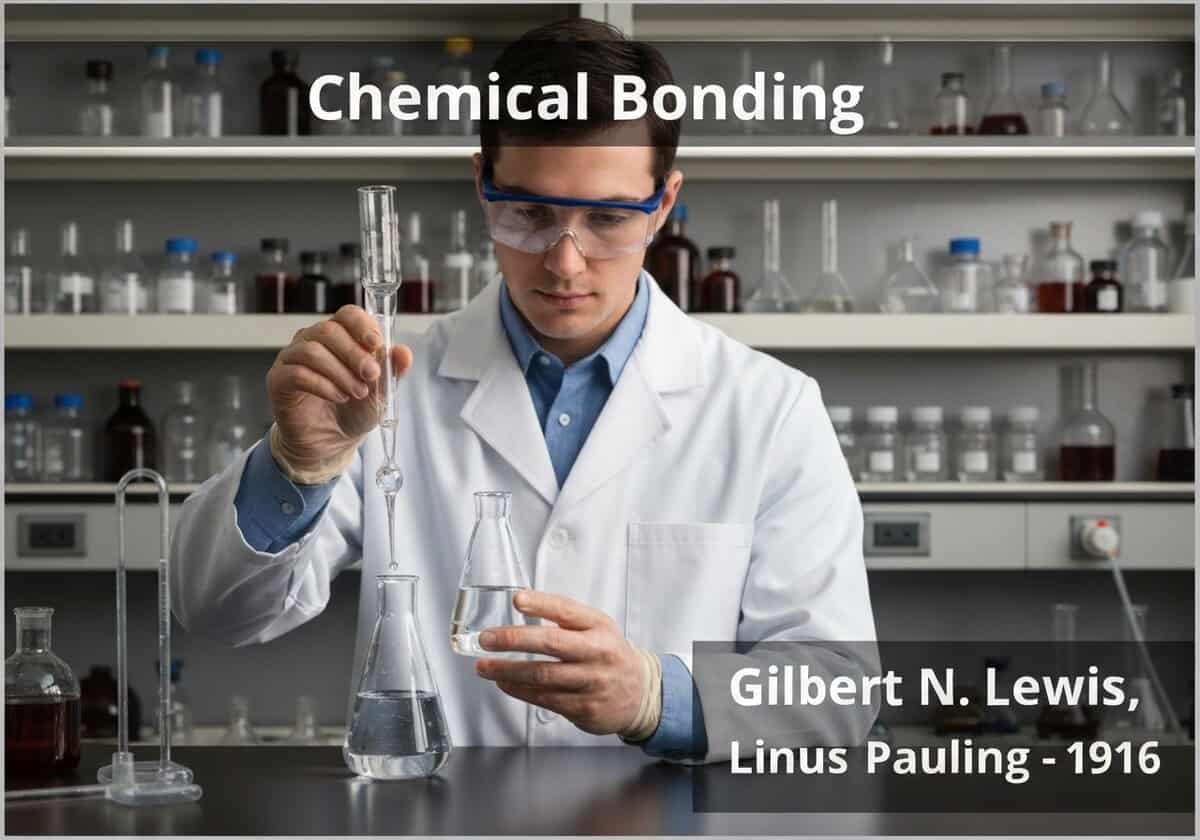
Laborszene zur Veranschaulichung chemischer Bindungen in der physikalischen Chemie.

(Abbildung dient nur zur Veranschaulichung)

A chemical bond is a lasting attraction between atoms, ions, or molecules that enables the formation of chemical compounds. Bonds result from the electrostatic force of attraction between oppositely charged ions (ionic bonds) or through the sharing of electrons (covalent bonds). The strength and type of bonds dictate the structure and properties of a substance.

The concept of chemical bonding explains how individual atoms combine to form the vast array of substances we observe. Gilbert N. Lewis’s 1916 proposal of the covalent bond, where atoms share pairs of electrons to achieve a stable electron configuration (the ‘octet rule’), was a monumental step. This simple yet powerful idea, visualized with Lewis structures, provided the first clear picture of bonding in non-ionic compounds. Ionic bonds, in contrast, are formed by the complete transfer of one or more electrons from an atom with low electronegativity (typically a metal) to one with high electronegativity (a nonmetal), creating charged ions that are held together by electrostatic attraction.

Our understanding was deepened significantly by the application of quantum mechanics. Linus Pauling’s valence bond theory, introduced in the 1930s, described covalent bonds as the result of the overlap of atomic orbitals. This theory introduced the concepts of hybridization (e.g., sp, sp2, sp3) and resonance to explain observed molecular geometries and bond properties. An alternative and often more powerful approach is molecular orbital (MO) theory, which considers electrons to be delocalized across the entire molecule in molecular orbitals formed from the combination of atomic orbitals. MO theory is essential for explaining the properties of conjugated systems, magnetism, and excited states. Beyond these primary types, there are also metallic bonds, characterized by a ‘sea’ of delocalized electrons, and weaker intermolecular forces like hydrogen bonds and van der Waals forces, which are critical for the properties of liquids, solids, and biological macromolecules like DNA.

UNESCO Nomenclature: 2209
- Physikalische Chemie

Typ

Abstraktes System

Störung

Grundlegendes

Verwendung

Weitverbreitete Verwendung

Vorläufer

  • atomic theory (John Dalton)
  • discovery of the electron (J.J. Thomson)
  • development of the nuclear model of the atom (Ernest Rutherford)
  • early concepts of ‘affinity’ and ‘valence’

Anwendungen

  • materials science and engineering (e.g., creating alloys, polymers)
  • drug design and pharmacology
  • synthesis of new chemical compounds
  • understanding biological processes (e.g., protein folding)
  • development of adhesives and composites
  • predicting molecular geometry (vsepr theory)

Patente:

NA

Potenzielle Innovationsideen

Aufgrund des hohen Datenverkehrs durch Web-Scraping-Bots, der derzeit mehr als 40.000 Anfragen pro Tag umfasst, ist dieser Inhalt ausschließlich Community-Mitgliedern vorbehalten.
> Anmelden < oder > Registrieren < (100% kostenlos) Zugriff darauf sowie auf alle anderen eingeschränkten Inhalte und Tools.

Related to: chemical bond, covalent bond, ionic bond, metallic bond, Gilbert N. Lewis, Linus Pauling, electronegativity, valence electrons, molecular orbital theory, intermolecular forces.

Historischer Kontext

Chemical Bonding

1912
1915
1915-11
1916
1918
1919-05-29
1920
1911-04-08
1913
1915
1916
1917
1918
1920
1920

(wenn das Datum unbekannt oder nicht relevant ist, z. B. „Strömungsmechanik“, wird eine gerundete Schätzung seines bemerkenswerten Auftretens bereitgestellt)

Verwandte Erfindungen, Innovationen und technische Prinzipien

Bilder in voller Größe und Downloads sind nur für registrierte Mitglieder 100% kostenlos verfügbar.

> Login <