Product Design, Manufacturing & Innovation Resources
Home » New Brunswick Community College (NBCC)

New Brunswick Community College (NBCC)

New Brunswick Community College (NBCC)
Address: Various locations, E1C 0E1 Moncton, New Brunswick, Canada (Corporate office, 6 campuses)
Trades and Technology, Health Sciences, Business Administration

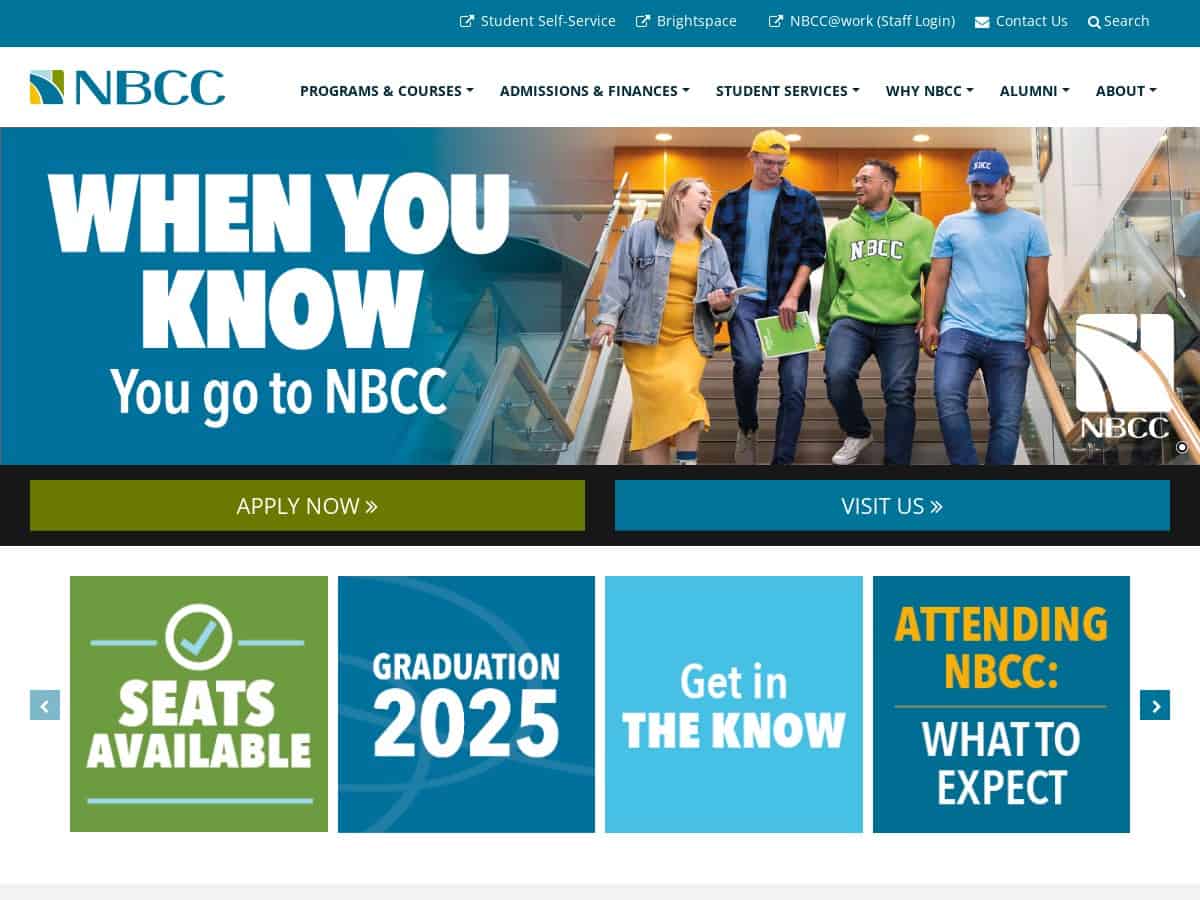
A public community college with six campuses across New Brunswick, providing skills-based and applied learning for workforce development.

Domains taught:

Diplomas*:

Status:

Partnerships:

Strong partnerships with employers across New Brunswick for co-op placements, apprenticeships, and program relevance. Focus on meeting provincial labour market needs.

Research:

Applied research and innovation projects aimed at solving problems for local businesses and communities, often in areas like advanced manufacturing or IT.

Famous Alumnis:

N/A

International recognition**:

Number of staff***:

1000

Current students***:

10000

Foreign students***:

2%

Cumulative former students***:

N/A

Pros

Key provider of skills training in NB, strong focus on employability, multiple campus locations for accessibility.

Cons

Focus is primarily on diplomas and certificates, not a degree-granting university.

Best For

Students in New Brunswick seeking practical, career-oriented training in trades, technology, health, or business, with a direct path to employment.

Most Similar Schools Locally

  • Collège communautaire du Nouveau-Brunswick sits close to this institution on civil engineering, automation and manufacturing; it runs the same certificate, diploma and graduate certificate programmes, and is smaller, enrolling about 5,000 students against roughly 10,000 here.
  • Cambrian College of Applied Arts and Technology works in much the same fields, chiefly automation, manufacturing and electrical and electronics, and it covers geotechnics as well, and has almost the same size, at about 11,000 students.
  • Red River College Polytechnic offers a comparable education in civil engineering, automation and manufacturing: it also offers bachelor's programmes, and is larger, enrolling about 22,000 students against roughly 10,000 here.
  • Among national alternatives, Collège Boréal stands out for its focus on automation, manufacturing and life sciences, and it covers data analytics and AI and machine learning as well, and is smaller, enrolling about 6,000 students against roughly 10,000 here.
  • A good alternative in the same country is Conestoga College Institute of Technology and Advanced Learning, which likewise covers civil engineering, automation and manufacturing; it is far larger, with about 45,000 students against roughly 10,000 here, and is also a public institution.

Most Similar Schools Abroad

  • The closest overseas parallel on civil engineering, manufacturing and electrical and electronics is Lincoln College, located in the United Kingdom; it covers AI and machine learning as well, and has almost the same size, at about 10,000 students.
  • Looking internationally, West Nottinghamshire College in the United Kingdom is where civil engineering, manufacturing and electrical and electronics get a comparable treatment; it is larger, enrolling about 15,000 students against roughly 10,000 here, and is also a public institution.
  • Seen from abroad, Western Norway University of Applied Sciences (Norway) is a close relative on subject matter, since civil engineering, automation and manufacturing are central to both, and it is also a public institution, and also offers bachelor's, master's and doctoral programmes.
  • Abroad, Tampere University of Applied Sciences (Finland) covers civil engineering, automation and electrical and electronics in a comparable way, and it has almost the same size, at about 10,000 students, and is also a public institution.
  • Turku University of Applied Sciences brings a Finland setting to the same core fields, manufacturing, electrical and electronics and life sciences, and it also offers bachelor's, master's and mba programmes, and covers logistics and mechanical engineering as well.

*our own picks (our criteria: a mix between domains, diploma delivered, reputation and size), but obviously too many criteria for an apple-to-apple ranking.

*: without any judgment of the quality, readers are strongly encouraged to check the official status of the exact diploma envisioned as many universities have a mix of recognized diplomas, not recognized, “co-delivered,” “equivalent to”,  “some pathways” (…), can change over time, and can be named differently from one country to another.


**: international reputation: is based on some criteria that do not mean much in some domains or specialties (number of researchers, of scientific publications, on budget ….). Our approximate 1-4 scale: 

  1. known locally
  2. known locally and internationally
  3. is listed in some of the world university’s classifications
  4. is listed among the 20 firsts in some of world university’s classifications

***: estimated numbers, based on online sources and/or feedbacks. The numbers can vary greatly depending on school organisation (ex.: school is part of a group, it employs internal staff or external consultants or has public staff without employing them …). Refer to all the links provided to have accurate and updated numbers.

Innovation.world is not affiliated with this school/university.
We recommend to contact them directly on their website for any special request.


To complete or correct any information here or share your opinion, please comment below or > send us a direct message <.

10th year anniversary

Full size images and downloads are only available, 100% free, for registered members.

> Login <















