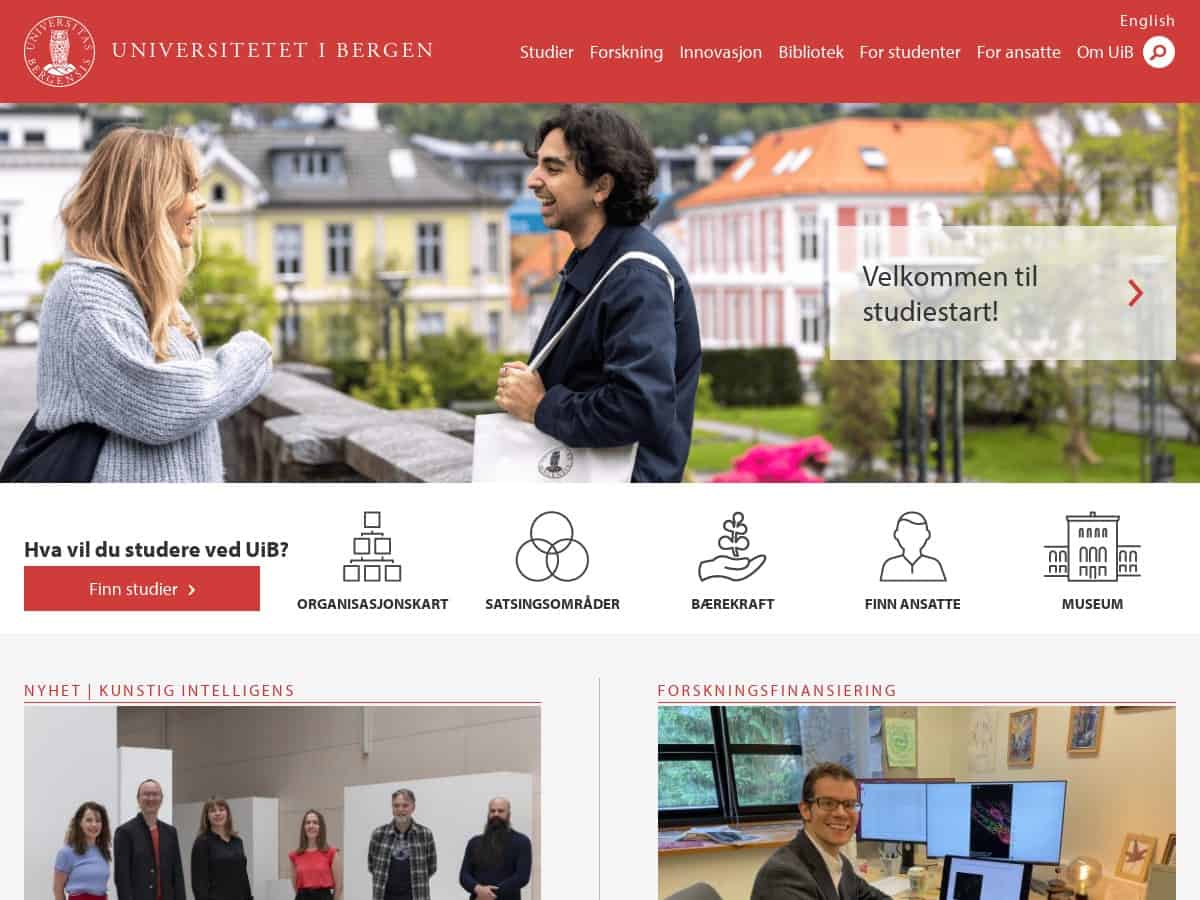
The University of Bergen (UiB) is a public research university located in Bergen, Norway. Established in 1946, it is now one of Norway’s leading universities, with a strong focus on marine research, climate and energy transition, and global challenges.
The University of Bergen, UiB, was founded in 1946, although its roots go back to the Bergen Museum of 1825. It has about 18,500 students and 4,000 staff, and around one student in ten comes from abroad. The main campus lies in the city centre around the University Museum on Muséplassen and the Nygaardsparken area, with the medical faculty at Haukeland University Hospital and science buildings at Realfagbygget and the Marine Research cluster at Bergen Harbour.
Bergen is a port city on the west coast, between the fjords and seven mountains, and the university shows this setting in its work. It is a leader in marine research, with fisheries, ocean science and marine biology as core fields, and it works closely with the Institute of Marine Research and local companies. In the early twentieth century, Vilhelm Bjerknes founded the Bergen School of Meteorology here, which introduced the concept of weather fronts, and the Bjerknes Centre for Climate Research continues that tradition.
The university has faculties of humanities, law, medicine, mathematics and natural sciences, psychology, social sciences and fine art, music and design. Its research is strong in climate and ocean science, global health, medicine, geology, energy and the social sciences, and its centre for development studies, with a focus on health, is known internationally. The Chr. Michelsen Institute, a development research body, is an important partner, and the Bergen Centre for Computational Science supports advanced modelling.
Public universities in Norway have long been free for all students, but tuition has now been introduced for most students from outside the EEA, so check the current rules. Every student pays a small semester fee. Bachelor’s programmes are in Norwegian, and Norwegian language skills are required, while many master’s programmes are in English. Applications for undergraduate studies go through the national system, and international students often apply directly.
Bergen is rainy and compact, with a lively student culture. Housing is scarce, and the student welfare organisation SiB offers rooms in several residences.
Domains taught:
Data Analytics, Ecology and Sustainability, Geotechnics, Life Sciences, Marine Science
Diplomas*:
Bachelor, Doctor, Master
Status:
Public
Partnerships:
UiB is part of several international networks, such as the Coimbra Group and the U5 group of Norwegian universities. It has numerous partnerships with institutions globally, with a strong focus on collaboration with the Global South.
Research:
UiB’s research is internationally recognized in marine science, climate research, and global development. The university hosts several centers of excellence and has a strong interdisciplinary approach to research.
Famous Alumnis:
N/A
International recognition**:
Number of staff***:
4000
Current students***:
18500
Foreign students***:
10%
Cumulative former students***:
50000
Pros
A leading university in marine and climate research, a beautiful campus located in the city center, and a strong international profile.
Cons
The weather in Bergen is notoriously rainy, which might be a drawback for some.
Best For
Students interested in marine and climate sciences, and those looking for a university with a strong international and interdisciplinary focus.
Both schools build their programmes around marine science, geotechnics and ecology and sustainability, and University of Tromsø – The Arctic University of Norway is the one to compare first within the country, since it covers astroscience and telecommunications as well, and has almost the same size, at about 16,500 students.
University of Oslo offers a comparable education in geotechnics and life sciences: it runs the same bachelor's, master's and doctoral programmes, and covers astroscience and chemistry as well.
University of Stavanger takes a similar route through marine science and geotechnics, and it is also a public institution, and runs the same bachelor's, master's and doctoral programmes.
Another national school that puts marine science at the centre is University of South-Eastern Norway, and it is also a public institution, and runs the same bachelor's, master's and doctoral programmes.
Norwegian University of Science and Technology overlaps with this institution on marine science, so the two are easy to compare, and it covers civil engineering and mechanical engineering as well, and is larger, enrolling about 43,550 students against roughly 18,500 here.
Most Similar Schools Abroad
University of Helsinki, based in Finland, is built around ecology and sustainability, life sciences and data analytics much like this institution, and it covers chemistry and statistics as well, and is larger, enrolling about 31,000 students against roughly 18,500 here.
Looking internationally, Aarhus University in Denmark is where life sciences get a comparable treatment; it covers astroscience and agriculture as well, and is larger, enrolling about 38,000 students against roughly 18,500 here.
On content, University of Gothenburg in Sweden and this institution are close, as both teach marine science, ecology and sustainability and life sciences; it is also a public institution, and teaches at the same levels, namely bachelor's, master's and doctoral.
For a study option in Sweden with a comparable spread of ecology and sustainability, life sciences and data analytics, Umeå University is the reference point: it is larger, enrolling about 34,000 students against roughly 18,500 here, and is also a public institution.
Murmansk Arctic State University (Russia) works on the same fields as this institution, chiefly marine science, geotechnics and ecology and sustainability; it teaches at the same levels, namely bachelor's, master's and doctoral, and covers logistics and engineering as well.
*our own picks (our criteria: a mix between domains, diploma delivered, reputation and size), but obviously too many criteria for an apple-to-apple ranking.
FAQ
Where is the University of Bergen?
The University Museum is at Muséplassen 1 in Bergen, Norway. Other buildings are spread across the city.
When was it founded?
In 1946, with roots in the Bergen Museum of 1825.
How large is it?
About 18,500 students and 4,000 staff.
What is UiB best known for?
Marine research, climate and ocean science, medicine, global health, geology and the social sciences.
What is the Bergen School of Meteorology?
A school founded by Vilhelm Bjerknes that introduced the concept of weather fronts.
What is the Bjerknes Centre?
A centre for climate research that continues the tradition of the Bergen School.
Which faculties does it have?
Humanities, law, medicine, mathematics and natural sciences, psychology, social sciences and fine art, music and design.
Is there tuition?
Tuition has now been introduced for most students from outside the EEA. Every student pays a small semester fee. Check the current rules.
In which language are courses taught?
Bachelor's programmes in Norwegian, and many master's programmes in English.
What is Bergen like for students?
Rainy and compact, with a lively student culture and scarce housing.
Aquaculture, Climate Change, Environmental Engineering, Environmental Impact, Global Warming, Marine Ecosystems, Renewable Energy, Sustainable Development
*: without any judgment of the quality, readers are strongly encouraged to check the official status of the exact diploma envisioned as many universities have a mix of recognized diplomas, not recognized, “co-delivered,” “equivalent to”, “some pathways” (…), can change over time, and can be named differently from one country to another.
**: international reputation: is based on some criteria that do not mean much in some domains or specialties (number of researchers, of scientific publications, on budget ….). Our approximate 1-4 scale:
known locally
known locally and internationally
is listed in some of the world university’s classifications
is listed among the 20 firsts in some of world university’s classifications
***: estimated numbers, based on online sources and/or feedbacks. The numbers can vary greatly depending on school organisation (ex.: school is part of a group, it employs internal staff or external consultants or has public staff without employing them …). Refer to all the links provided to have accurate and updated numbers.
Innovation.world is not affiliated with this school/university. We recommend to contact them directly on their website for any special request.
To complete or correct any information here or share your opinion, please comment below or > send us a direct message <.