Address: Viamonte 430, C1053ABJ Buenos Aires, Argentina
Exact and Natural Sciences, Engineering, Computer Science
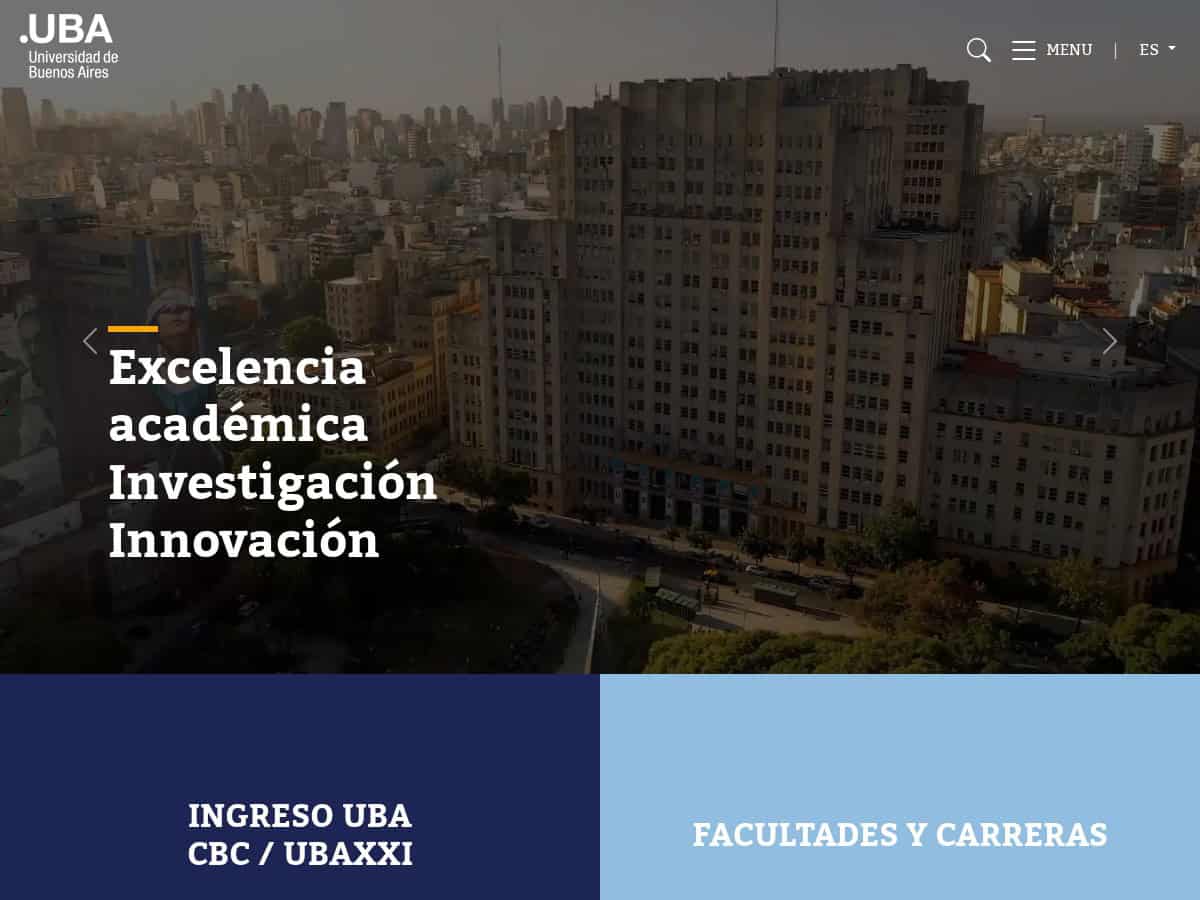
Founded in 1821, the University of Buenos Aires is the largest university in Argentina and one of the most prestigious academic institutions in Latin America. It is a public institution composed of 13 independent faculties, six hospitals, and ten museums.
Scale defines the University of Buenos Aires. With about 310,000 students and 40,000 staff, it is among the largest universities in Latin America and carries roughly eight students for every employee. Teaching is spread across the faculties, the Common Basic Cycle for first-year students, two well-known secondary schools run by the university, and a group of hospitals that includes the Hospital de Clínicas.
For technical readers the strongest ground is engineering and the exact sciences. The Faculty of Engineering teaches in the city centre, while the Faculty of Exact and Natural Sciences works at Ciudad Universitaria in the Núñez district, beside the river. Bernardo Houssay, Luis Federico Leloir and César Milstein, three Argentine Nobel laureates in science and medicine, studied or worked here, and the alumni list also holds many politicians, jurists and writers.
Research runs through dozens of institutes, many of them shared with the national research council CONICET, in fields from physics and chemistry to computer science and biology. Exchange agreements with universities in Europe, North America and Asia support mobility for students and researchers, and the university’s museums and observatory facilities add teaching collections that few institutions can match.
Practical points matter more here than at most universities. Undergraduate study has long been free of tuition, although the rules for non-resident foreign students have been under review, so check the current terms. Entry to most degrees goes through the Common Basic Cycle rather than a selective entrance exam. Classes are in Spanish, and the first year is known for crowded lecture halls and heavy attrition, so students who arrive prepared and plan their timetable early do noticeably better.
The numbers behind the university are worth keeping in mind when planning a stay. Around 1.5 million graduates have passed through since the nineteenth century, and the 13 faculties, hospitals and museums operate with a great deal of autonomy, so procedures, timetables and even academic culture can differ sharply between the engineering faculty and the sciences. Visiting students should contact their target faculty directly instead of relying on central offices.
Extensive partnerships with hundreds of universities and institutions worldwide, including academic exchange programs and research collaborations across Europe, North America, and Asia.
Research:
As a leading research university in South America, UBA has numerous research institutes and hosts projects funded by national and international organizations. Its research spans a vast range of disciplines, from basic sciences to applied technology.
Famous Alumnis:
Carlos Saavedra Lamas, Bernardo Houssay, Luis Federico Leloir, Adolfo Pérez Esquivel, César Milstein
International recognition**:
Number of staff***:
40000
Current students***:
310000
Foreign students***:
10%
Cumulative former students***:
1500000
Pros
No tuition fees, high academic standards, internationally recognized programs, wide variety of degrees, located in a vibrant capital city.
Cons
High student-to-faculty ratio, significant bureaucracy, aging infrastructure in some faculties, frequent political activism that can disrupt classes.
Best For
Students seeking a prestigious, comprehensive, and tuition-free education in a major cultural and economic hub.
Another national school that puts chemistry, physics and mathematics at the centre is National University of Córdoba, and it runs the same bachelor's, master's and doctoral programmes, and covers astroscience and agriculture as well.
National University of La Plata is the closest domestic counterpart for chemistry, physics and software engineering; it runs the same bachelor's, master's and doctoral programmes, and covers astroscience and computer vision as well.
For students who like the chemistry, physics and mathematics focus of this institution but want another option nearby, National University of Rosario fits well: it is far smaller, with about 80,000 students against roughly 310,000 here, and is also a public institution.
For students who like the civil engineering, chemistry and physics focus of this university but want another option nearby, National University of Cuyo fits well: it is also a public institution, and runs the same bachelor's, master's and doctoral programmes.
National Technological University is the closest domestic counterpart for civil engineering, electrical and electronics and software engineering; it covers industrial design and telecommunications as well, and is far smaller, with about 90,000 students against roughly 310,000 here.
Most Similar Schools Abroad
University of Belgrade, based in Serbia, is built around civil engineering, chemistry and physics much like this institution, and it is far smaller, with about 94,425 students against roughly 310,000 here, and is also a public institution.
Cairo University (Egypt) works on the same fields as this university, chiefly civil engineering, chemistry and physics; it is slightly smaller, at about 207,853 students against roughly 310,000 here, and is also a public institution.
Abroad, National Autonomous University of Mexico (Mexico) covers chemistry, physics and mathematics in a comparable way, and it teaches at the same levels, namely bachelor's, master's and doctoral, and covers finance and astroscience as well.
For a study option in Iran with a comparable spread of civil engineering, chemistry and physics, University of Tehran is the reference point: it teaches at the same levels, namely bachelor's, master's and doctoral, and covers agriculture and mechanical engineering as well.
For civil engineering, chemistry and physics outside the home country, King Saud University in Saudi Arabia is a natural reference; it is also a public institution, and runs the same bachelor's, master's and doctoral programmes.
*our own picks (our criteria: a mix between domains, diploma delivered, reputation and size), but obviously too many criteria for an apple-to-apple ranking.
FAQ
How big is the University of Buenos Aires?
It has about 310,000 students and 40,000 staff, organised in 13 faculties, with hospitals and museums attached.
Is the university free?
Undergraduate study at Argentine national universities has traditionally been free of tuition. Rules for non-resident foreign students can change, so confirm the current conditions before applying.
What language are courses taught in?
Almost all teaching is in Spanish. Some exchange and graduate activities use English, but a working level of Spanish is needed for regular study.
How do you get in?
Most degrees start with the Common Basic Cycle, a shared first-year programme. Passing its subjects allows you to continue in the faculty of your choice.
Where is the Faculty of Engineering?
Its main building is on Paseo Colón in central Buenos Aires, a short distance from the historic centre.
Where is the Faculty of Exact and Natural Sciences?
It is at Ciudad Universitaria in the Núñez district, on the River Plate waterfront in the north of the city.
Which Nobel laureates are linked to the university?
Bernardo Houssay, Luis Federico Leloir and César Milstein, who received Nobel prizes in physiology or medicine and in chemistry, studied or worked at UBA.
Which fields is UBA strongest in?
Exact and natural sciences, engineering, computer science, medicine and the social sciences, all with large faculties and research institutes.
How many international students are there?
About 10 percent of the students come from abroad, most of them from other Latin American countries.
Where is the central administration?
The rectorate is at Viamonte 430 in Buenos Aires, and the university counts about 1.5 million alumni.
Artificial Intelligence (AI), Biomedical Sensors, Engineering, Environmental Impact, Innovation, Research and Development, User-Centered Design
*: without any judgment of the quality, readers are strongly encouraged to check the official status of the exact diploma envisioned as many universities have a mix of recognized diplomas, not recognized, “co-delivered,” “equivalent to”, “some pathways” (…), can change over time, and can be named differently from one country to another.
**: international reputation: is based on some criteria that do not mean much in some domains or specialties (number of researchers, of scientific publications, on budget ….). Our approximate 1-4 scale:
known locally
known locally and internationally
is listed in some of the world university’s classifications
is listed among the 20 firsts in some of world university’s classifications
***: estimated numbers, based on online sources and/or feedbacks. The numbers can vary greatly depending on school organisation (ex.: school is part of a group, it employs internal staff or external consultants or has public staff without employing them …). Refer to all the links provided to have accurate and updated numbers.
Innovation.world is not affiliated with this school/university. We recommend to contact them directly on their website for any special request.
To complete or correct any information here or share your opinion, please comment below or > send us a direct message <.