Product Design, Manufacturing & Innovation Resources
بيت » Faraday’s First Law of Electrolysis

Faraday’s First Law of Electrolysis

1834-01-01
  • Michael Faraday
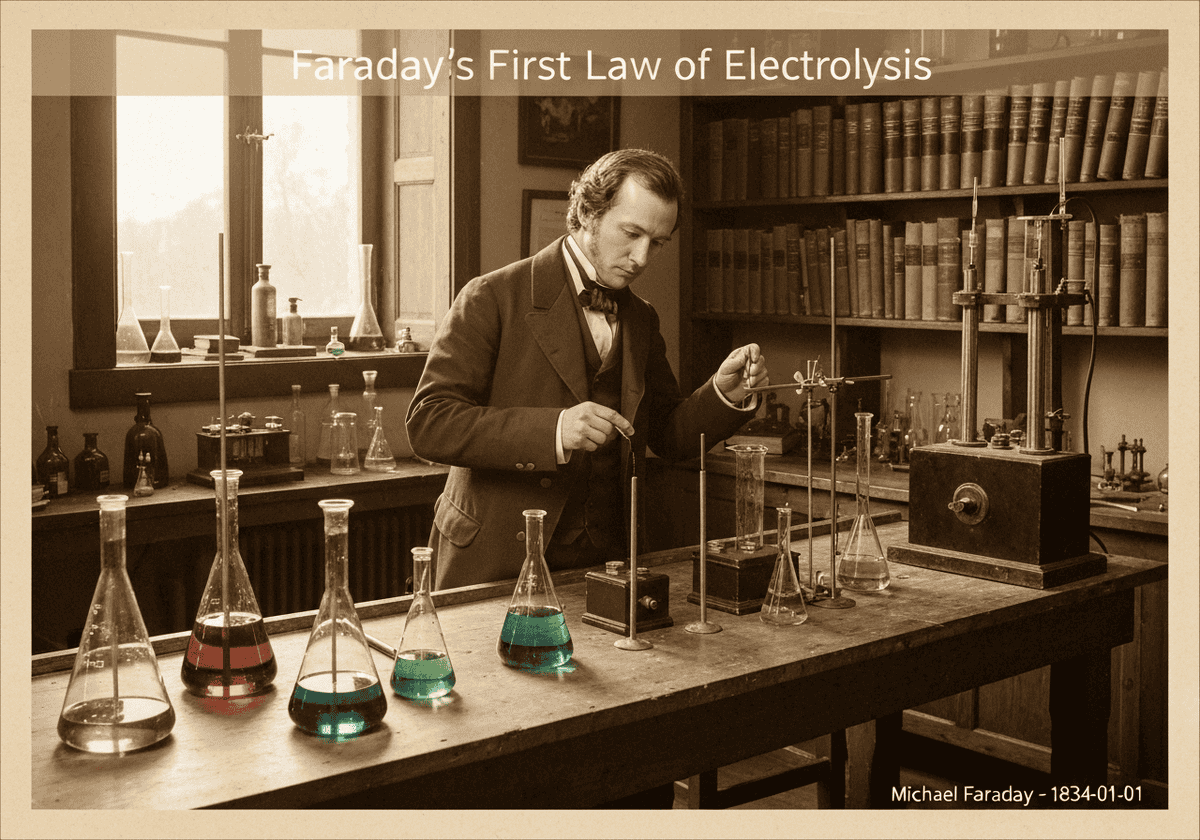
Electrolysis experiment by Michael Faraday in a historical laboratory setting.

(صورة توضيحية فقط)

This law states that the mass of a substance altered at an electrode during التحليل الكهربائي is directly proportional to the quantity of electricity transferred. The relationship is expressed by the formula [latex]m = \frac{Q}{F} \frac{M}{z}[/latex], where m is mass, Q is total electric charge, F is the Faraday constant, M is molar mass, and z is the valence number of ions of the substance.


Faraday’s first law of التحليل الكهربائي provides a quantitative relationship between electricity and chemical change. It establishes that the amount of chemical reaction that occurs at an electrode is directly proportional to the electric charge passed through the electrolyte. The charge, Q, is the product of the current (I) and the time (t), so Q = It. The formula can be rewritten as [latex]m = (\frac{M}{zF})It[/latex], highlighting this dependency.

In this equation, the term [latex]\frac{M}{zF}[/latex] is known as the electrochemical equivalent of the substance. It represents the mass of the substance deposited or liberated per unit of charge. The Faraday constant, F, is a fundamental physical constant representing the magnitude of electric charge per mole of electrons, approximately 96,485 coulombs per mole. The variable ‘z’ represents the number of moles of electrons transferred per mole of the substance in the electrode reaction (e.g., z=1 for Na⁺, z=2 for Cu²⁺, z=3 for Al³⁺).

كان هذا القانون خطوةً جوهريةً في ربط مجالي الكهرباء والكيمياء المنفصلين سابقًا. قبل فاراداي، كانت العلاقة نوعيةً في أحسن الأحوال. وقد وفرت تجاربه الدقيقة، التي تضمنت تمرير تيارات معروفة لفترات زمنية مُقاسة عبر محاليل مختلفة ووزن الرواسب الناتجة، الدليل التجريبي على هذه العلاقة الرياضية الدقيقة. وقد مهدت هذه التجارب الطريق للكيمياء الكهربائية كعلم كمي، وأثبتت أن القوى الكهربائية ترتبط ارتباطًا مباشرًا بالروابط والتفاعلات الكيميائية على مستوى أساسي، وذلك قبل اكتشاف الإلكترون نفسه.

UNESCO Nomenclature: 2406
– Electrochemistry

يكتب

Physical Law

خلل

أساسيات

الاستخدام

استخدام واسع النطاق

مقدمات

  • invention of the voltaic pile by alessandro volta
  • humphry davy’s isolation of sodium and potassium using electrolysis
  • اكتشاف العلاقة بين الكهرباء والمغناطيسية بواسطة هانز كريستيان أورستد

التطبيقات

  • الطلاء الكهربائي
  • الاستخلاص الكهربائي والتكرير الكهربائي للمعادن
  • الكولومتري للتحليل الكيميائي
  • إنتاج المواد الكيميائية الصناعية
  • قياس سعة البطارية

براءات الاختراع:

NA

أفكار ابتكارية محتملة

  • on-demand synthesis of nanoparticles with precise mass control
  • الطباعة ثلاثية الأبعاد للأجسام المعدنية باستخدام الترسيب الكهربائي الموضعي
  • wearable sensors that measure electrolyte loss through sweat via coulometry
  • مفاعلات مصغرة لإنتاج المواد الأولية الصيدلانية
  • طلاءات ذاتية الإصلاح تعمل على ترسيب المعدن كهربائيًا لملء الخدوش
  • أنظمة تنقية المياه اللامركزية باستخدام التطهير الكهروكيميائي
  • أنظمة تخزين الطاقة القائمة على الترسيب المعدني القابل للعكس
  • النقش الدقيق للمكونات الإلكترونية الدقيقة
Related to: faraday’s law, electrolysis, electrochemistry, quantity of electricity, faraday constant, electrochemical equivalent, electroplating, coulometry.

السياق التاريخي

Faraday’s First Law of Electrolysis

1800
1834-01-01
1880
1902
1920
1928
1930
1800
1800-05-02
1880
1900
1910
1921
1930
1930

(إذا كان التاريخ غير معروف أو غير ذي صلة، على سبيل المثال "ميكانيكا الموائع"، يتم توفير تقدير تقريبي لظهوره الملحوظ)

أحدث الإضافات

أهم المنشورات والمقالات

أفضل الأدوات الأصلية

السنة العاشرة عيد

الصور والتنزيلات بالحجم الكامل متاحة فقط، ومجانية تمامًا، للأعضاء المسجلين.