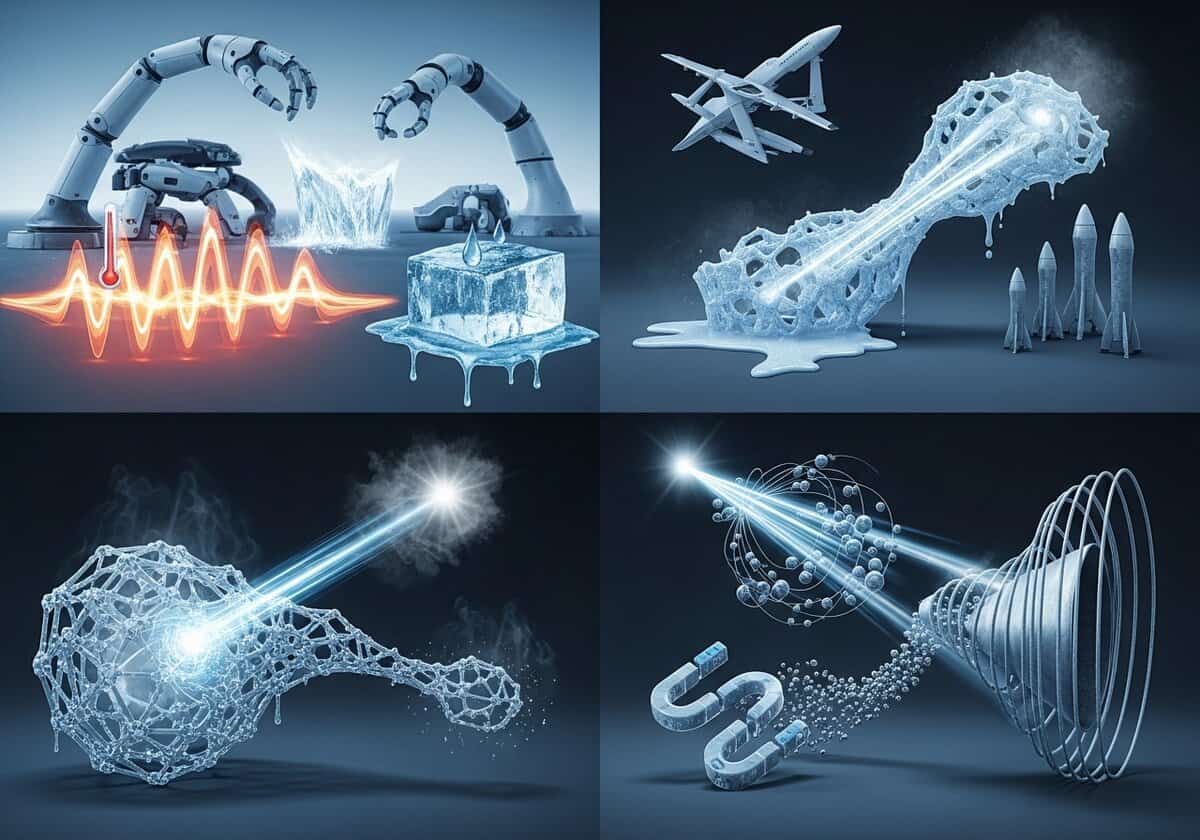
4D printing extends additive تصنيع by integrating time-dependent shape transformation through stimuli-responsive materials such as shape memory polymers, hydrogels, and self-assembling composites. This domain focuses on the design, fabrication, and control of structures capable of programmed morphological changes triggered by environmental factors including temperature, moisture, light, and magnetic fields. Research advances address material formulation, multi-material printing techniques, actuation mechanisms, and predictive modeling of dynamic behaviors. The following compilation presents recent publications and patented innovations highlighting developments in 4D printing materials, fabrication processes, application-specific designs, and functional performance optimization across fields such as soft الروبوتات, والأجهزة الطبية الحيوية وهندسة الطيران.
هذه هي أحدث مجموعة مختارة من المنشورات وبراءات الاختراع العالمية باللغة الإنجليزية حول الطباعة رباعية الأبعاد، بين العديد من المجلات العلمية على الإنترنت، مصنفة ومركزة على الطباعة رباعية الأبعاد، والمواد المستجيبة المحفزة، وبوليمر ذاكرة الشكل، وبنية التجميع الذاتي، والمادة القابلة للبرمجة، والمحرك المطبوع رباعي الأبعاد، والطباعة رباعية الأبعاد الحركية, المواد الذكية، وتصميم الطباعة رباعية الأبعاد، وتصنيع الطباعة رباعية الأبعاد، وتصنيع الطباعة رباعية الأبعاد، والطباعة رباعية الأبعاد، والطباعة رباعية الأبعاد، وتحويل شكل الطباعة رباعية الأبعاد، والاستجابة الحرارية للطباعة رباعية الأبعاد، والطباعة رباعية الأبعاد، والمواد المستجيبة للضوء، والاستجابة المغناطيسية للطباعة رباعية الأبعاد، ومشغل الهيدروجيل، والسلوك المعتمد على الوقت، والمحفز البيئي.
Symbolic morphogenic manufacturing protocol for self-assembling infrastructure and programmable matter reconfiguration
Patent published on the 2026-06-04 in US under Ref US20260153855 by ODEH SAMUEL [US] (Odeh Samuel [us])
Abstract: A system, method, and distributed control protocol for autonomous physical structure formation and reconfiguration using programmable matter. The system comprises a plurality of discrete, mechanically interlocking robotic units (“voxels”), each voxel including on-board power storage, computation, sensing, actuation, and selectively switchable inter-unit coupling mechanisms. The voxels are governed by a Symbolic Morphogenic Architecture Kernel configured to receive a digital volumetric struct[...]
Our summary: This protocol enables autonomous formation and reconfiguration of structures using programmable matter. It utilizes mechanically interlocking robotic units called voxels, which operate based on a centralized architecture kernel. The system includes a verification mechanism for evaluating structural integrity during the assembly process.
programmable matter, self-assembly, robotic units, distributed control
Patent
Enhancing Shape Recovery and Mechanical Properties of Bisphenol-A-Epoxy-Based Shape Memory Polymer Composites (SMPCs) Using Amine Curing Agent Blends
Published on 2026-01-30 by Garam Do, Sungwoong Choi, Seongeun Jang, Duyoung Choi @MDPI
Abstract: Shape memory polymer (SMP) has broad applications in various industries, including automotive, aerospace, and medical, as it can maintain a given shape and return to its original form upon exposure to external stimuli such as heat, magnetic fields, or light. However, the intrinsic limitation of epoxy results in the low thermal conductivity of SMP, which reduces the difference in temperature (ΔT) between the glass transition temperature (Tg) and the actuation temperature, thereby ne[...]
Our summary: This study investigates the enhancement of shape recovery and mechanical properties of Bisphenol-A-epoxy-based shape memory polymer composites using amine curing agent blends. The research shows that optimal filler content and improved dispersion of carbon-based fillers significantly enhance the performance of the composites. Results indicate a notable improvement in shape recovery time and mechanical strength.
Shape Memory Polymer, Amine Curing Agents, Thermal Stability, Mechanical Properties
Publication
Advances in Modular Synthesis, Responsive Design, and Multifaceted Applications
Published on 2026-01-26 by Akhil Sharma, Monu Sharma, Sonu Sharma, Vikas Sharma, Shivika Sharma, Iyyakkannu Sivanesan @MDPI
Abstract: The recent development in polymer science has gone beyond the traditional linear and randomly functionalizable macromolecules to the architected polymer systems, which integrate modular synthesis and dynamic responsiveness. Although the literature related to polymer synthesis and stimuli-responsive materials and applications is widely discussed, it is common to review the aspects independently, restricting a complete picture of how architectural modularity controls adaptive performance. This gap[...]
Our summary: This review integrates modular polymer synthesis with stimuli-responsive design. It highlights the importance of structural precision in determining polymer performance. The framework aims to advance the development of multifunctional and environmentally friendly polymer systems for real-world applications.
Modular Synthesis, Responsive Design, Polymer Science, Multifunctional Applications
Publication
Design Strategies for Enhanced Performance of 3D-Printed Microneedle Arrays
Published on 2026-01-12 by Mahmood Razzaghi, Hamid Reza Bakhsheshi-Rad @MDPI
Abstract: Three-dimensional (3D) printing has transformed the development of microneedle arrays (MNAs) by enabling exceptional control over their geometry, distribution, materials, and functionality in a single-step, customizable process. This review represents a design-centric framework that organizes recent advancements in four interconnected levers: (i) individual microneedle (MN) geometry and size; (ii) patch-level MN distribution and multi-array architectures; (iii) computer-aided design (CAD), finit[...]
Our summary: This review discusses design strategies for 3D-printed microneedle arrays (MNAs) to enhance their performance. It highlights advancements in microneedle geometry, distribution, and optimization through digital tools. The challenges and future directions in 3D printing for personalized medicine are also addressed.
3D printing, microneedle arrays, design optimization, therapeutic delivery
Publication
Mapping the Evidence
Published on 2025-12-11 by Maria T?nase, Cristina Veres, Dan-Alexandru Szabo @MDPI
Abstract: This study provides an integrated synthesis of Artificial Intelligence (AI) applications in Biomedical 3D Printing, mapping the conceptual and structural evolution of this rapidly emerging field. The bibliometric analysis, based on 229 publications indexed in the Web of Science Core Collection (2018–2025) and visualised in CiteSpace, identifies three interconnected research domains: AI-driven design and process optimisation, data-assisted bioprinting for tissue engineering, and the[...]
Our summary: This study synthesizes AI applications in Biomedical 3D Printing, identifying three key research domains. It reveals a progression from algorithmic control to autonomous fabrication systems. The analysis highlights a multidisciplinary ecosystem converging computational intelligence and biomedical engineering.
Artificial Intelligence, Biomedical 3D Printing, Bibliometric Analysis, Smart Materials
Publication
Biomedical applications of anionic-terminal phenylalanine-modified dendrimers with unique stimuli-responsive behaviors
Published on 2025-11-26 by Chie Kojima @NATURE
Abstract: Polymer Journal, Published online: 26 November 2025; doi:10.1038/s41428-025-01115-8Dendrimers are synthetic polymers with well-defined structures and are useful as drug carriers as well as smart materials. Recently, anionic-terminal phenylalanine (Phe)-modified polyamidoamine (PAMAM) dendrimers were synthesized. These dendrimers exhibited unique pH- and temperature-responsive properties, which were controlled by the dendrimer structure. These dendrimers also showed the ability to be delivered in[...]
Our summary: Anionic-terminal phenylalanine-modified dendrimers exhibit pH- and temperature-responsive behaviors. They are effective as drug carriers for lymph node-resident immune cells. This review highlights their potential applications in biomedical delivery systems.
dendrimers, stimuli-responsive, drug delivery, immune cells
Publication
Tailoring the Functional Properties of NiTi Shape Memory Alloy by Laser Powder Bed Fusion Process Conditions for 4D Printing
Published on 2025-11-23 by Stanislav V. Chernyshikhin, Dmitry D. Zherebtsov, Leonid V. Fedorenko, Vladimir Yu. Egorov, Viktor O. Filinov, Stanislav O. Rogachev, Andrey N. Urzhumtsev, Ella L. Dzidziguri, Maria V. Lyange, Igor V. Shishkovsky @MDPI
Abstract: Over the last decade, laser powder bed fusion (LPBF) received increased attention as a method of producing complex-shaped products from various materials. Recent results indicate the potential of this technology for the production of intermetallic NiTi alloys with shape memory. Several studies have demonstrated a strong influence of the LPBF process conditions on the resulting material properties, i.e., the martensitic phase transformation temperatures, reversible/irreversible strain after cycli[...]
Our summary: This study investigates the influence of laser powder bed fusion (LPBF) process conditions on the functional properties of NiTi shape memory alloys. It reveals the effects of laser power and scanning speed on material characteristics, including phase transformation temperatures and mechanical properties. The findings aim to establish protocols for producing NiTi alloys with tailored functionalities.
Laser Powder Bed Fusion, NiTi Alloy, Shape Memory, 4D Printing
Publication