Product Design, Manufacturing & Innovation Resources
بيت » تعريف القوة الدافعة الكهربائية (EMF)

تعريف القوة الدافعة الكهربائية (EMF)

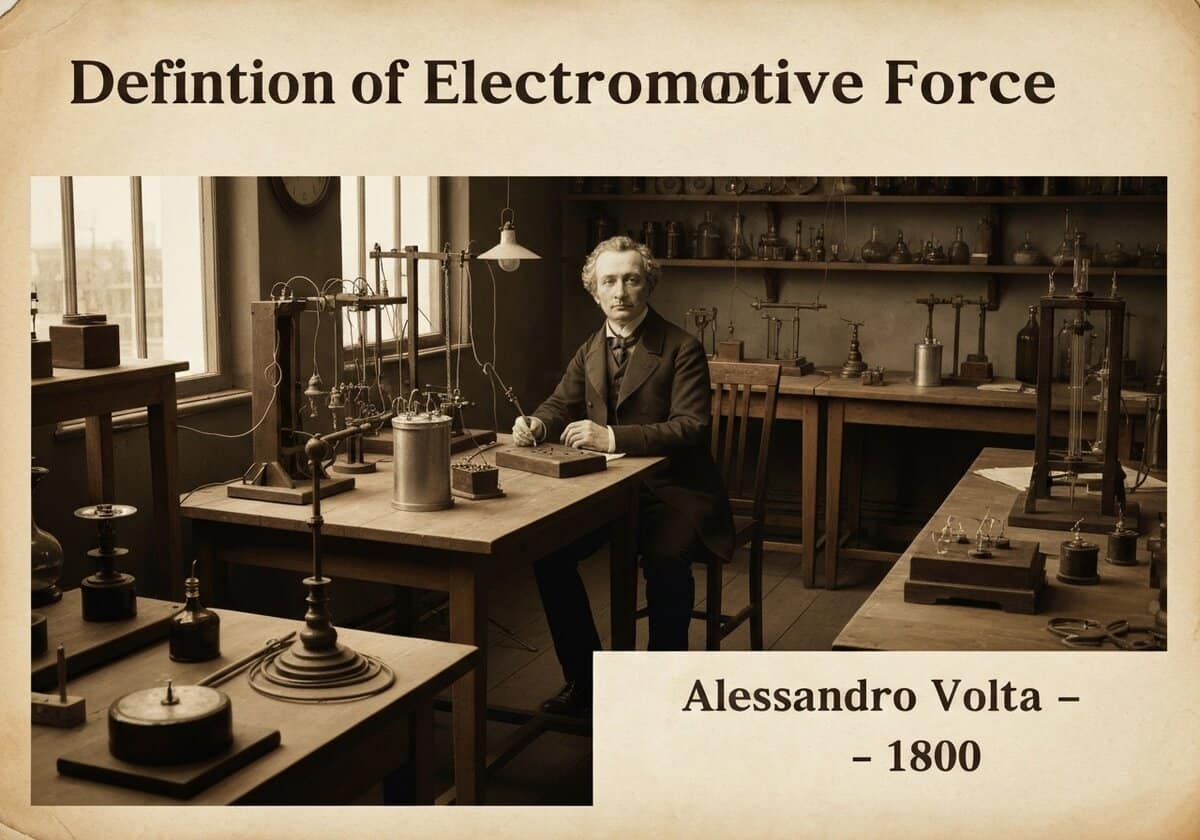
1800
  • Alessandro Volta
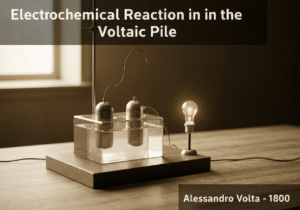
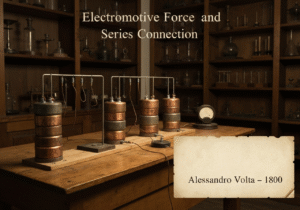
Alessandro Volta's laboratory demonstrating electromotive force with early electrical apparatus.

(صورة توضيحية فقط)

Electromotive force ([latex]\mathcal{E}[/latex]) is the work done per unit of electric charge by a non-electrical source, such as a battery or generator. Despite its name, it is not a mechanical force but an electric potential, measured in volts. It represents the energy converted from another form (chemical, mechanical) into electrical energy as a charge traverses the source.

Electromotive force, or EMF, is a fundamental concept in electromagnetism that quantifies the energy conversion process within a source. When a charge [latex]q[/latex] moves through a device that provides EMF, the work done [latex]W[/latex] on the charge is given by [latex]W = \mathcal{E}q[/latex]. This work is performed by a non-conservative field, often called an impressed field [latex]\mathbf{E}_{im}[/latex], which is distinct from the conservative electrostatic field generated by static charges. The EMF is formally defined as the line integral of this impressed field around a closed loop: [latex]\mathcal{E} = \oint \mathbf{E}_{im} \cdot d\mathbf{l}[/latex].

This distinction is crucial. An electrostatic field, described by Coulomb’s law, is conservative, meaning the work it does on a charge around any closed loop is zero. This is why a simple configuration of static charges cannot sustain a continuous current in a circuit. An EMF source, however, provides the “push” to drive charges against the electrostatic field’s potential gradient, maintaining a current. In a battery, this impressed field arises from chemical processes at the electrodes. In a generator, it’s due to a changing magnetic field (Faraday’s law) or the motion of a conductor in a magnetic field (motional EMF). The EMF represents the maximum potential difference the source can provide when no current is flowing, also known as the open-circuit voltage. When current flows, the terminal voltage across the source is typically lower than the EMF due to internal resistance within the source itself.

UNESCO Nomenclature: 2205
– Electricity and Magnetism

يكتب

نظام مجرد

خلل

Revolutionary

الاستخدام

استخدام واسع النطاق

مقدمات

  • Luigi Galvani’s discovery of “animal electricity”
  • Charles-Augustin de Coulomb’s formulation of the law of electrostatic force
  • فهم الجهد الكهربائي والشحنة

التطبيقات

  • تشغيل جميع الأجهزة الإلكترونية
  • المركبات الكهربائية
  • تخزين الطاقة على نطاق الشبكة
  • الأجهزة الإلكترونية المحمولة

براءات الاختراع:

NA

أفكار ابتكارية محتملة

  • بطاريات ذاتية الشحن ومتكاملة بيولوجيًا باستخدام العمليات الأيضية
  • ambient energy harvesters based on atmospheric charge separation
  • مولدات نانوية تحول الضغط الميكانيكي الخلوي إلى مجال كهرومغناطيسي
  • بطاريات كمية ذات امتصاص فائق للشحن الفوري
  • الأقمشة الحرارية الكهربائية التي تولد الطاقة من حرارة الجسم
  • الطرق الكهرضغطية التي تولد قوة دافعة كهربائية من اهتزازات المرور
  • EMF sources powered by الميكروبات fuel cells in wastewater treatment
  • التحويل المباشر للطاقة من التغيرات المحتملة للجاذبية
Related to: emf, electromotive force, voltage, potential difference, work, charge, battery, generator.

السياق التاريخي

تعريف القوة الدافعة الكهربائية (EMF)

1757
1788
1800
1800
1800
1800
1801
1750
1785
1788
1800
1800
1800
1800
1802

(إذا كان التاريخ غير معروف أو غير ذي صلة، على سبيل المثال "ميكانيكا الموائع"، يتم توفير تقدير تقريبي لظهوره الملحوظ)

أحدث الإضافات

أهم المنشورات والمقالات

أفضل الأدوات الأصلية

السنة العاشرة عيد

الصور والتنزيلات بالحجم الكامل متاحة فقط، ومجانية تمامًا، للأعضاء المسجلين.