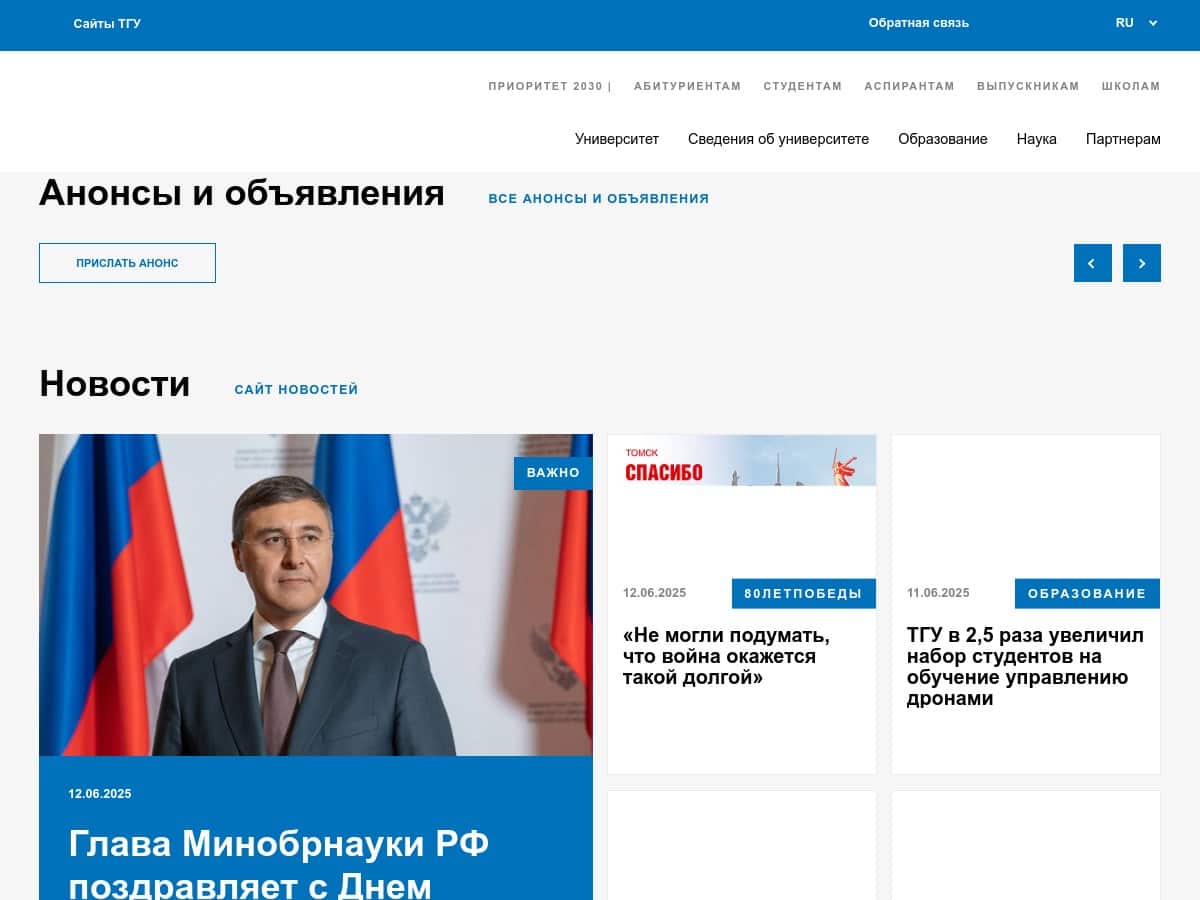
Tomsk State University, officially National Research Tomsk State University and abbreviated TSU, was created by an 1878 decree of Emperor Alexander II and counts as the first university in Siberia. Lectures began in 1888, when 72 students were taught by eight professors under the first rector, Nikolai Gezekhus. The university stands in the Siberian city of Tomsk.
The university’s research library was opened together with the university in 1888. Two Nobel laureates, Ivan Pavlov (physiology or medicine) and Nikolay Semyonov (chemistry), are named among the scientists who worked there at different times.
Teaching and research are spread across faculties and institutes that include physics, physics and engineering, chemistry, mechanics and mathematics, radiophysics, geology and geography, applied mathematics and computer science, a Higher IT School and a Biological Institute, besides law, psychology, journalism, philology and foreign languages. The university states that its students come from nearly 70 countries, and QS likewise records international students from 70 countries.
Domains taught:
Chemistry, Ecology and Sustainability, Life Sciences, Mathematics, Optics, Physics, Software Engineering
Diplomas*:
Bachelor, Doctor, Master
Status:
Public
Partnerships:
Extensive international collaborations, member of several global university networks; strong ties with Siberian Branch of Russian Academy of Sciences.
Research:
Research in materials science, climate change, biodiversity, radiophysics, optics and photonics, IT, and humanities.
Famous Alumnis:
Nikolay Semyonov, Ivan Pavlov (honorary member)
International recognition**:
Number of staff***:
4000
Current students***:
17000
Foreign students***:
20%
Cumulative former students***:
200000
Pros
Historic and prestigious classical university, strong in fundamental sciences, participant in Russian academic excellence projects.
Cons
Competition from specialized technical university (TPU) in the same city for some engineering fields.
Within Russia, Skolkovo Institute of Science and Technology offers a technology contrast, with data science and energy systems beside the physical sciences taught at Tomsk.
Most Similar Schools Abroad
Georg-August-Universität Göttingen (Germany) is strong in physics and chemistry, with molecular biosciences.
A second German option, Universität Leipzig, combines physics and earth sciences with chemistry and mineralogy.
For Italy, Università degli Studi di Trieste teaches physics, neuroscience and engineering.
Università degli Studi di Pavia in Italy spans engineering, physics and life sciences.
In Switzerland, Université de Fribourg brings together materials science, biology, chemistry and computing.
*our own picks (our criteria: a mix between domains, diploma delivered, reputation and size), but obviously too many criteria for an apple-to-apple ranking.
FAQ
When was Tomsk State University established?
Emperor Alexander II approved its creation by decree in 1878, and the first classes took place in 1888.
Is it described as the first university in Siberia?
Yes; the university and encyclopaedic sources present it as the first university in Siberia, also phrased as Asian Russia. It opened in 1888, ten years after the founding decree.
Who led the university at its opening?
Nikolai Gezekhus was the first rector. The first group of 72 students was taught by eight professors.
Which Nobel laureates are linked with TSU?
Ivan Pavlov and Nikolay Semyonov worked at the university at different times. Pavlov received the Nobel Prize in physiology or medicine and Semyonov the Nobel Prize in chemistry.
What can students study at TSU?
Units include faculties of physics, chemistry, mechanics and mathematics, radiophysics, and geology and geography, as well as institutes for applied mathematics and computer science and for biology. Humanities, law, psychology and journalism are also taught.
Does the university attract foreign students?
The university reports students from nearly 70 countries, and QS also records international students from 70 countries. Language of instruction and admission rules differ by programme, so check the international pages.
Is there a university library?
A research library opened together with the university in 1888. Access rules for visitors and students are listed on the library's own pages.
Biodiversity, Chemistry, Climate Change, Materials Science, Physics, Research and Development, Sustainable Development, Sustainable Practices
*: without any judgment of the quality, readers are strongly encouraged to check the official status of the exact diploma envisioned as many universities have a mix of recognized diplomas, not recognized, “co-delivered,” “equivalent to”, “some pathways” (…), can change over time, and can be named differently from one country to another.
**: international reputation: is based on some criteria that do not mean much in some domains or specialties (number of researchers, of scientific publications, on budget ….). Our approximate 1-4 scale:
known locally
known locally and internationally
is listed in some of the world university’s classifications
is listed among the 20 firsts in some of world university’s classifications
***: estimated numbers, based on online sources and/or feedbacks. The numbers can vary greatly depending on school organisation (ex.: school is part of a group, it employs internal staff or external consultants or has public staff without employing them …). Refer to all the links provided to have accurate and updated numbers.
Innovation.world is not affiliated with this school/university. We recommend to contact them directly on their website for any special request.
To complete or correct any information here or share your opinion, please comment below or > send us a direct message <.