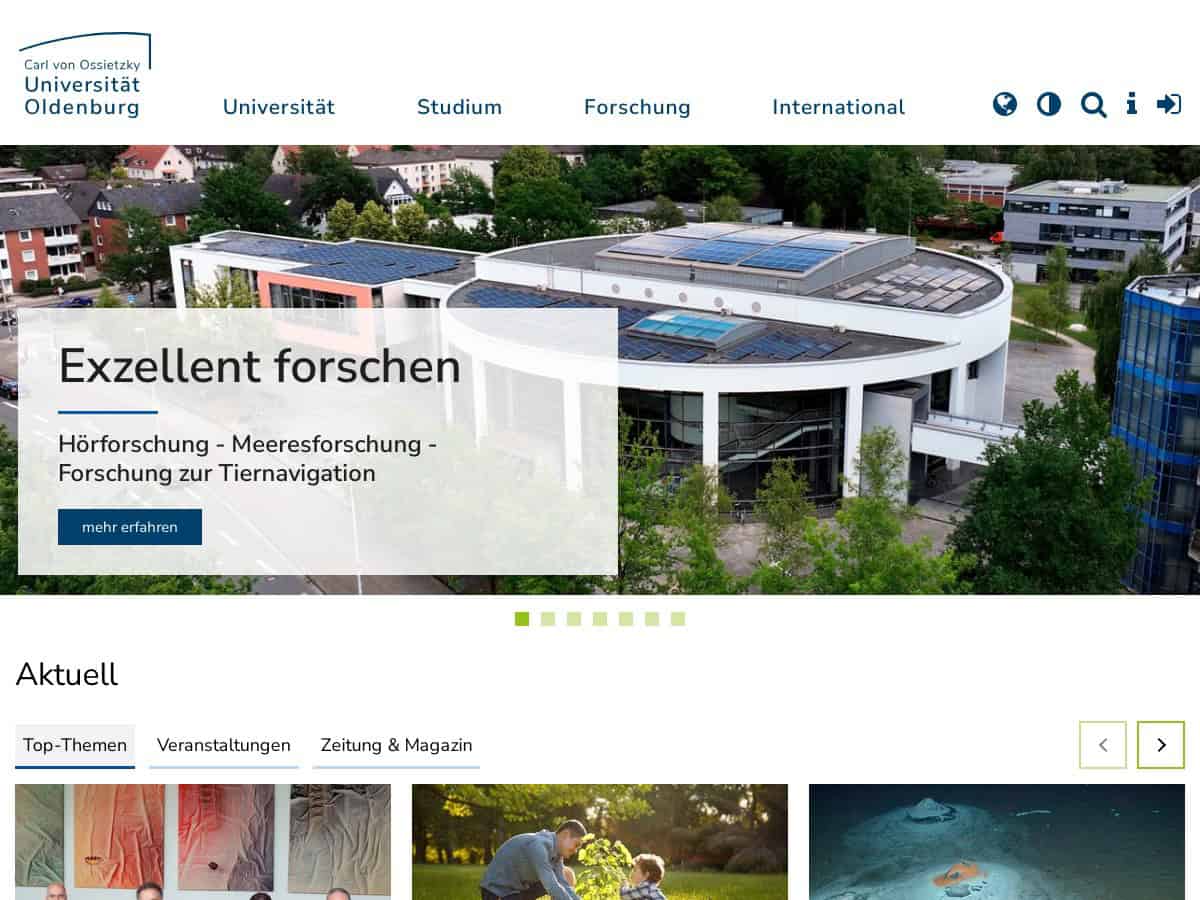
Carl von Ossietzky Universität Oldenburg is a public university in the city of Oldenburg in Lower Saxony, Germany. It was established by a Lower Saxony law that took effect in 1973, and study began in 1974 with eight degree programmes. Its roots lie in teacher training in Oldenburg, which reaches back to 1793.
The university took the name of Carl von Ossietzky in 1991. Ossietzky was a journalist and pacifist who was awarded the Nobel Peace Prize for 1935 and died in 1938.
Teaching and research are organised in six faculties, the sixth being the Faculty of Medicine and Health Sciences, added in 2012. The medical faculty belongs to the European Medical School Oldenburg-Groningen, a joint programme with the University of Groningen in the Netherlands. The university’s own profile speaks of around 15,000 students.
Domains taught:
Aerospace, AI and Machine Learning, Astroscience, Automation, Bioengineering, Bioinformatics, Chemistry, Civil Engineering, Computer Vision, Data Analytics, Ecology and Sustainability, Electrical and Electronics, Engineering, Fluid Dynamics, Life Sciences, Manufacturing, Marine Science, Materials, Mathematics, Mechanical Engineering, Microbiology and Genetics, Nanotechnologies, Optics, Physics, Process Control, Project Management, Robotics, Signal Processing, Software Engineering, Sound Engineering, Statistics, Structural Engineering, Telecommunications, Thermodynamics, Transportations
Diplomas*:
Bachelor, Doctor, Master
Status:
Public
Partnerships:
Strong in renewable energy (NEXT ENERGY institute), marine research, and hearing research. Interdisciplinary approach.
Research:
Wind energy systems and smart grids, Marine sensor technology and oceanography, Auditory signal processing and hearing aid technology, AI and data science for sustainability.
Famous Alumnis:
N/A
International recognition**:
Number of staff***:
2000
Current students***:
15000
Foreign students***:
N/A%
Cumulative former students***:
N/A
Pros
Leading in renewable energy and marine research, strong interdisciplinary programs, focus on sustainability.
Cons
Located in Oldenburg, a regional city.
Best For
Interdisciplinary university strong in renewable energy, marine science, hearing research, and computer science.
University of Regensburg lists Catholic Theology, Law, Business and Economics among its main specialties.
Dresden University of Technology lists Engineering, Natural Sciences, Medicine among its main specialties.
Heinrich Heine University Düsseldorf lists Medicine, Natural Sciences, Arts and Humanities among its main specialties.
Johannes Gutenberg University Mainz lists Theology, Social Sciences, Law and Economics among its main specialties.
Julius-Maximilians-Universität Würzburg lists Physics & Astronomy, Chemistry & Pharmacy (with tech focus), Life Sciences & Biomedicine among its main specialties.
Most Similar Schools Abroad
National Tsing Hua University in Taiwan lists Science, Engineering, Electrical Engineering and Computer Science among its main specialties.
Laval University in Canada lists Administrative Sciences, Agriculture and Food Sciences, Architecture among its main specialties.
Hebrew University of Jerusalem in Israel lists Sciences, Humanities, Social Sciences among its main specialties.
Guizhou University in China lists Agriculture, Engineering, Sciences among its main specialties.
Henan University in China lists Fine Arts, Medicine, Natural Sciences among its main specialties.
*our own picks (our criteria: a mix between domains, diploma delivered, reputation and size), but obviously too many criteria for an apple-to-apple ranking.
FAQ
In which German state is the University of Oldenburg?
It is in the city of Oldenburg in Lower Saxony. The institution is public and uses the full name Carl von Ossietzky Universität Oldenburg.
How did the university come into being?
Teacher training in Oldenburg goes back to 1793, and a Lower Saxony law established the university in 1973. Study began in 1974 with eight degree programmes.
Who was Carl von Ossietzky?
He was a journalist and pacifist who was awarded the Nobel Peace Prize for 1935 and died in 1938. The university adopted his name in 1991.
Is it possible to study medicine in Oldenburg?
Yes, a Faculty of Medicine and Health Sciences was added in 2012. It is part of the European Medical School Oldenburg-Groningen, run together with the University of Groningen.
How is the university structured?
It has six faculties, one of which is the Faculty of Medicine and Health Sciences. The others cover areas such as education and social sciences, computing and economics, linguistics and cultural studies, humanities, and mathematics and natural sciences.
How many students does the university have?
The university's own profile speaks of around 15,000 students. Exact figures change every semester and are published by the university.
Where do prospective students find application details?
The university's official website lists programmes, application deadlines and language requirements for each degree. Information for international applicants is published there as well.
*: without any judgment of the quality, readers are strongly encouraged to check the official status of the exact diploma envisioned as many universities have a mix of recognized diplomas, not recognized, “co-delivered,” “equivalent to”, “some pathways” (…), can change over time, and can be named differently from one country to another.
**: international reputation: is based on some criteria that do not mean much in some domains or specialties (number of researchers, of scientific publications, on budget ….). Our approximate 1-4 scale:
known locally
known locally and internationally
is listed in some of the world university’s classifications
is listed among the 20 firsts in some of world university’s classifications
***: estimated numbers, based on online sources and/or feedbacks. The numbers can vary greatly depending on school organisation (ex.: school is part of a group, it employs internal staff or external consultants or has public staff without employing them …). Refer to all the links provided to have accurate and updated numbers.
Innovation.world is not affiliated with this school/university. We recommend to contact them directly on their website for any special request.
To complete or correct any information here or share your opinion, please comment below or > send us a direct message <.