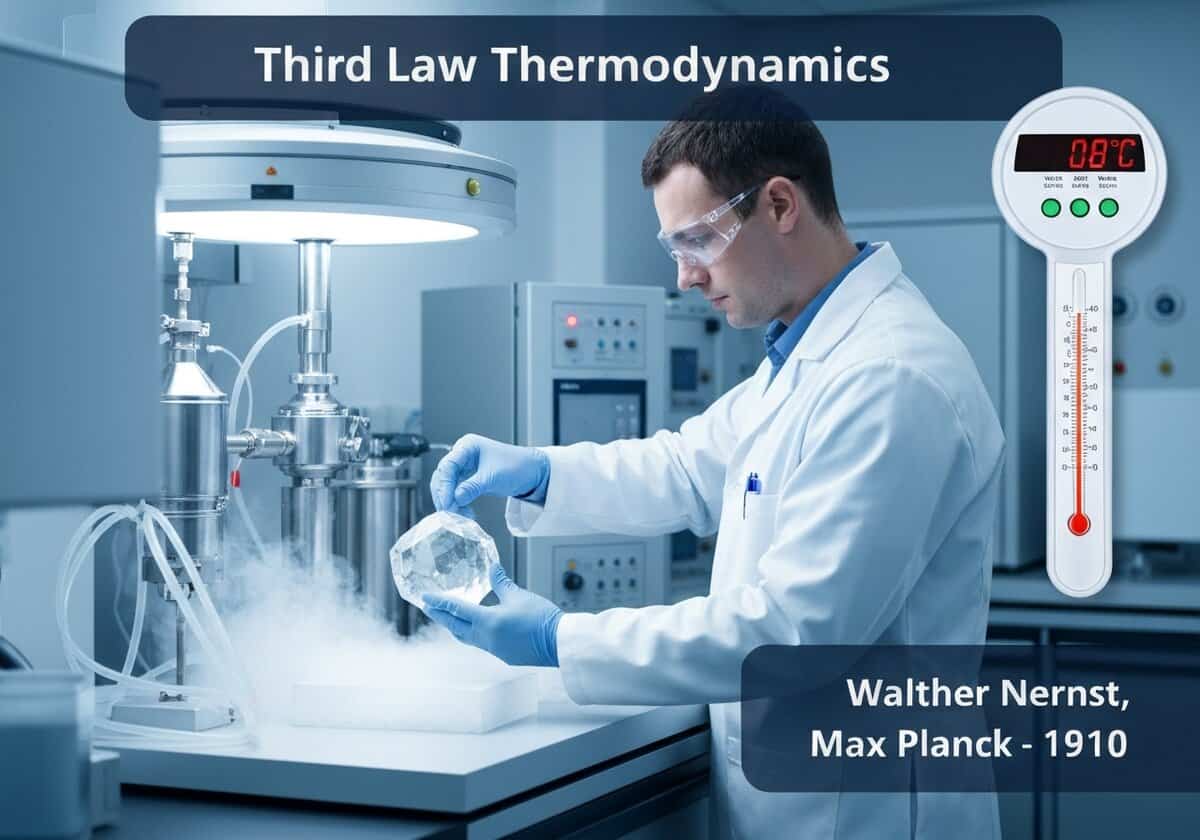
The Third Law originated from Walther Nernst’s work on chemical reactions at low temperatures, formulated as the Nernst Heat Theorem in 1906. He observed that the change in entropy for chemical reactions approaches zero as the temperature approaches absolute zero. Max Planck later extended this to state that the entropy of each individual perfect crystalline substance is itself zero at absolute zero. This provides an absolute, rather than relative, scale for entropy.
The law’s novelty lies in its connection between thermodynamics and the quantum-mechanical nature of matter. At absolute zero, a system is in its ground state, which for a perfect crystal is a unique, non-degenerate state, corresponding to zero entropy ([latex]S = k_B \ln(1) = 0[/latex]). Amorphous materials like glass, however, have residual entropy at absolute zero due to their disordered structure. The law also implies that as [latex]T \rightarrow 0[/latex], specific heats ([latex]C_p[/latex], [latex]C_v[/latex]) and the coefficient of thermal expansion also approach zero. The unattainability principle arises because each step in a cooling process removes a smaller and smaller amount of entropy, requiring an infinite number of steps to reach zero entropy.