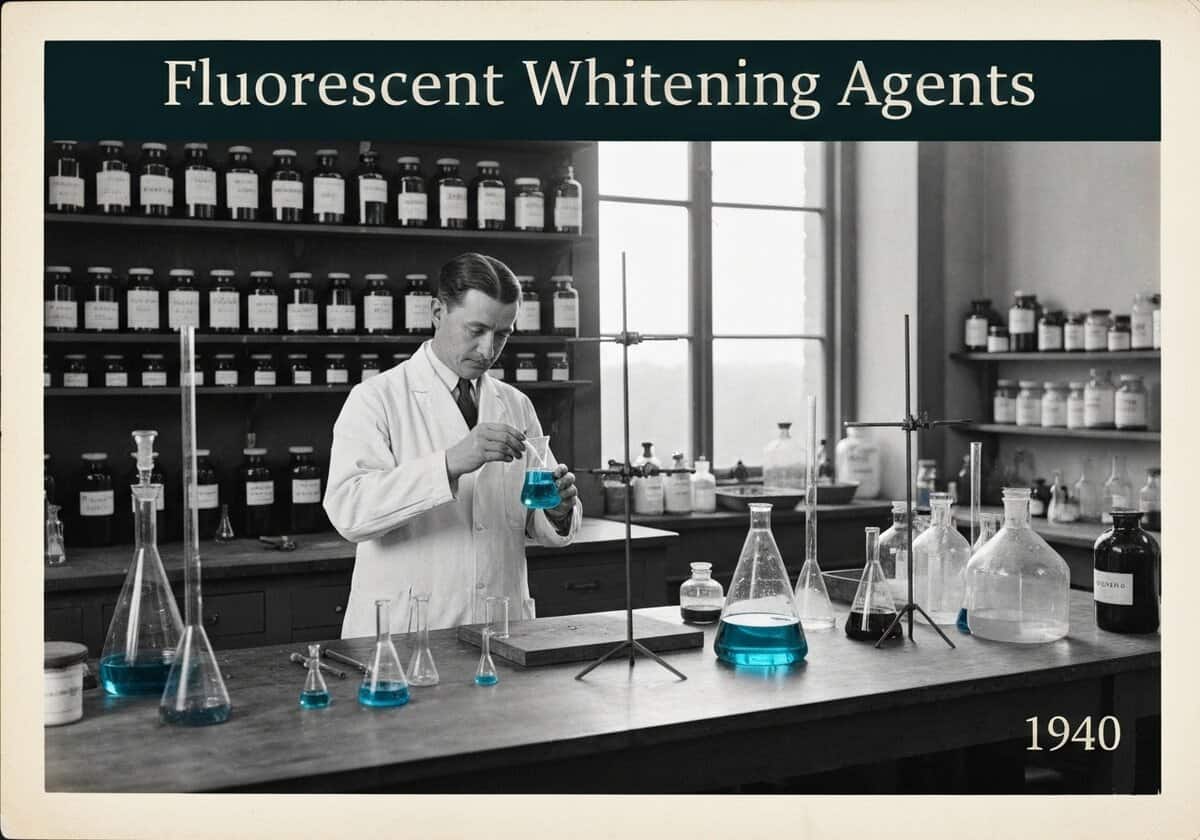
Fluorescent Whitening Agents (FWAs) are a key technology for achieving high levels of whiteness in many consumer and industrial products. Their mechanism relies on the phenomenon of fluorescence. FWAs are designed to absorb high-energy photons from the near-ultraviolet range (typically 340–370 nm) and, through a process of electronic excitation and relaxation, re-emit lower-energy photons in the blue part of the visible spectrum (typically 420–470 nm). This emitted blue light adds to the light reflected by the material, making it appear brighter. More importantly, the blue emission masks the inherent yellowish appearance common in many natural and synthetic materials like cotton, wool, and paper pulp. This masking effect shifts the material’s color towards blue, which the human eye perceives as ‘whiter than white.’ The effectiveness of an FWA depends on the presence of a UV component in the viewing light source. For this reason, whiteness measurements of FWA-treated materials must be performed under a calibrated illuminant with a known UV content, such as CIE Standard Illuminant D65, which simulates daylight. Without UV energy, the FWA is inactive, and the material will appear less white. This is why white clothes can look different indoors under incandescent light (low UV) compared to outdoors in daylight (high UV).