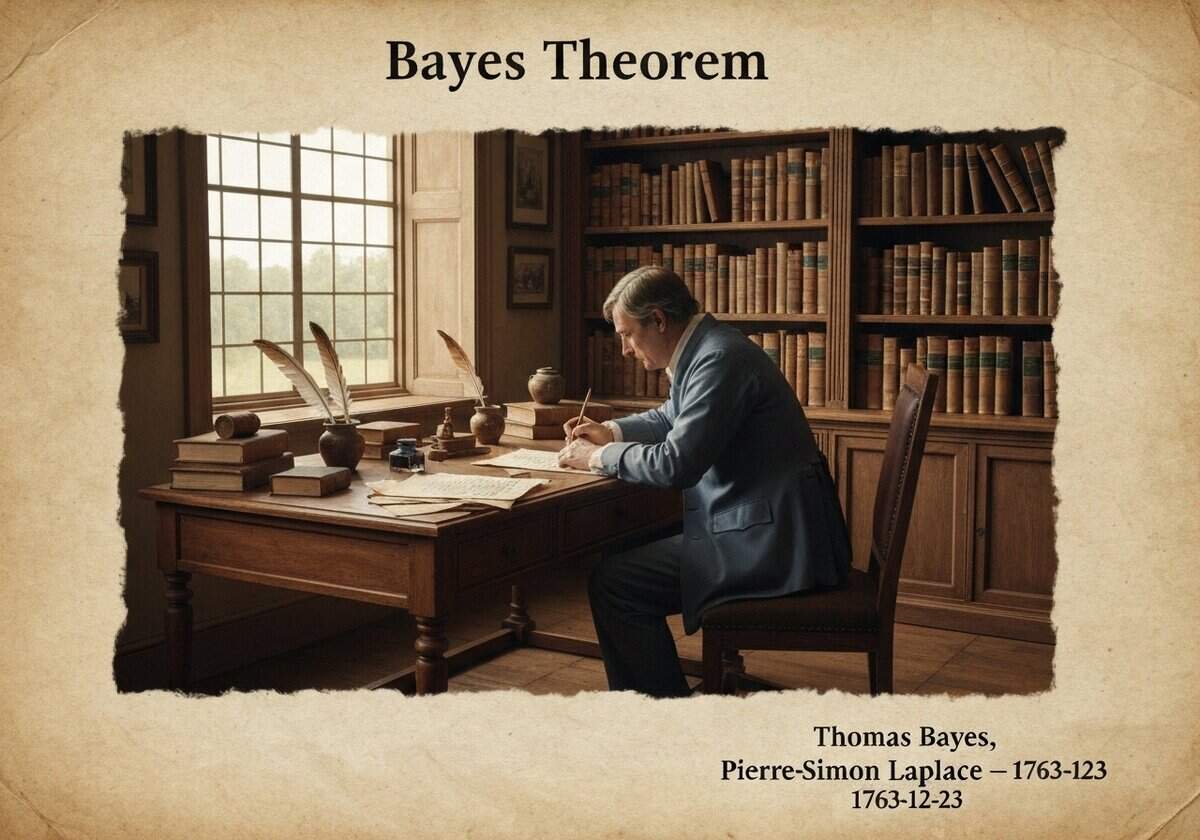
贝叶斯定理描述了基于对可能与事件相关的条件的先验知识的事件概率。它是概率论和统计学中的一个基本概念。在数学上,它被表述为 [latex]P(A|B) = \frac{P(B|A)P(A)}{P(B)}[/latex], 其中 A 和 B 是事件,[latex]P(B) \neq 0[/latex]。它涉及两个随机事件的条件概率和边际概率。.
贝叶斯定理提供了一种用新证据更新现有信念的数学方法。在公式 [latex]P(A|B) = \frac{P(B|A)P(A)}{P(B)}[/latex] 中,[latex]P(A|B)[/latex] 是后验概率:给定证据 B 的假设 A 的概率。[latex]P(A)[/latex] 是先验概率:在看到证据 B 之前对假设 A 的初始信念。最后,[latex]P(B)[/latex] 是边际似然或证据:在所有可能的假设下观察到证据 B 的总概率。这个项作为归一化常数,确保后验概率总和为 1。.
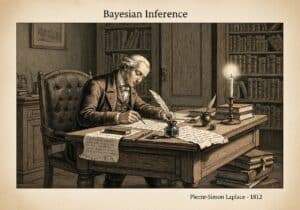
The theorem was first presented in Thomas Bayes’s essay “An Essay towards solving a Problem in the Doctrine of Chances,” which was read to the Royal Society in 1763 after his death. However, it was Pierre-Simon Laplace who independently developed and popularized the theorem, applying it to problems in celestial mechanics, medical statistics, and jurisprudence. The novelty of the theorem was its formalization of inverse probability—reasoning from effects back to their causes. While classical (frequentist) statistics focuses on the probability of data given a hypothesis, Bayesian statistics focuses on the probability of the hypothesis given the data, which is often a more intuitive and direct answer to scientific questions.