Product Design, Manufacturing & Innovation Resources
» 베이즈 정리

베이즈 정리

1763-12-23
  • Thomas Bayes
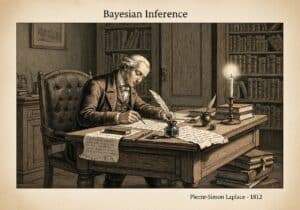
  • Pierre-Simon Laplace
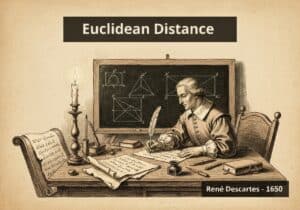
Historical study room with mathematician calculating Bayes' theorem.

(설명을 위한 생성된 이미지입니다)

Bayes’ theorem describes the probability of an event based on prior knowledge of conditions that might be related to the event. It is a fundamental concept in probability theory and statistics. Mathematically, it is stated as [latex]P(A|B) = \frac{P(B|A)P(A)}{P(B)}[/latex], where A and B are events and [latex]P(B) \neq 0[/latex]. It relates the conditional and marginal probabilities of two random events.

Bayes’ Theorem provides a mathematical way to update existing beliefs with new evidence. In the formula [latex]P(A|B) = \frac{P(B|A)P(A)}{P(B)}[/latex], [latex]P(A|B)[/latex] is the posterior probability: the probability of hypothesis A given the evidence B. [latex]P(B|A)[/latex] is the likelihood: the probability of observing evidence B if hypothesis A is true. [latex]P(A)[/latex] is the prior probability: the initial belief in hypothesis A before seeing evidence B. Finally, [latex]P(B)[/latex] is the marginal likelihood or evidence: the total probability of observing the evidence B under all possible hypotheses. This term serves as a normalization constant, ensuring the posterior probabilities sum to one.

The theorem was first presented in Thomas Bayes’s essay “An Essay towards solving a Problem in the Doctrine of Chances,” which was read to the Royal Society in 1763 after his death. However, it was Pierre-Simon Laplace who independently developed and popularized the theorem, applying it to problems in celestial mechanics, medical statistics, and jurisprudence. The novelty of the theorem was its formalization of inverse probability—reasoning from effects back to their causes. While classical (frequentist) statistics focuses on the probability of data given a hypothesis, Bayesian statistics focuses on the probability of the hypothesis given the data, which is often a more intuitive and direct answer to scientific questions.

UNESCO Nomenclature: 1208
통계

유형

추상 시스템

분열

혁명가

용법

널리 사용됨

전구체

  • General theory of probability (developed by Pascal, Fermat, Bernoulli)
  • 조건부 확률의 개념
  • 이전 수학자들의 역확률 문제 연구

응용 프로그램

  • 이메일 클라이언트의 스팸 필터링
  • 의료 진단 검사
  • 머신러닝 알고리즘(예: 나이브 베이즈 분류기)
  • 수색 및 구조 작전
  • 생태 모델링
  • 금융 시장 예측

특허:

NA

잠재적 혁신 아이디어

현재 하루 4만 건이 넘는 봇 트래픽을 차단하기 위해 이 콘텐츠는 커뮤니티 회원만 이용할 수 있습니다.
> 로그인 < 또는 >등록 < 이 콘텐츠를 비롯한 모든 제한된 콘텐츠와 도구는 (100% 무료로) 이용할 수 있습니다.

관련 용어: 베이즈 정리, 조건부 확률, 사후 확률, 사전 확률, 가능도, 베이지안 통계, 역확률, 토마스 베이즈, 라플라스, 증거.

역사적 맥락

베이즈 정리

1650
1736
1750
1763-12-23
1780
1805
1822
1640
1650
1747
1758
1777
1799
1812
1822

(날짜를 알 수 없거나 관련이 없는 경우, 예를 들어 "유체역학"의 경우, 주목할 만한 등장 시기를 대략적으로 추정하여 제공합니다.)

관련 발명, 혁신 및 기술 원칙

고화질 이미지 및 다운로드는 등록된 회원에게만 100% 무료로 제공됩니다.

> 로그인 <