Product Design, Manufacturing & Innovation Resources
Hogar » Teorema de Bayes

Teorema de Bayes

1763-12-23
  • Thomas Bayes
  • Pierre-Simon Laplace
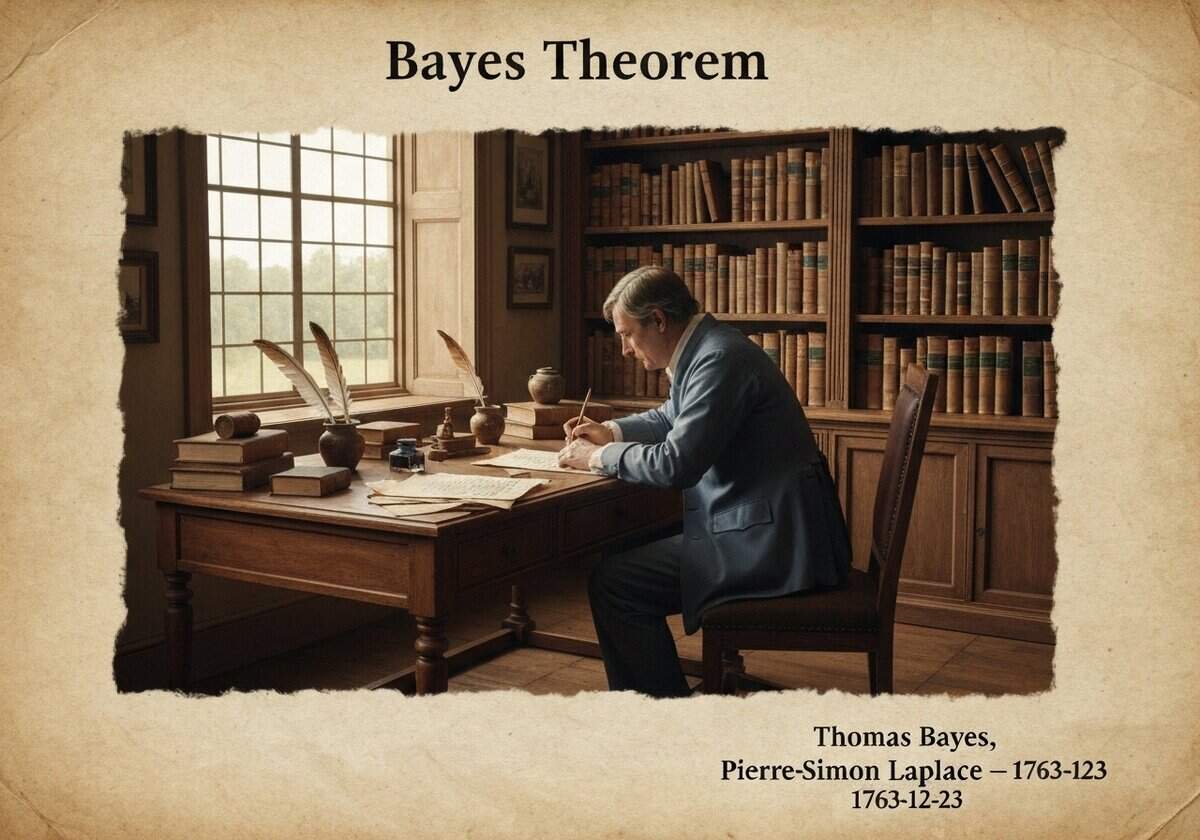
Historical study room with mathematician calculating Bayes' theorem.

(Imagen generada únicamente con fines ilustrativos)

Bayes’ theorem describes the probability of an event based on prior knowledge of conditions that might be related to the event. It is a fundamental concept in probability theory and statistics. Mathematically, it is stated as [latex]P(A|B) = \frac{P(B|A)P(A)}{P(B)}[/latex], where A and B are events and [latex]P(B) \neq 0[/latex]. It relates the conditional and marginal probabilities of two random events.

Bayes’ Theorem provides a mathematical way to update existing beliefs with new evidence. In the formula [latex]P(A|B) = \frac{P(B|A)P(A)}{P(B)}[/latex], [latex]P(A|B)[/latex] is the posterior probability: the probability of hypothesis A given the evidence B. [latex]P(B|A)[/latex] is the likelihood: the probability of observing evidence B if hypothesis A is true. [latex]P(A)[/latex] is the prior probability: the initial belief in hypothesis A before seeing evidence B. Finally, [latex]P(B)[/latex] is the marginal likelihood or evidence: the total probability of observing the evidence B under all possible hypotheses. This term serves as a normalization constant, ensuring the posterior probabilities sum to one.

The theorem was first presented in Thomas Bayes’s essay “An Essay towards solving a Problem in the Doctrine of Chances,” which was read to the Royal Society in 1763 after his death. However, it was Pierre-Simon Laplace who independently developed and popularized the theorem, applying it to problems in celestial mechanics, medical statistics, and jurisprudence. The novelty of the theorem was its formalization of inverse probability—reasoning from effects back to their causes. While classical (frequentist) statistics focuses on the probability of data given a hypothesis, Bayesian statistics focuses on the probability of the hypothesis given the data, which is often a more intuitive and direct answer to scientific questions.

UNESCO Nomenclature: 1208
- Estadísticas

Tipo

Sistema abstracto

Ruptura

Revolucionario

Uso

Uso generalizado

Precursores

  • Teoría general de la probabilidad (desarrollada por Pascal, Fermat, Bernoulli)
  • Concepto de probabilidad condicional
  • Trabajos sobre problemas de probabilidad inversa realizados por matemáticos anteriores

Aplicaciones

  • Filtrado de spam en clientes de correo electrónico
  • Pruebas de diagnóstico médico
  • Algoritmos de aprendizaje automático (por ejemplo, clasificadores Naive Bayes)
  • Operaciones de búsqueda y rescate
  • Modelado ecológico
  • Predicción del mercado financiero

Patentes:

NA

Ideas para posibles innovaciones

Debido al bloqueo del tráfico generado por bots, que actualmente supera los 40.000 al día, este contenido está reservado para los miembros de la comunidad.
> Iniciar sesión < o > Registrarse < (100% gratis) para acceder a esto, al igual que a todo el demás contenido y herramientas restringidos.

Relacionado con: teorema de Bayes, probabilidad condicional, posterior, previa, verosimilitud, estadística bayesiana, probabilidad inversa, Thomas Bayes, Laplace, evidencia.

Contexto histórico

Teorema de Bayes

1650
1736
1750
1763-12-23
1780
1805
1822
1640
1650
1747
1758
1777
1799
1812
1822

(Si la fecha es desconocida o no es relevante, por ejemplo "mecánica de fluidos", se proporciona una estimación redondeada de su aparición notable)

Invención, innovación y principios técnicos relacionados.

Las imágenes a tamaño completo y las descargas sólo están disponibles, 100% gratis, para los miembros registrados.

> Acceso <