Product Design, Manufacturing & Innovation Resources
بيت » الإثبات بالاستقراء الرياضي

الإثبات بالاستقراء الرياضي

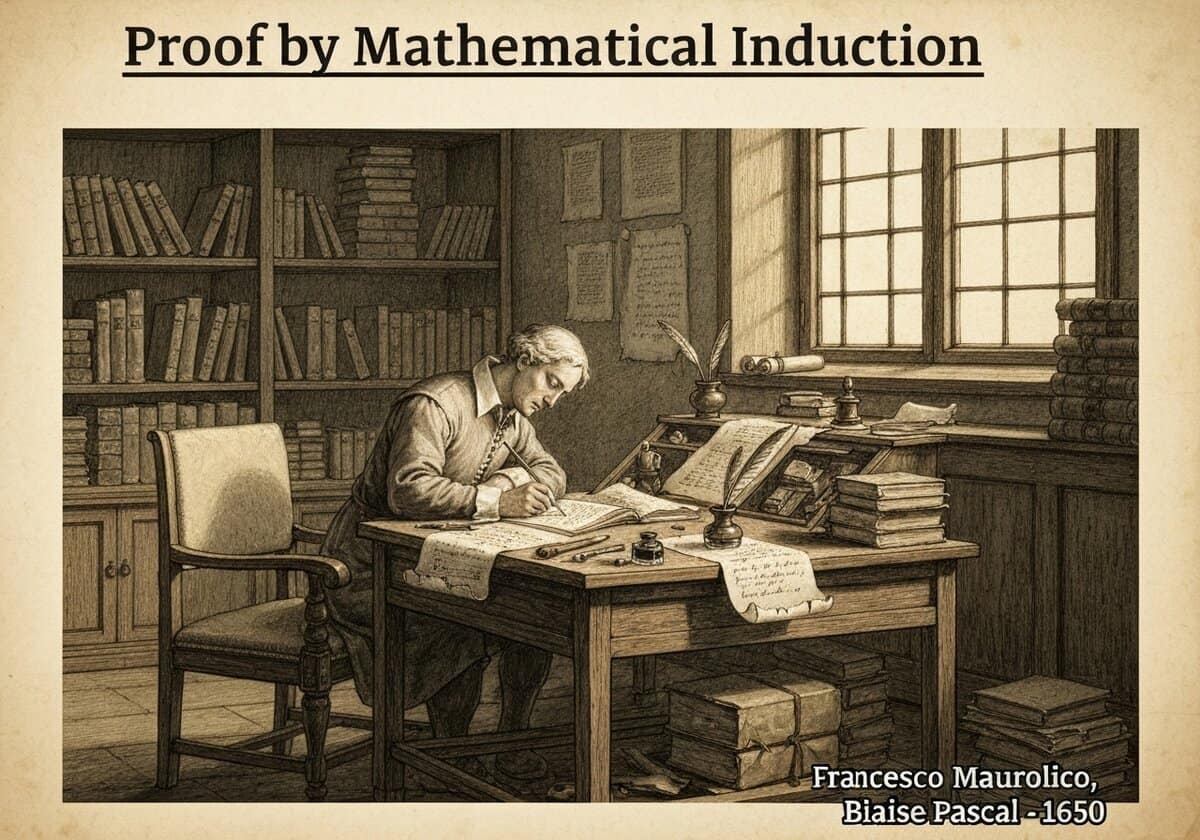
1650
  • Francesco Maurolico
  • Blaise Pascal
Study room with mathematician proving properties using mathematical induction.

(صورة توضيحية فقط)

Mathematical induction is a technique used to prove that a property [latex]P(n)[/latex] holds for every natural number [latex]n[/latex]. It involves two steps: the base case, proving [latex]P(0)[/latex] or [latex]P(1)[/latex] is true, and the inductive step, proving that if [latex]P(k)[/latex] is true for some natural number [latex]k[/latex] (the induction hypothesis), then [latex]P(k+1)[/latex] is also true.
Proof by mathematical induction is analogous to the domino effect. If you can prove the first domino will fall (the base case) and that any falling domino will knock over the next one (the inductive step), you can conclude that all dominoes will fall. The base case establishes the truth of the statement for the initial value, typically [latex]n=0[/latex] or [latex]n=1[/latex]. The inductive step is the core of the proof. It assumes the statement holds for an arbitrary case [latex]n=k[/latex], an assumption known as the induction hypothesis. Then, using this assumption, it must be shown that the statement also holds for the next case, [latex]n=k+1[/latex]. For example, to prove the formula for the sum of the first n integers, [latex]\sum_{i=1}^{n} i = \frac{n(n+1)}{2}[/latex]. Base case (n=1): [latex]1 = \frac{1(1+1)}{2}[/latex], which is true. Inductive step: Assume [latex]\sum_{i=1}^{k} i = \frac{k(k+1)}{2}[/latex]. We need to show [latex]\sum_{i=1}^{k+1} i = \frac{(k+1)(k+2)}{2}[/latex]. We start with the left side: [latex]\sum_{i=1}^{k+1} i = (\sum_{i=1}^{k} i) + (k+1)[/latex]. By the induction hypothesis, this is [latex]\frac{k(k+1)}{2} + (k+1)[/latex]. Factoring out [latex](k+1)[/latex] gives [latex](k+1)(\frac{k}{2} + 1) = (k+1)(\frac{k+2}{2}) = \frac{(k+1)(k+2)}{2}[/latex], which completes the proof. This powerful method is indispensable in discrete mathematics and computer science.

UNESCO Nomenclature: 1202
– Algebra

يكتب

نظام مجرد

خلل

Substantial

الاستخدام

استخدام واسع النطاق

مقدمات

  • برهان إقليدس على لا نهائية الأعداد الأولية (والذي له طابع استقرائي)
  • طريقة النزول اللانهائي لبيير دي فيرما
  • تطوير التدوين الجبري

التطبيقات

  • إثبات صحة خوارزميات الكمبيوتر، وخاصة الخوارزميات المتكررة
  • تحليل النماذج المالية التي تتضمن خطوات متسلسلة
  • إثبات الصيغ في التركيبات ونظرية الأعداد
  • تحديد خصائص هياكل البيانات في علوم الكمبيوتر

براءات الاختراع:

NA

أفكار ابتكارية محتملة

  • formal verification of loop invariants in software engineering
  • تطوير محللات الانحدار التكراري للمترجمين
  • proof-of-stake consensus algorithms in تقنية البلوك تشين technology
  • نماذج توليدية للهندسة الكسورية
  • مُثبتات النظريات الآلية للخواص الاستقرائية
  • تحليل التعقيد الحسابي للخوارزميات التكرارية
  • نمذجة نمو السكان في خطوات زمنية منفصلة
  • تصميم أنظمة مقاومة للأخطاء مع استعادة الحالة المتسلسلة
  • إثبات إنهاء برامج الكمبيوتر
  • تطوير الاستدلال الهيكلي لأنواع البيانات المعقدة
يتعلق بـ: الاستقراء الرياضي، والتكرار، والحالة الأساسية، والخطوة الاستقرائية، ونظرية الأعداد، والرياضيات المتقطعة، وصحة الخوارزمية، والمتسلسلات، والمجموع، وبديهيات بيانو.

السياق التاريخي

الإثبات بالاستقراء الرياضي

-500
150
1640
1650
1747
1758
1777
-400
-550
1635
1650
1736
1750
1763-12-23
1780

(إذا كان التاريخ غير معروف أو غير ذي صلة، على سبيل المثال "ميكانيكا الموائع"، يتم توفير تقدير تقريبي لظهوره الملحوظ)

أحدث الإضافات

أهم المنشورات والمقالات

أفضل الأدوات الأصلية

السنة العاشرة عيد

الصور والتنزيلات بالحجم الكامل متاحة فقط، ومجانية تمامًا، للأعضاء المسجلين.