Product Design, Manufacturing & Innovation Resources
» 反电动势(Back-EMF)

反电动势(Back-EMF)

1831
  • Michael Faraday
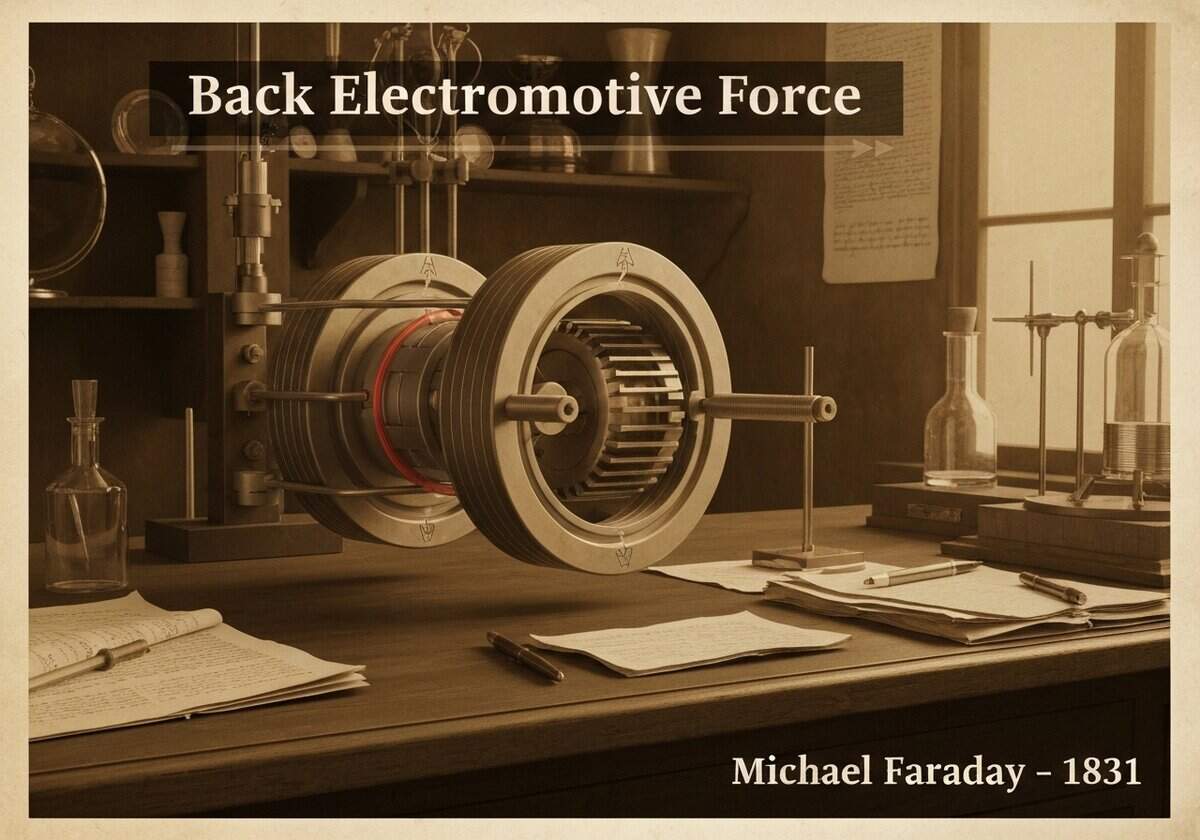
电机电枢在磁场中旋转,说明电磁学中的反向电动势。.

(图片仅供参考)

电机电枢旋转时,其导体穿过磁场,根据法拉第感应定律产生电压。这个 ‘反向电磁场 ’与驱动电动机的主电压相抵消。 发动机. .它的大小与电机的转速成正比([latex]\mathcal{E}_{back} \propto \omega[/latex] )。这一现象对于电机速度和电流的自我调节至关重要。.

Back-EMF is a direct consequence of the motor also acting as a generator. While the applied voltage causes current to flow and produce torque (motor action), the resulting rotation of the conductors in the magnetic field generates a voltage (generator action). Lenz’s law dictates that this induced voltage must oppose the change that created it, which is the flow of current from the external supply. Therefore, it is called a ‘back’ or ‘counter’ electromotive force.

电枢绕组上的净电压是电源电压与反向电磁场之差:[latex]V_{net} = V_{applied} - \mathcal{E}_{back}[/latex]。根据欧姆定律,电枢电流为 [latex]I_a = (V_{applied} - \mathcal{E}_{back}) / R_a[/latex],其中 [latex]R_a[/latex] 为电枢电阻。启动时,速度 [latex]\omega[/latex] 为零,因此 [latex]\mathcal{E}_{back}[/latex] 为零。这就导致了非常大的浪涌电流,而这仅受限于较低的电枢电阻。随着电机加速,[latex]/mathcal{E}_{back}[/latex] 会增加,从而降低净电压并导致电流下降。电机会稳定在一个速度,此时电流产生的转矩与负载转矩相匹配。这种固有的自我调节功能是电机行为的基础。.

UNESCO Nomenclature: 2212
- 电与磁

类型

物理现象

中断

基础

用法

广泛使用

前体

  • 汉斯-克里斯蒂安-厄斯泰德发现电磁学
  • 迈克尔·法拉第发现电磁感应

应用程序

  • 电机调速
  • 电动汽车再生制动
  • 无刷直流电机的无传感器速度控制
  • 浪涌电流限制电路
  • 运动健康诊断系统

专利:

    潜在创新理念

    由于机器人流量被拦截(目前每天超过 4 万),此内容仅限社区成员查看。
    > 登录 > 或者 > 注册 < (100% 免费)即可访问此内容,以及所有其他受限内容和工具。

    Related to: back-EMF, counter-EMF, Faraday’s law of induction, Lenz’s law, motor speed, self-regulation, armature current, electric generator, Inrush current, electromotive force.

    历史背景

    反电动势(Back-EMF)

    1822
    1827
    1831
    1831
    1832
    1834
    1835
    1822
    1824
    1827
    1831
    1831
    1833
    1834
    1836

    (如果日期未知或不相关,例如“流体力学”,则提供其显著出现的近似估计)

    相关发明、创新和技术原理

    只有注册会员才能免费获得 100% 的全尺寸图片和下载。.

    > 登录 <