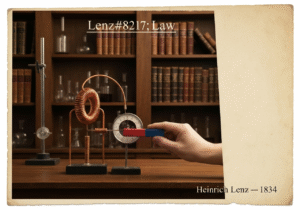
自感是电路的一种特性,即流经电路的电流发生变化时,会在电路中感应出 电动势 (电磁场在电路本身中会产生这种‘反电动势’。根据伦茨定律,该反电动势会阻碍电流变化。其关系由公式[latex]mathcal{E}_L = -L frac{dI}{dt}[/latex]给出,其中L为自感,单位为亨利(H)。.

(图片仅供参考)
自感是电路的一种特性,即流经电路的电流发生变化时,会在电路中感应出 电动势 (电磁场在电路本身中会产生这种‘反电动势’。根据伦茨定律,该反电动势会阻碍电流变化。其关系由公式[latex]mathcal{E}_L = -L frac{dI}{dt}[/latex]给出,其中L为自感,单位为亨利(H)。.
Any circuit carrying a current generates a magnetic field, which in turn creates a magnetic flux through the area enclosed by the circuit. If this current changes, the magnetic flux it produces also changes. According to Faraday’s law, this change in self-flux induces an opposing 电磁场 within the same circuit. The property that quantifies this effect is self-inductance, or simply inductance (L). It is primarily a function of the geometry of the circuit, such as the number of turns in a coil, its area, and its length. It is defined as the ratio of magnetic flux to the current: [latex]L = frac{NPhi_B}{I}[/latex].
该特性赋予电感器抵抗电流变化的特征性‘惯性’。当电路初次通电时,反电动势会阻碍电流上升,使其逐渐建立而非瞬间形成。 相反地,当电路断开时,磁场的急剧坍塌会感应出巨大的正向电动势,试图维持电流流动。这可能产生极高电压,常表现为开关触点间的火花现象——该效应被广泛应用于汽车点火系统中。.
自感
(如果日期未知或不相关,例如“流体力学”,则提供其显著出现的近似估计)
只有注册会员才能免费获得 100% 的全尺寸图片和下载。.
> 登录 <