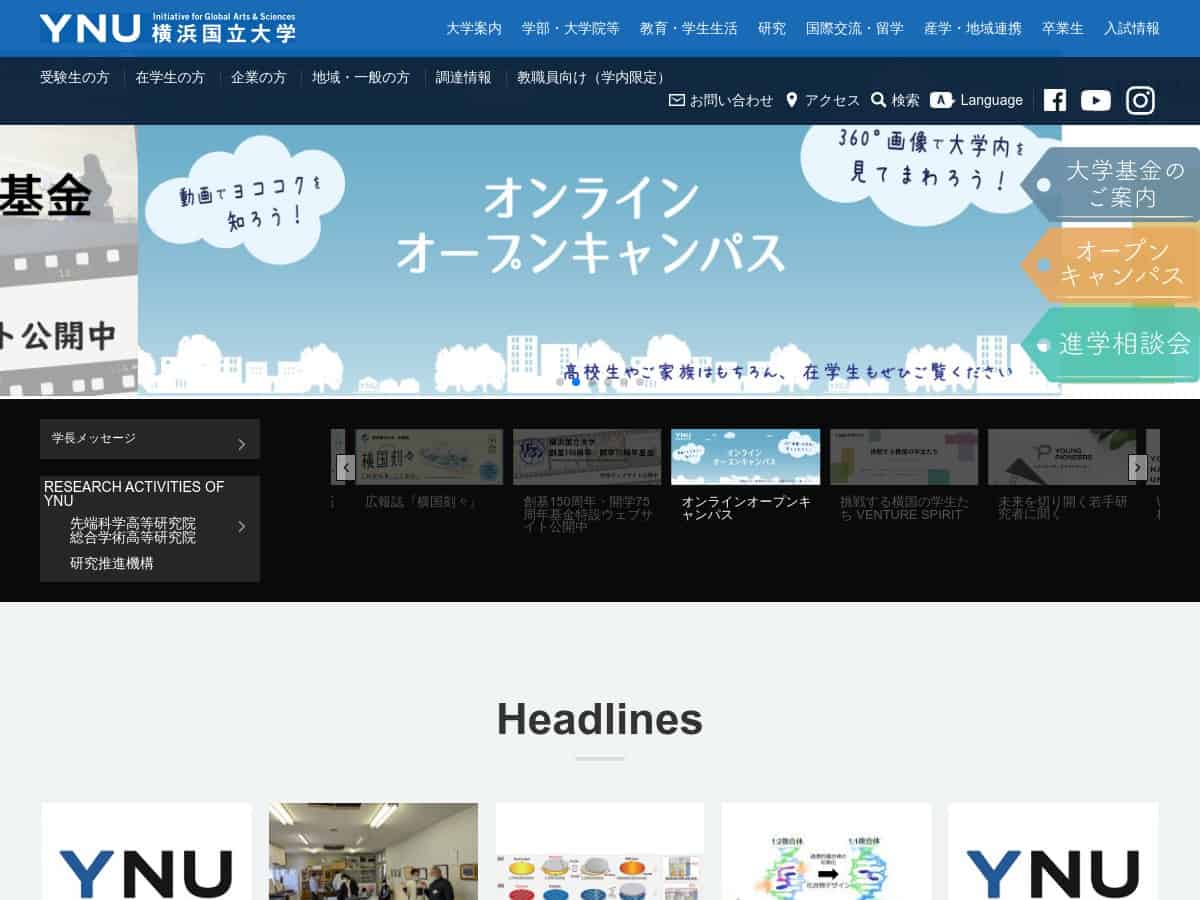
Yokohama National University took shape in 1949, when four earlier institutions were unified into a single national university: Kanagawa Normal School, a second Kanagawa teacher-training school, Yokohama College of Economics and Yokohama Institute of Technology. That mix of teacher education, economics and engineering still shows in the way the university is organised.
Its Tokiwadai campus lies in Hodogaya Ward in the Tokyo-Yokohama metropolitan area. Five undergraduate colleges are listed: Education, Economics, Business Administration, Engineering Science and Urban Sciences. Teaching at graduate level takes place in six graduate schools, namely Education, International Social Sciences, Engineering Science, Environment and Information Sciences, Urban Innovation, and the Interfaculty Graduate School of Innovative and Practical Studies.
The university reports a community of roughly 10,000 students. The university’s English website carries information on international programmes, and it is the reference for current admission conditions.
Domains taught:
AI and Machine Learning, Automation, Bioengineering, Chemistry, Civil Engineering, Computer Vision, Data Analytics, Ecology and Sustainability, Electrical and Electronics, Engineering, Fluid Dynamics, Geotechnics, Industrial Design, Life Sciences, Logistics, Manufacturing, Marine Science, Materials, Mathematics, Mechanical Engineering, Microbiology and Genetics, Nanotechnologies, Optics, Physics, Process Control, Project Management, Robotics, Signal Processing, Software Engineering, Statistics, Structural Engineering, Telecommunications, Thermodynamics, Transportations
Diplomas*:
Bachelor, Doctor, Master
Status:
Public
Partnerships:
Located in the major port city of Yokohama. Strong industry links.
Research:
Advanced materials & Manufacturing, Risk management & Safety science, Information & Telecommunication systems, Environmental engineering & Green chemistry.
Famous Alumnis:
Sumio Iijima (discovered carbon nanotubes, professor emeritus)
International recognition**:
Number of staff***:
1000
Current students***:
10000
Foreign students***:
10%
Cumulative former students***:
N/A
Pros
Strong engineering programs, particularly in areas relevant to urban and industrial environments, international outlook.
Cons
Primarily focused on specific engineering and business areas.
Best For
National university with strong engineering programs and an international outlook in Yokohama.
Osaka Metropolitan University in Osaka is a public university with engineering in mechanical, electrical, chemical and materials fields.
Most Similar Schools Abroad
École Centrale de Nantes in France is a public engineering school in Nantes working in mechanical engineering and marine engineering and hydrodynamics.
Gdańsk University of Technology, a public university in Poland, is known for naval architecture and ocean engineering alongside electronics.
University of the Basque Country in Spain is a public university in Leioa whose recorded fields include science and technology, medicine and nursing, and engineering.
Dresden University of Technology, a public university in Germany, covers engineering, natural sciences, medicine and humanities.
Kyungpook National University in Daegu, South Korea, is a public university with mechanical engineering and life sciences among its fields.
*our own picks (our criteria: a mix between domains, diploma delivered, reputation and size), but obviously too many criteria for an apple-to-apple ranking.
FAQ
How was Yokohama National University formed?
It was established in 1949 by uniting Kanagawa Normal School, a second Kanagawa teacher-training school, Yokohama College of Economics and Yokohama Institute of Technology. The union created a national university in Yokohama.
In which part of Yokohama is the main campus?
The Tokiwadai campus is in Hodogaya Ward. It sits in the wider Tokyo-Yokohama metropolitan region.
What undergraduate colleges are there?
The five colleges are Education, Economics, Business Administration, Engineering Science and Urban Sciences.
Which graduate schools exist?
There are six: Education, International Social Sciences, Engineering Science, Environment and Information Sciences, Urban Innovation, and the Interfaculty Graduate School of Innovative and Practical Studies.
About how many students does the university have?
Official material speaks of roughly 10,000 students, and government university statistics show slightly under 9,800 in May 2026. The figure varies slightly from year to year.
Where can international students look up entry requirements?
The university runs an English-language website for prospective international students. Deadlines, language requirements and tuition can differ by programme, so check the pages of the college or graduate school you are interested in.
*: without any judgment of the quality, readers are strongly encouraged to check the official status of the exact diploma envisioned as many universities have a mix of recognized diplomas, not recognized, “co-delivered,” “equivalent to”, “some pathways” (…), can change over time, and can be named differently from one country to another.
**: international reputation: is based on some criteria that do not mean much in some domains or specialties (number of researchers, of scientific publications, on budget ….). Our approximate 1-4 scale:
known locally
known locally and internationally
is listed in some of the world university’s classifications
is listed among the 20 firsts in some of world university’s classifications
***: estimated numbers, based on online sources and/or feedbacks. The numbers can vary greatly depending on school organisation (ex.: school is part of a group, it employs internal staff or external consultants or has public staff without employing them …). Refer to all the links provided to have accurate and updated numbers.
Innovation.world is not affiliated with this school/university. We recommend to contact them directly on their website for any special request.
To complete or correct any information here or share your opinion, please comment below or > send us a direct message <.