Address: 16 Richmond Street, Glasgow, G1 1XQ, Scotland, United Kingdom
Engineering, Business, Pharmacy
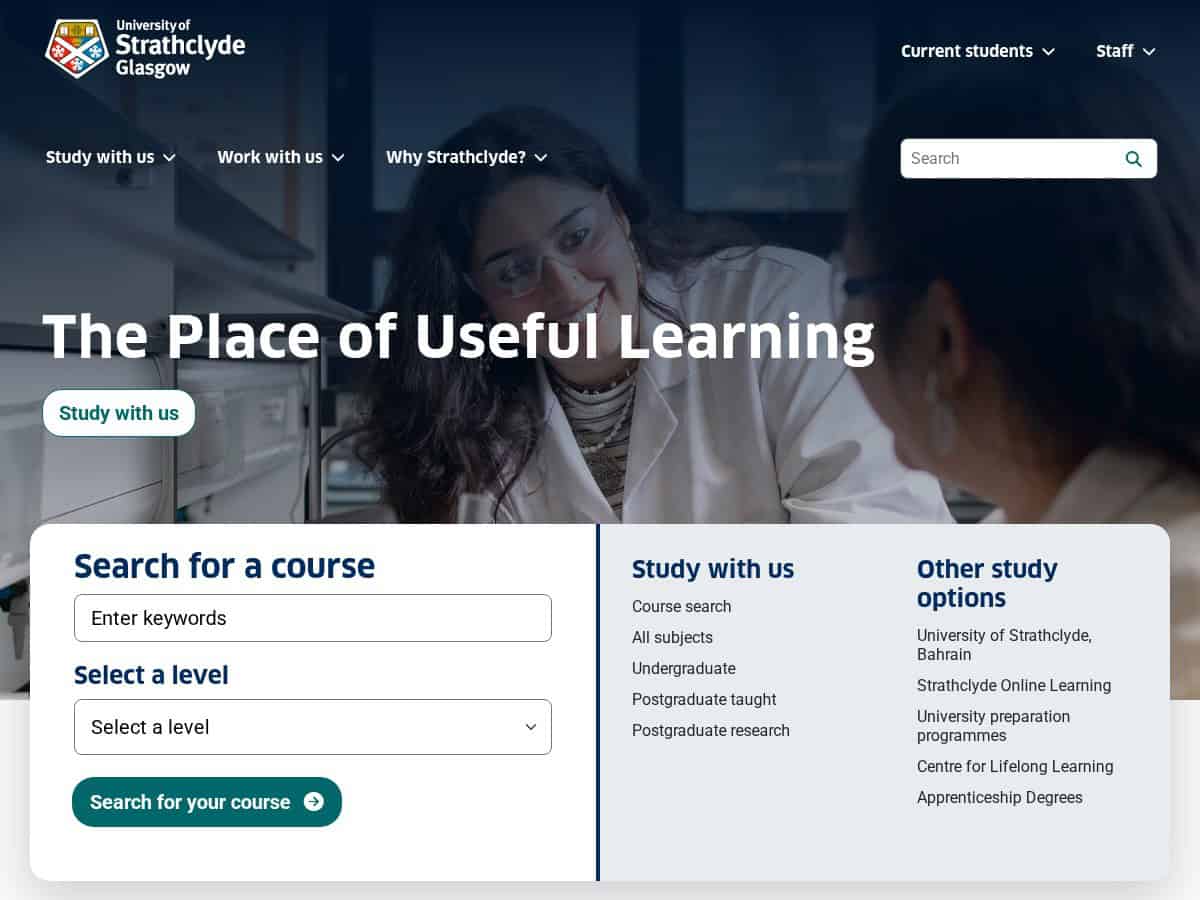
The University of Strathclyde grew out of Anderson’s Institution, founded in Glasgow in 1796 under the will of John Anderson, a professor of natural philosophy at the University of Glasgow. Anderson envisioned a place of useful learning. The institution became the Royal Technical College in 1912 and received its Royal Charter as the University of Strathclyde in 1964.
In 1993 Jordanhill College of Education merged with Strathclyde. Today the university is organised in four faculties: Engineering, Humanities and Social Sciences, Science, and Strathclyde Business School.
The university’s official website sets out undergraduate and postgraduate programmes, entry requirements and fees, which vary by programme and year of entry.
Domains taught:
AI and Machine Learning, Electrical and Electronics, Engineering, Life Sciences, Manufacturing, Mechanical Engineering, Software Engineering
Diplomas*:
Bachelor, Doctor, Master, MBA
Status:
Public
Partnerships:
Extensive partnerships with industry (e.g., Rolls-Royce, GSK, SSE), government, and public sector. Home to Technology & Innovation Centre (TIC) and Advanced Forming Research Centre (AFRC).
Research:
World-leading research in engineering (electrical, mechanical, civil), business, pharmacy and biomedical sciences, advanced manufacturing, and energy. Strong focus on innovation and enterprise.
Famous Alumnis:
John Logie Baird, David Livingstone (attended Anderson’s Institution), Annabel Goldie, Henry Faulds
International recognition**:
Number of staff***:
4500
Current students***:
23000
Foreign students***:
20%
Cumulative former students***:
180000
Pros
Leading technological university, excellent industry links and graduate employability, strong research in engineering and business, located in Glasgow city centre.
Cons
Large student numbers, campus is integrated into the city rather than a distinct ‘green’ campus.
Best For
Students interested in engineering, technology, business, or pharmacy, with a strong emphasis on industry collaboration, innovation, and practical application.
Lancaster University lists Business, Environmental Science, Physics among its main specialties.
University of Liverpool lists Medicine, Veterinary Science, Engineering among its main specialties.
University of Exeter lists Environmental Science, Business, Humanities among its main specialties.
University of Warwick lists Business (WBS), Economics, Engineering (WMG) among its main specialties.
Most Similar Schools Abroad
Griffith University in Australia lists Criminology and Criminal Justice, Education, Humanities and Social Science among its main specialties.
RMIT University in Australia lists Business and Law, Design and Social Context, Vocational Education among its main specialties.
University of the Basque Country in Spain lists Science and Technology, Medicine and Nursing, Law among its main specialties.
Luleå University of Technology in Sweden lists Mining and Metallurgical Engineering, Space Science, Wood Technology among its main specialties.
Shandong University in China lists Materials Science & Engineering, Control Science & Engineering, Computer Science & Technology among its main specialties.
*our own picks (our criteria: a mix between domains, diploma delivered, reputation and size), but obviously too many criteria for an apple-to-apple ranking.
FAQ
How did Strathclyde begin?
It started as Anderson's Institution in Glasgow in 1796, founded under the will of John Anderson. Anderson envisioned a place of useful learning.
When did Strathclyde get its Royal Charter?
The Royal Charter creating the University of Strathclyde dates from 1964. Before that the institution was known as the Royal Technical College, a name it carried from 1912.
Which faculties does the university have?
There are four: Engineering, Humanities and Social Sciences, Science, and Strathclyde Business School.
What happened with Jordanhill College?
Jordanhill College of Education merged with Strathclyde in 1993. The merger brought teacher education into the university.
Who was John Anderson?
He was a professor of natural philosophy at the University of Glasgow. His will led to the founding of Anderson's Institution in 1796.
Does Strathclyde have a business school?
Yes, Strathclyde Business School is one of the four faculties.
What does the university publish about entry requirements and fees?
The university's official website sets out undergraduate and postgraduate programmes, entry requirements and fees. These vary by programme and year of entry.
*: without any judgment of the quality, readers are strongly encouraged to check the official status of the exact diploma envisioned as many universities have a mix of recognized diplomas, not recognized, “co-delivered,” “equivalent to”, “some pathways” (…), can change over time, and can be named differently from one country to another.
**: international reputation: is based on some criteria that do not mean much in some domains or specialties (number of researchers, of scientific publications, on budget ….). Our approximate 1-4 scale:
known locally
known locally and internationally
is listed in some of the world university’s classifications
is listed among the 20 firsts in some of world university’s classifications
***: estimated numbers, based on online sources and/or feedbacks. The numbers can vary greatly depending on school organisation (ex.: school is part of a group, it employs internal staff or external consultants or has public staff without employing them …). Refer to all the links provided to have accurate and updated numbers.
Innovation.world is not affiliated with this school/university. We recommend to contact them directly on their website for any special request.
To complete or correct any information here or share your opinion, please comment below or > send us a direct message <.