Address: Wivenhoe Park, Colchester, CO4 3SQ, England, United Kingdom
Social Sciences, Human Rights, Data Analytics
The University of Essex welcomed its first 122 students in 1964 under its first Vice-Chancellor, Sir Albert Sloman. Its main site is the Colchester Campus, and there is also a Loughton campus, and the university announced that its Southend Campus would close at the end of August 2026.
Academically it is organised into three faculties covering arts and humanities, science and health, and social sciences. Among its institutes is the Human Rights Centre, which has been recognised with a Queen’s Anniversary Prize, reflecting the strong standing of human rights and social science teaching at the university.
Research areas and groups are described on the university’s website, together with course lists. Detailed course lists, entry requirements and fees are published on the university website.
Domains taught:
AI and Machine Learning, Bioinformatics, Data Analytics, Electrical and Electronics, Life Sciences, Robotics, Software Engineering
Diplomas*:
Bachelor, Doctor, Master
Status:
Public
Partnerships:
Strong international collaborations, particularly in social science research. Research partnerships with government, NGOs, and industry. Home to the UK Data Archive.
Research:
Leading research in social sciences (politics, sociology, economics), human rights law, data science (Institute for Analytics and Data Science), AI, and robotics.
Famous Alumnis:
Óscar Arias, Priti Patel, John Bercow, Daniel Libeskind
International recognition**:
Number of staff***:
2600
Current students***:
17800
Foreign students***:
40%
Cumulative former students***:
105000
Pros
Strong reputation in social sciences and data analytics, international outlook, research-intensive, TEF Gold rated.
Cons
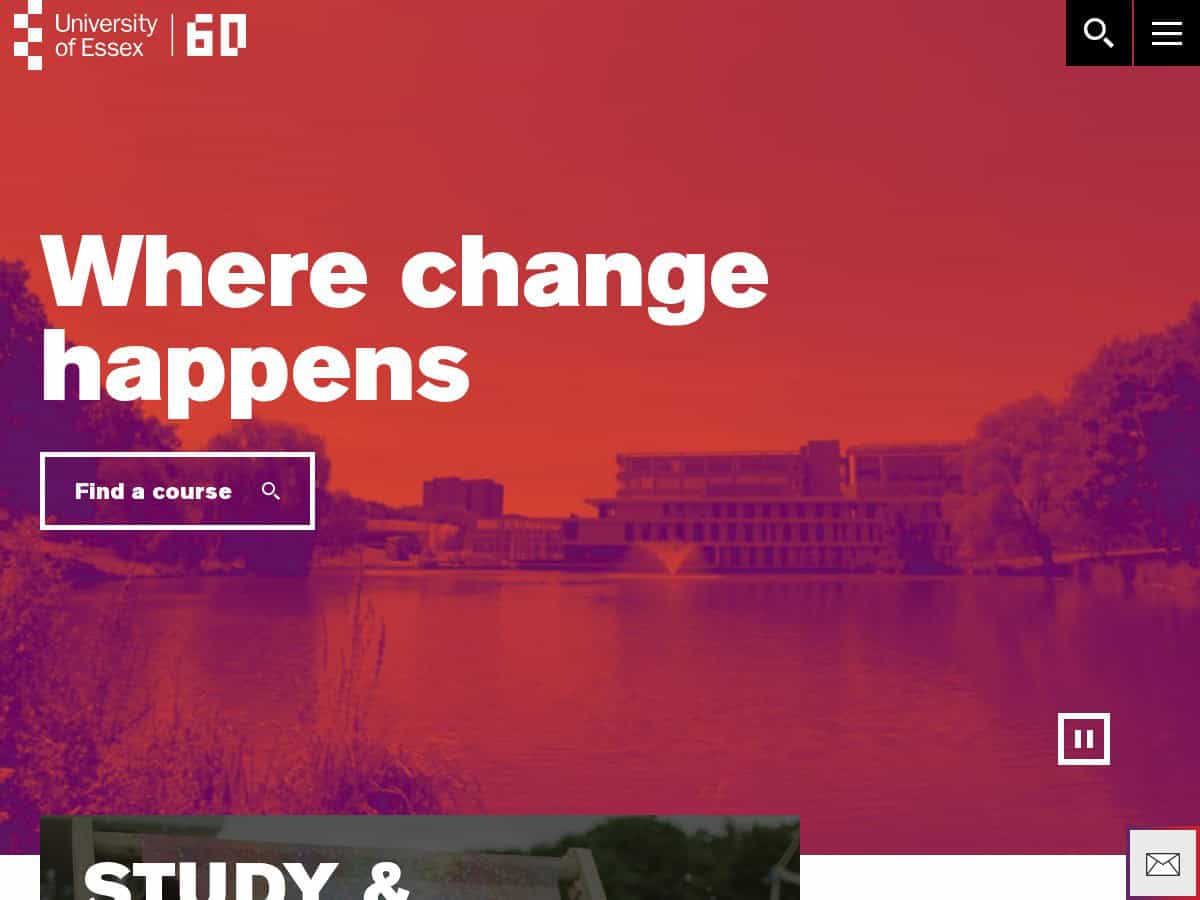
Campus location is outside Colchester town centre, some find the 1960s architecture unappealing.
Best For
Students passionate about social sciences, human rights, or data analytics and AI, at a research-led university with a global perspective and strong analytical focus.
*our own picks (our criteria: a mix between domains, diploma delivered, reputation and size), but obviously too many criteria for an apple-to-apple ranking.
FAQ
When did Essex begin teaching?
The first 122 students arrived in 1964, in the year the university opened. Sir Albert Sloman was the first Vice-Chancellor.
How many campuses does Essex have?
Three campuses existed in Colchester, Southend-on-Sea and Loughton, but the Southend Campus was scheduled to close at the end of August 2026. Its courses are moving to Colchester.
Which faculties does Essex have?
There are three: arts and humanities, science and health, and social sciences. Departments sit within these faculties.
What is the Human Rights Centre?
It is an interdisciplinary research and education centre at Essex that runs a student clinic, competitions and Human Rights Week events. It has received a Queen's Anniversary Prize.
Where can I read about research at Essex?
The research pages of the university website list its research areas and groups. They are the best starting point for supervisors and topics.
Where is the main campus?
The main site is the Colchester Campus. Applicants can check the website for travel and accommodation details.
Artificial Intelligence (AI), Social Engineering, Sustainable Development, User experience (UX)
*: without any judgment of the quality, readers are strongly encouraged to check the official status of the exact diploma envisioned as many universities have a mix of recognized diplomas, not recognized, “co-delivered,” “equivalent to”, “some pathways” (…), can change over time, and can be named differently from one country to another.
**: international reputation: is based on some criteria that do not mean much in some domains or specialties (number of researchers, of scientific publications, on budget ….). Our approximate 1-4 scale:
known locally
known locally and internationally
is listed in some of the world university’s classifications
is listed among the 20 firsts in some of world university’s classifications
***: estimated numbers, based on online sources and/or feedbacks. The numbers can vary greatly depending on school organisation (ex.: school is part of a group, it employs internal staff or external consultants or has public staff without employing them …). Refer to all the links provided to have accurate and updated numbers.
Innovation.world is not affiliated with this school/university. We recommend to contact them directly on their website for any special request.
To complete or correct any information here or share your opinion, please comment below or > send us a direct message <.