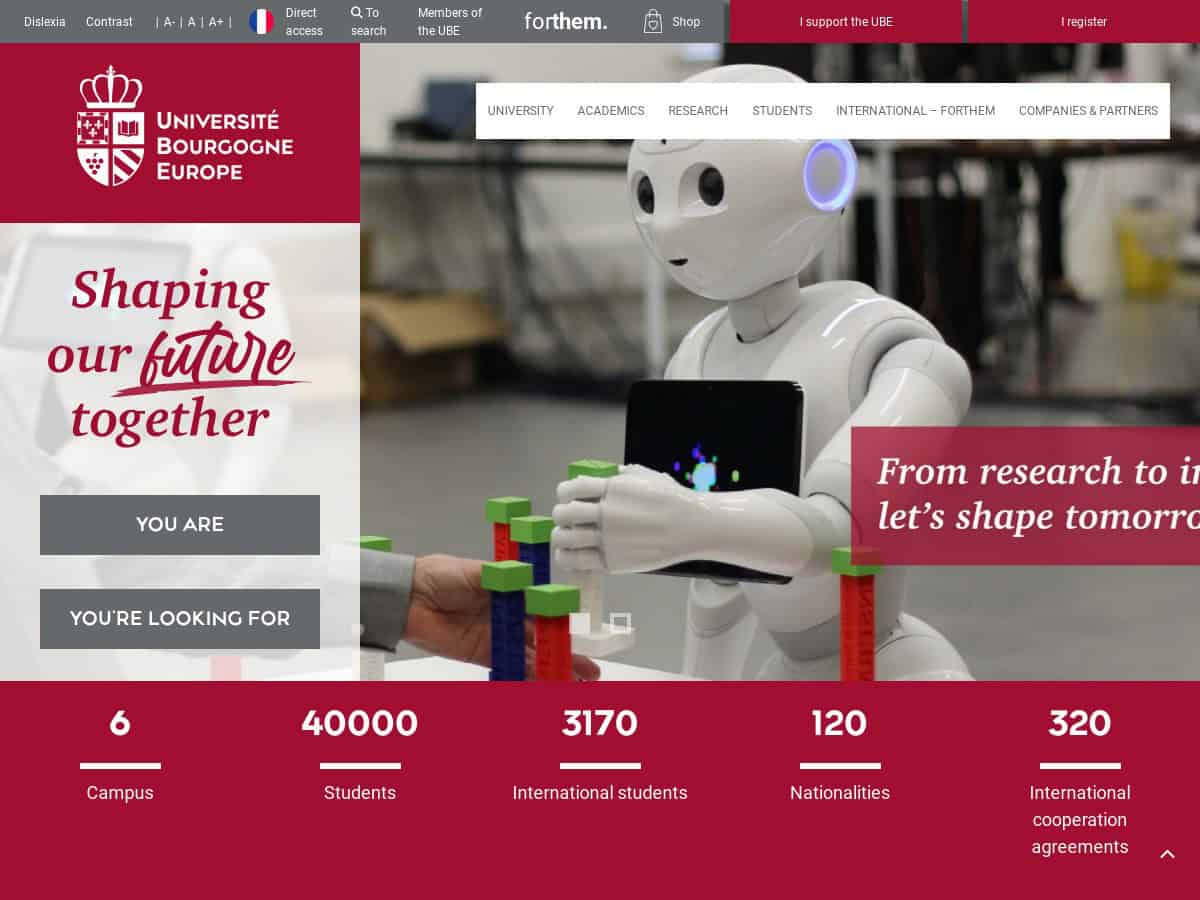
Founded in 1722 with a faculty of law as its only teaching unit, the university in Dijon has changed names more than once. It was called the University of Dijon until the 1980s, took the name Université de Bourgogne in 1984 and now operates as Université Bourgogne Europe. Dijon, in the Burgundy region of eastern France, remains its historic home.
The foundation was created by royal authorisation, and the original charter covered law alone. Teaching in the sciences and letters came later: a faculty of science followed in 1809 and a faculty of letters in 1810 alongside the law faculty, which gave the institution the broader shape of a university and set the pattern for the multidisciplinary profile it keeps today.
The university is a public institution with teaching sites spread over six campuses in Burgundy: Dijon, Auxerre, Chalon-sur-Saône, Le Creusot, Mâcon and Nevers. In recent figures it counts about 33,000 students, among them more than 3,000 international students, and its courses run from the bachelor’s level up to the doctorate. This regional spread makes it a university of the whole Burgundy territory rather than of a single city.
Domains taught:
Aerospace, AI and Machine Learning, Automation, Bioengineering, Bioinformatics, Chemistry, Civil Engineering, Computer Vision, Data Analytics, Ecology and Sustainability, Electrical and Electronics, Engineering, Fluid Dynamics, Food Science, Geotechnics, Life Sciences, Manufacturing, Materials, Mathematics, Mechanical Engineering, Microbiology and Genetics, Nanotechnologies, Optics, Physics, Process Control, Robotics, Software Engineering, Statistics, Structural Engineering, Telecommunications, Thermodynamics
Diplomas*:
Bachelor, Doctor, Master
Status:
Public
Partnerships:
Part of FORTHEM European University Alliance. Regional partnerships, especially in agrifood and health sectors.
Research:
Advanced materials, Food and wine sciences, Photonics, Health and molecular imaging, Environmental sciences.
Famous Alumnis:
Gustave Eiffel (born in Dijon, links to region)
International recognition**:
Number of staff***:
2500
Current students***:
34000
Foreign students***:
10%
Cumulative former students***:
N/A
Pros
Comprehensive university in a historic region known for gastronomy and wine, growing research in specific areas.
Cons
Some facilities may be older, less international visibility compared to larger metropolitan universities.
Best For
Multidisciplinary university with strengths in materials science, food science, and health.
Université de Lorraine is a public university in the Grand Est region whose listed strengths include materials science and engineering and computer science and automation.
Université de Poitiers, a public university in Nouvelle-Aquitaine, combines engineering in mechanics, energy and materials with chemistry.
Université Clermont Auvergne is another public multidisciplinary university, centred on physics and materials science and on chemistry and chemical engineering.
Université de Rennes, in Brittany, pairs computer science and cybersecurity with materials science, as a public university of comparable breadth.
Université Savoie Mont Blanc is a public university in the Auvergne-Rhône-Alpes region, with mountain environment engineering and mechatronics among its specialities.
Most Similar Schools Abroad
Universität Hohenheim in Germany is a public university whose listed fields include food science and biotechnology, echoing the food-related side of the Burgundy profile.
Universität Bayreuth, also in Germany, is a public university known in the directory for polymer and materials science and for ecology research.
Jiangnan University in China is a public university in Jiangsu with food science and engineering and biotechnology among its main areas.
Anhui University, a public Chinese university, lists computer science and materials science and engineering alongside physics.
Niigata University in Japan is a public university whose directory profile includes engineering and agricultural sciences, a mix of applied fields.
*our own picks (our criteria: a mix between domains, diploma delivered, reputation and size), but obviously too many criteria for an apple-to-apple ranking.
FAQ
When was the university established and how has its name changed?
It was established in 1722 with a faculty of law. It was known as the University of Dijon until the 1980s, then as the Université de Bourgogne from 1984, and it now uses the name Université Bourgogne Europe.
Which subjects could students take in the beginning?
Only law was authorised when the university opened in 1722. Faculties of science and letters were added in the early nineteenth century, so the range of disciplines grew gradually over the following decades.
Where are the teaching sites located?
The university operates six campuses in Burgundy, in Dijon, Auxerre, Chalon-sur-Saône, Le Creusot, Mâcon and Nevers. The Dijon site is the historic centre, and the others bring higher education to smaller towns of the region.
How large is the student body?
Recent figures show about 33,000 students. More than 3,000 of them come from abroad, which is a meaningful share for a regional French university.
What levels of study are offered?
Programmes are available from the bachelor's degree through the master's to doctoral studies. Applicants can consult the English-language section of the university's official website for the list of courses open to international students.
Where in France is the university?
It is based in Dijon, in the Burgundy part of eastern France. Students and researchers planning a stay should check the official website for practical information on fees, admission calendars and accommodation.
*: without any judgment of the quality, readers are strongly encouraged to check the official status of the exact diploma envisioned as many universities have a mix of recognized diplomas, not recognized, “co-delivered,” “equivalent to”, “some pathways” (…), can change over time, and can be named differently from one country to another.
**: international reputation: is based on some criteria that do not mean much in some domains or specialties (number of researchers, of scientific publications, on budget ….). Our approximate 1-4 scale:
known locally
known locally and internationally
is listed in some of the world university’s classifications
is listed among the 20 firsts in some of world university’s classifications
***: estimated numbers, based on online sources and/or feedbacks. The numbers can vary greatly depending on school organisation (ex.: school is part of a group, it employs internal staff or external consultants or has public staff without employing them …). Refer to all the links provided to have accurate and updated numbers.
Innovation.world is not affiliated with this school/university. We recommend to contact them directly on their website for any special request.
To complete or correct any information here or share your opinion, please comment below or > send us a direct message <.