Physics & Mathematics, Chemistry & Geosciences, Life Sciences & Bioinformatics
The University of Cologne (Universität zu Köln) was founded in 1388 as a municipal university in the Rhineland city of Cologne in North Rhine-Westphalia. The charter was signed that year, and the institution describes itself today as one of the largest universities in Europe.
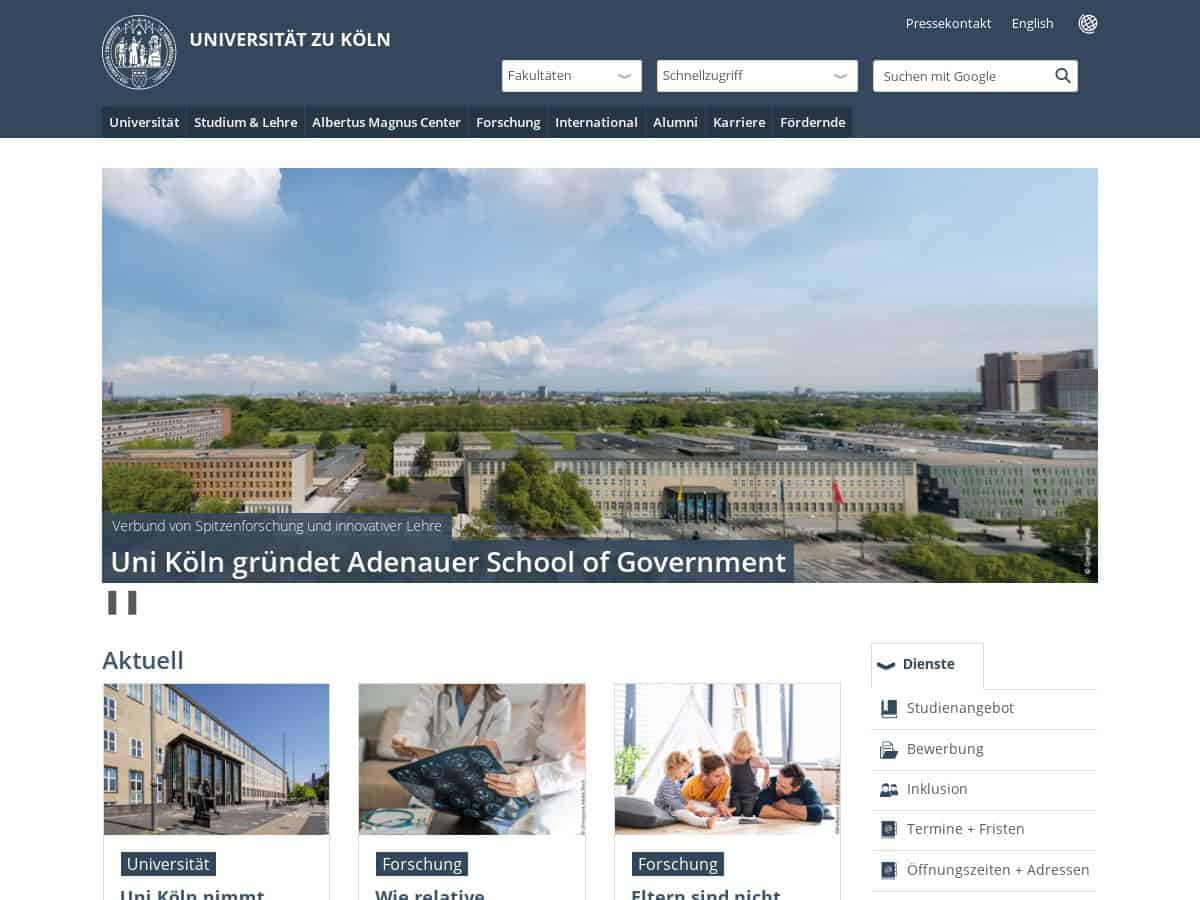
Its first period ended in 1798, when the French abolished it after occupying Cologne. The university was refounded in 1919 as an autonomous, state-supported institution, and Konrad Adenauer, then the city’s lord mayor, signed the new charter on 29 May 1919. The Adenauer School of Government, announced in June 2025, is among its newer institutions.
The university is organised in six faculties: Management, Economics and Social Sciences; Law; Medicine; Arts and Humanities; Mathematics and Natural Sciences; and Human Sciences. It also runs a Center for Teacher Education. Subject areas run from archaeology, history, philosophy and languages to business, law, medicine, psychology, mathematics, physics, chemistry and the geosciences. About 45,000 students were enrolled in the winter semester 2023/24, and the university belongs to the German U15 association of large research-intensive universities.
Domains taught:
AI and Machine Learning, Astroscience, Bioengineering, Bioinformatics, Chemistry, Computer Vision, Data Analytics, Ecology and Sustainability, Fluid Dynamics, Geotechnics, Life Sciences, Manufacturing, Materials, Mathematics, Mechanical Engineering, Microbiology and Genetics, Nanotechnologies, Optics, Physics, Process Control, Signal Processing, Software Engineering, Statistics, Structural Engineering, Telecommunications, Thermodynamics
Diplomas*:
Bachelor, Doctor, Master
Status:
Public
Partnerships:
Member of German U15. Strong research in specific areas like aging research, quantum matter, and plant sciences.
Research:
Quantum matter and materials, Aging research and cellular stress responses, Plant sciences and sustainable agriculture, Theoretical physics and cosmology.
Famous Alumnis:
Kurt Alder (Nobel laureate), Peter Grünberg (Nobel laureate, alumnus)
International recognition**:
Number of staff***:
8000
Current students***:
48000
Foreign students***:
10%
Cumulative former students***:
N/A
Pros
Historic and large comprehensive university, strong in basic sciences, located in a major city.
Cons
Engineering faculties are not its primary focus.
Best For
Large historic university with strong programs in physics, mathematics, chemistry, and life sciences.
Heinrich Heine University Düsseldorf, a public university in Düsseldorf, shares Cologne's combination of medicine, law, business and economics with natural sciences and humanities.
Johann Wolfgang Goethe-Universität Frankfurt am Main is a public university in Frankfurt with physics and geosciences, biosciences and chemistry, and computer science and mathematics.
Universität Hamburg offers climate and earth system science, physics and nanoscience, and informatics and data science as a public university in Hamburg.
In Berlin, Freie Universität Berlin is public and teaches physics and chemistry, life sciences, and mathematics and computer science.
Johannes Gutenberg University Mainz, public and based in Mainz, ranges from theology, law and economics to university medicine, philosophy and translation studies.
Most Similar Schools Abroad
Universiteit Leiden (Netherlands), a public university in Leiden, works across life sciences, natural sciences and data science.
Switzerland's Universität Zürich is public, sits in Zürich and is known in the directory for natural sciences, mathematics and computational science.
University of Helsinki, Finland: a public university in Helsinki with atmospheric science, life sciences and computer science.
Lund University is a public university in Lund, Sweden, covering engineering, law and medicine.
In Spain, the University of Barcelona is a public university in Barcelona spanning biology, chemistry, physics, mathematics, medicine and law.
*our own picks (our criteria: a mix between domains, diploma delivered, reputation and size), but obviously too many criteria for an apple-to-apple ranking.
FAQ
When was Cologne's university established?
The charter was signed in 1388, and the institution began as a municipal university run by the city. Its modern form dates from the refounding of 1919.
Why is there a gap in the university's history?
French forces occupied Cologne and the university was abolished in 1798. It was re-established in 1919 as an autonomous, state-supported institution.
What role did Konrad Adenauer play?
As lord mayor of Cologne he took part in the refounding, and he signed the new charter on 29 May 1919. The Adenauer School of Government, announced in June 2025, carries his name.
How is the university organised?
There are six faculties: Management, Economics and Social Sciences; Law; Medicine; Arts and Humanities; Mathematics and Natural Sciences; and Human Sciences. A Center for Teacher Education and the Adenauer School of Government stand alongside them.
How many students attend the University of Cologne?
About 45,000 students were enrolled in the winter semester 2023/24.
Which networks is the university part of?
It is a member of the German U15 association, a coalition of large research-intensive universities.
Where are the official admission details?
Degree-specific entry requirements, language rules and deadlines are published on uni-koeln.de, so the page of the programme concerned should be checked before applying.
Agriculture, Biology, Chemistry, Physics, Sustainable Development
*: without any judgment of the quality, readers are strongly encouraged to check the official status of the exact diploma envisioned as many universities have a mix of recognized diplomas, not recognized, “co-delivered,” “equivalent to”, “some pathways” (…), can change over time, and can be named differently from one country to another.
**: international reputation: is based on some criteria that do not mean much in some domains or specialties (number of researchers, of scientific publications, on budget ….). Our approximate 1-4 scale:
known locally
known locally and internationally
is listed in some of the world university’s classifications
is listed among the 20 firsts in some of world university’s classifications
***: estimated numbers, based on online sources and/or feedbacks. The numbers can vary greatly depending on school organisation (ex.: school is part of a group, it employs internal staff or external consultants or has public staff without employing them …). Refer to all the links provided to have accurate and updated numbers.
Innovation.world is not affiliated with this school/university. We recommend to contact them directly on their website for any special request.
To complete or correct any information here or share your opinion, please comment below or > send us a direct message <.