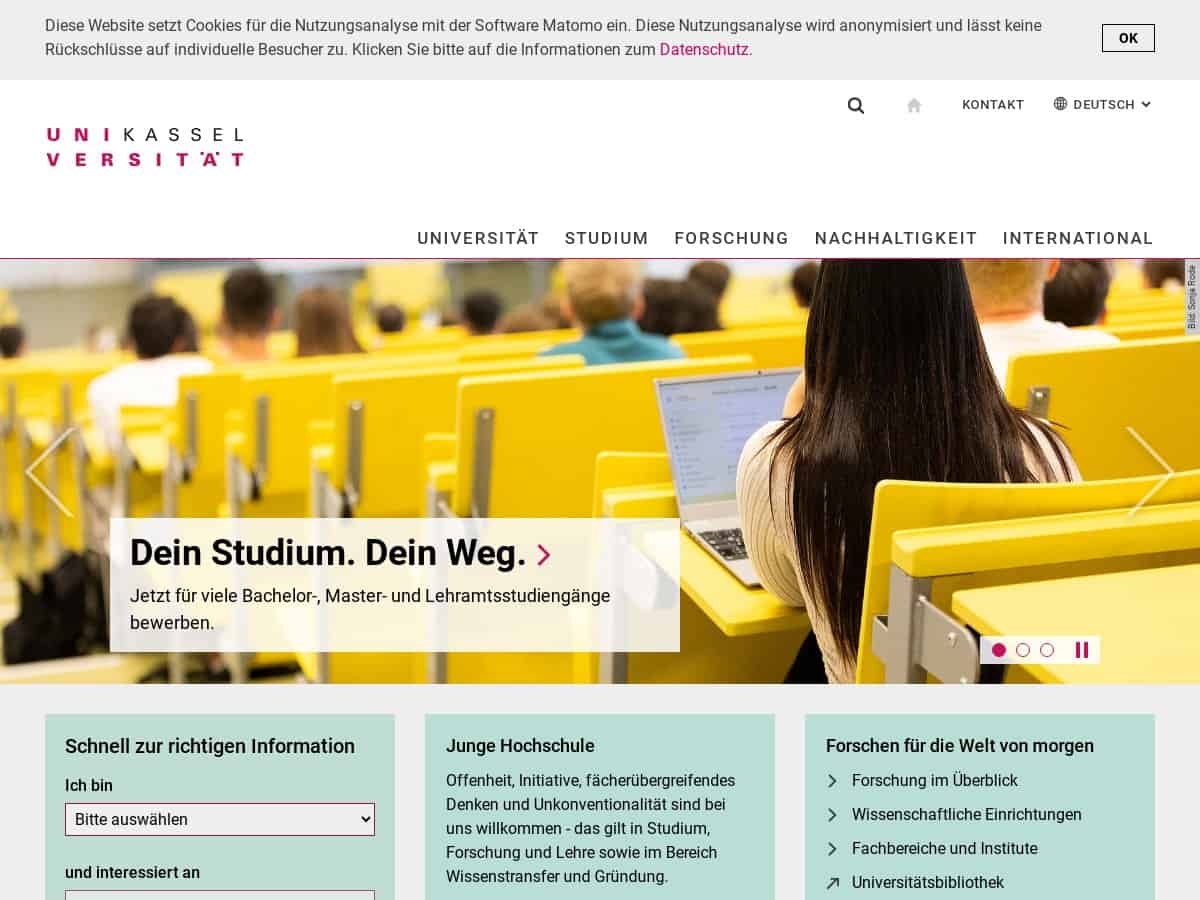
Founded in 1971, the University of Kassel is a public comprehensive university with a strong interdisciplinary approach, offering programs in engineering (mechanical, electrical, civil, environmental), computer science, natural sciences, agriculture, art, humanities, and social sciences.
Domains taught:
Aerospace, Agriculture, AI and Machine Learning, Astroscience, Automation, Bioengineering, Bioinformatics, Chemistry, Civil Engineering, Computer Vision, Data Analytics, Ecology and Sustainability, Electrical and Electronics, Engineering, Ergonomics and UX, Fluid Dynamics, Food Science, Geotechnics, Industrial Design, Life Sciences, Manufacturing, Materials, Mathematics, Mechanical Engineering, Microbiology and Genetics, Nanotechnologies, Optics, Physics, Process Control, Project Management, Robotics, Signal Processing, Software Engineering, Statistics, Structural Engineering, Telecommunications, Thermodynamics, Transportations
Diplomas*:
Bachelor, Doctor, Master
Status:
Public
Partnerships:
Strong focus on environmental science, renewable energies, and interdisciplinary research. Documenta art exhibition is hosted in Kassel.
Research:
Distributed energy systems and smart grids, Nanostructure science and technology, Ecological agriculture and environmental systems, Human-centered IT design and AI.
Famous Alumnis:
N/A
International recognition**:
Number of staff***:
2500
Current students***:
24000
Foreign students***:
10%
Cumulative former students***:
N/A
Pros
Interdisciplinary university with a strong focus on sustainability, renewable energy, and environmental engineering.
Cons
Comprehensive university, specific research strengths.
Best For
Comprehensive university with strong programs in environmental engineering, nanoscience, electrical and mechanical engineering.
*: without any judgment of the quality, readers are strongly encouraged to check the official status of the exact diploma envisioned as many universities have a mix of recognized diplomas, not recognized, “co-delivered,” “equivalent to”, “some pathways” (…), can change over time, and can be named differently from one country to another.
**: international reputation: is based on some criteria that do not mean much in some domains or specialties (number of researchers, of scientific publications, on budget ….). Our approximate 1-4 scale:
known locally
known locally and internationally
is listed in some of the world university’s classifications
is listed among the 20 firsts in some of world university’s classifications
***: estimated numbers, based on online sources and/or feedbacks. The numbers can vary greatly depending on school organisation (ex.: school is part of a group, it employs internal staff or external consultants or has public staff without employing them …). Refer to all the links provided to have accurate and updated numbers.
Innovation.world is not affiliated with this school/university. We recommend to contact them directly on their website for any special request.
To complete or correct any information here or share your opinion, please comment below or > send us a direct message <.