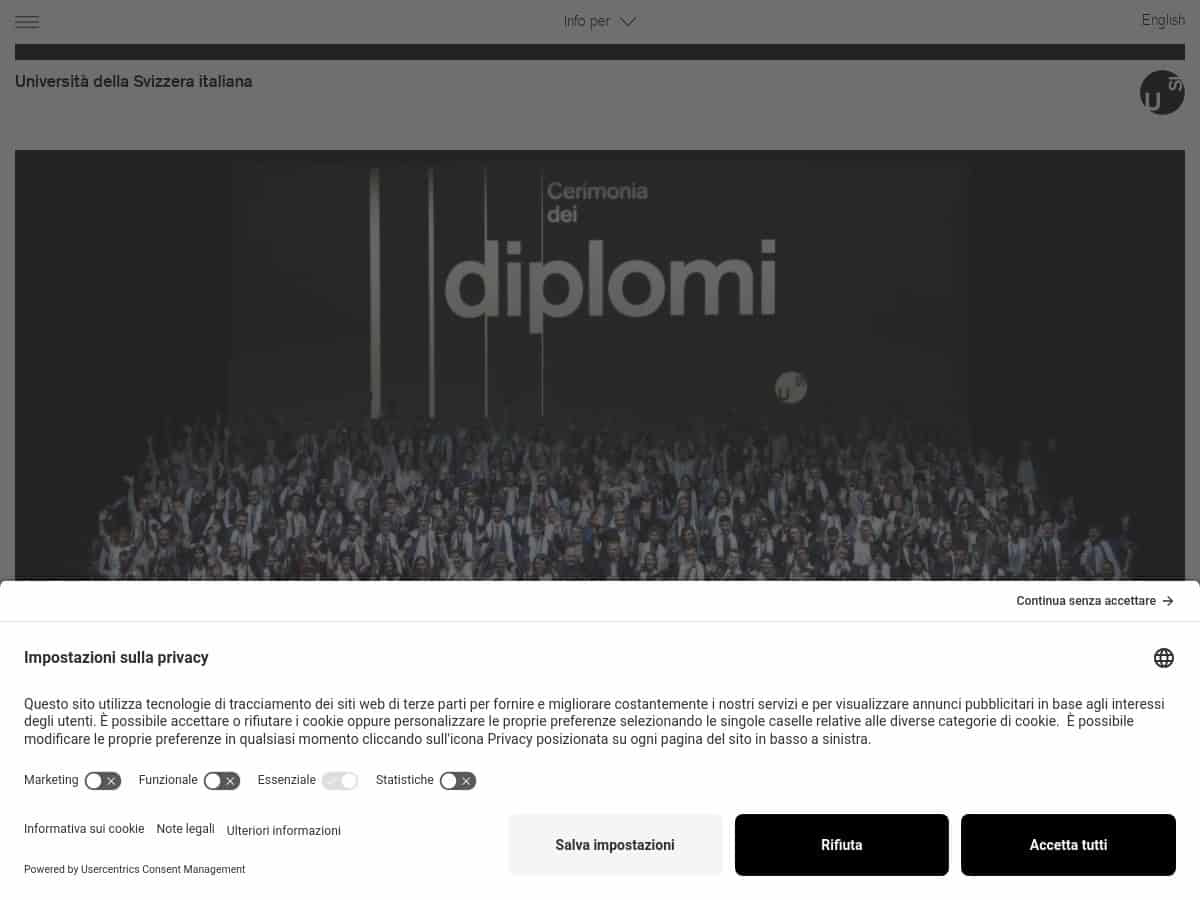
The University of Italian Switzerland, founded in 1996, is a public university with campuses in Lugano and Mendrisio. Its Faculty of Informatics and Faculty of Biomedical Sciences offer relevant programs. It also has an affiliated Faculty of Architecture.
The Università della Svizzera italiana, USI, is a public university founded in 1996, with campuses in Lugano and Mendrisio in the Italian-speaking canton of Ticino. It has about 3,500 students and 800 staff, and around 60 percent of the students come from abroad, which makes it one of the most international universities in Switzerland. The main site is in Lugano, at Via Buffi, in the city centre, with the lake and the mountains nearby, and the Academy of Architecture is in Mendrisio.
USI is small and organised in faculties of economics, communication sciences and media, informatics, architecture and, since 2020, biomedical sciences. The Faculty of Biomedical Sciences works with the Institute for Research in Biomedicine in Bellinzona and offers a master in medicine in cooperation with ETH Zurich. The Academy of Architecture, founded in 1996 by the architect Mario Botta, is known internationally for its design teaching and its studio culture.
The university has strong links with research centres in Lugano. The Swiss National Supercomputing Centre, run by ETH Zurich, is located in the city and cooperates with the informatics faculty. The Dalle Molle Institute for Artificial Intelligence, IDSIA, is a joint research institute of USI and the University of Applied Sciences of Southern Switzerland, and it is known for work on deep learning and neural networks. Communication and media studies are strong in Lugano, as are banking and finance programmes.
Tuition is higher than at most public Swiss universities, around 4,000 francs per year at present, and the university offers grants and scholarships. Check the current tariff. Teaching is in Italian and English, with many programmes in English. Admission requires a Swiss Matura or an equivalent, and foreign applicants must meet language and academic conditions.
Lugano is a small city at the foot of the Alps with a mild climate and Italian culture. Milan is about an hour by train, and the city is expensive but smaller than Zurich or Geneva.
Domains taught:
AI and Machine Learning, Bioengineering, Bioinformatics, Chemistry, Computer Vision, Data Analytics, Electrical and Electronics, Engineering, Fluid Dynamics, Materials, Mathematics, Mechanical Engineering, Nanotechnologies, Physics, Process Control, Project Management, Robotics, Signal Processing, Software Engineering, Statistics, Structural Engineering, Telecommunications, Thermodynamics
Diplomas*:
Bachelor, Doctor, Master
Status:
Public
Partnerships:
International university with a strong focus on interdisciplinary research. Numerous partnerships with universities and research institutions worldwide. Collaborations with local and international companies.
Research:
Research in areas such as artificial intelligence, software engineering, high-performance computing, computational science, data science, biomedical informatics, oncology, and immunology.
Famous Alumnis:
N/A
International recognition**:
Number of staff***:
800
Current students***:
3500
Foreign students***:
60%
Cumulative former students***:
15000
Pros
Young and dynamic university with a strong international character, focus on cutting-edge fields like AI and computational science. Bilingual (Italian/English).
Cons
Fewer traditional engineering disciplines.
Best For
Students interested in computer science, computational science, or biomedical sciences in an international, Italian-speaking environment.
In terms of fields, EPFL is the nearest neighbour, with bioinformatics, nanotechnologies and signal processing again at the core; it is far larger, with about 12,000 students against roughly 3,500 here, and is also a public institution.
For students who like the nanotechnologies, signal processing and fluid dynamics focus of this university but want another option nearby, Scuola universitaria professionale della Svizzera italiana fits well: it covers metrology and quality as well, and is slightly larger, at about 5,000 students against roughly 3,500 here.
Universität Basel overlaps with this institution on bioinformatics, nanotechnologies and signal processing, so the two are easy to compare, and it covers astroscience and microbiology and genetics as well, and is far larger, with about 13,000 students against roughly 3,500 here.
The comparison with Eidgenössische Technische Hochschule Zürich is straightforward on subjects, since both focus on bioinformatics, nanotechnologies and signal processing, and it is also a public institution, and runs the same bachelor's, master's and doctoral programmes.
SUPSI Dipartimento tecnologie innovative works in much the same fields, chiefly nanotechnologies, signal processing and fluid dynamics, and it is also a public institution and does not run the doctoral programmes found here.
Most Similar Schools Abroad
Looking internationally, Technische Universiteit Eindhoven in the Netherlands is where bioinformatics, nanotechnologies and fluid dynamics get a comparable treatment; it covers optics and industrial design as well, and is far larger, with about 14,000 students against roughly 3,500 here.
A foreign alternative with a similar emphasis on bioinformatics, nanotechnologies and signal processing is École Normale Supérieure Paris-Saclay in France, and it is also a public institution, and runs the same bachelor's, master's and doctoral programmes.
X - École Polytechnique (France) works on the same fields as this university, chiefly bioinformatics, nanotechnologies and fluid dynamics; it is slightly larger, at about 4,600 students against roughly 3,500 here, and is also a public institution.
The closest overseas parallel on bioinformatics, nanotechnologies and signal processing is Tokyo University of Agriculture and Technology, located in Japan; it covers agriculture and food science as well, and is larger, enrolling about 6,000 students against roughly 3,500 here.
Seen from abroad, ShanghaiTech University (China) is a close relative on subject matter, since bioinformatics, nanotechnologies and signal processing are central to both, and it is also a public institution, and runs the same bachelor's, master's and doctoral programmes.
*our own picks (our criteria: a mix between domains, diploma delivered, reputation and size), but obviously too many criteria for an apple-to-apple ranking.
FAQ
Where is USI?
The main site is at Via Buffi 13 in Lugano, Switzerland. The Academy of Architecture is in Mendrisio.
When was it founded?
In 1996.
How large is it?
About 3,500 students and 800 staff, with around 60 percent of students from abroad.
What are its faculties?
Economics, communication sciences and media, informatics, architecture and biomedical sciences.
Who founded the Academy of Architecture?
The architect Mario Botta was a founder of the Academy in Mendrisio.
What is IDSIA?
The Dalle Molle Institute for Artificial Intelligence, a joint research institute of USI and the University of Applied Sciences of Southern Switzerland.
What is the Swiss National Supercomputing Centre?
A centre run by ETH Zurich and located in Lugano.
What does it cost?
Tuition is higher than at most public Swiss universities, around 4,000 francs per year at present. Check the current tariff and scholarships.
In which language are courses taught?
Italian and English, with many programmes in English.
*: without any judgment of the quality, readers are strongly encouraged to check the official status of the exact diploma envisioned as many universities have a mix of recognized diplomas, not recognized, “co-delivered,” “equivalent to”, “some pathways” (…), can change over time, and can be named differently from one country to another.
**: international reputation: is based on some criteria that do not mean much in some domains or specialties (number of researchers, of scientific publications, on budget ….). Our approximate 1-4 scale:
known locally
known locally and internationally
is listed in some of the world university’s classifications
is listed among the 20 firsts in some of world university’s classifications
***: estimated numbers, based on online sources and/or feedbacks. The numbers can vary greatly depending on school organisation (ex.: school is part of a group, it employs internal staff or external consultants or has public staff without employing them …). Refer to all the links provided to have accurate and updated numbers.
Innovation.world is not affiliated with this school/university. We recommend to contact them directly on their website for any special request.
To complete or correct any information here or share your opinion, please comment below or > send us a direct message <.