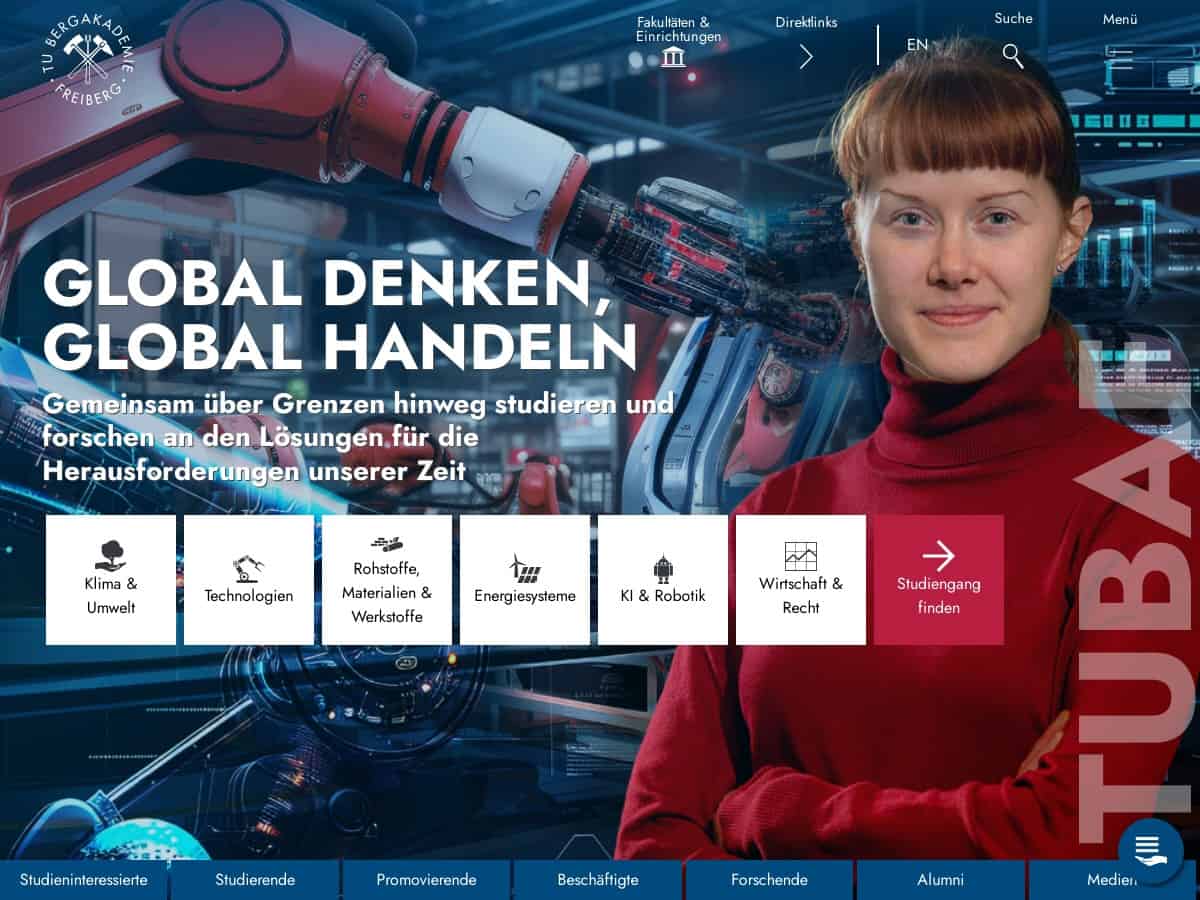
The Bergakademie in Freiberg, in Saxony, Germany, was founded in 1765 and is today known as Technische Universität Bergakademie Freiberg, or TU Freiberg. The university holds the title of a technical university and keeps the word Bergakademie, meaning mining academy, in its official name.
The university has six faculties, covering subjects from mathematics and computer science to geosciences, materials and energy engineering and business, so mining and geoscience students study in the same university as materials, energy and process engineers. Its research is centred on raw materials, energy and recycling.
In 1885 Mary Hegeler became the first woman to enrol at the academy. The directory profile lists geosciences and mining engineering, materials science and metallurgy, and energy and environmental engineering as main areas. Applicants should check the official website for current programmes, admission requirements and fees, which are revised for each intake.
Domains taught:
AI and Machine Learning, Automation, Chemistry, Civil Engineering, Computer Vision, Data Analytics, Ecology and Sustainability, Electrical and Electronics, Engineering, Fluid Dynamics, Geotechnics, Industrial Design, Life Sciences, Manufacturing, Materials, Mathematics, Mechanical Engineering, Microbiology and Genetics, Nanotechnologies, Optics, Physics, Process Control, Project Management, Robotics, Software Engineering, Statistics, Structural Engineering, Telecommunications, Thermodynamics
Diplomas*:
Bachelor, Doctor, Master
Status:
Public
Partnerships:
World’s oldest mining university. Strong international collaborations in geosciences and resource engineering.
Ruhr-Universität Bochum, in Bochum, lists materials science and engineering, IT security and computer science, and mechanical and civil engineering.
Universität des Saarlandes, in Saarbrücken, covers computer science, materials science and engineering, and systems engineering.
Universität Bayreuth, in Bayreuth, adds polymer and materials science to ecology and environmental research.
Universität Bremen, in Bremen, lists marine and environmental sciences alongside materials science and production engineering.
Leibniz Universität Hannover, in Hannover, includes mechanical engineering, civil engineering and geodesy.
Most Similar Schools Abroad
China University of Mining and Technology in China lists mining engineering, safety science and surveying.
Saint Petersburg Mining University, in Russia, covers mining engineering, geology and oil and gas engineering.
University of Nevada, Reno in the United States includes earthquake and mining engineering.
Swansea University, in the United Kingdom, combines engineering with materials science.
Université de Lorraine in France lists materials science and engineering, automation, and chemical and process engineering.
*our own picks (our criteria: a mix between domains, diploma delivered, reputation and size), but obviously too many criteria for an apple-to-apple ranking.
FAQ
When was the Bergakademie in Freiberg founded?
It was founded in 1765 in Freiberg, Saxony. The university's history pages give a list of milestones since then.
How is the official name of the university written?
Its full name is Technische Universität Bergakademie Freiberg. The word Bergakademie recalls its origin as a mining academy.
Which faculties does the university have?
It has six faculties, covering subjects from mathematics and computer science and chemistry to geosciences, engineering, materials science and business. The website lists their institutes.
How old is the academy compared with other mining universities?
Britannica describes the Freiberg Mining Academy, opened in 1765, as the oldest of its kind in the world. The university's history pages give its milestones.
What research topics define the university?
Research concentrates on raw materials, energy and recycling. Further details are on the university's research pages.
Who was the first woman at the academy?
Mary Hegeler enrolled in 1885 and is recorded as its first female student. The university's milestone pages mention her.
*: without any judgment of the quality, readers are strongly encouraged to check the official status of the exact diploma envisioned as many universities have a mix of recognized diplomas, not recognized, “co-delivered,” “equivalent to”, “some pathways” (…), can change over time, and can be named differently from one country to another.
**: international reputation: is based on some criteria that do not mean much in some domains or specialties (number of researchers, of scientific publications, on budget ….). Our approximate 1-4 scale:
known locally
known locally and internationally
is listed in some of the world university’s classifications
is listed among the 20 firsts in some of world university’s classifications
***: estimated numbers, based on online sources and/or feedbacks. The numbers can vary greatly depending on school organisation (ex.: school is part of a group, it employs internal staff or external consultants or has public staff without employing them …). Refer to all the links provided to have accurate and updated numbers.
Innovation.world is not affiliated with this school/university. We recommend to contact them directly on their website for any special request.
To complete or correct any information here or share your opinion, please comment below or > send us a direct message <.