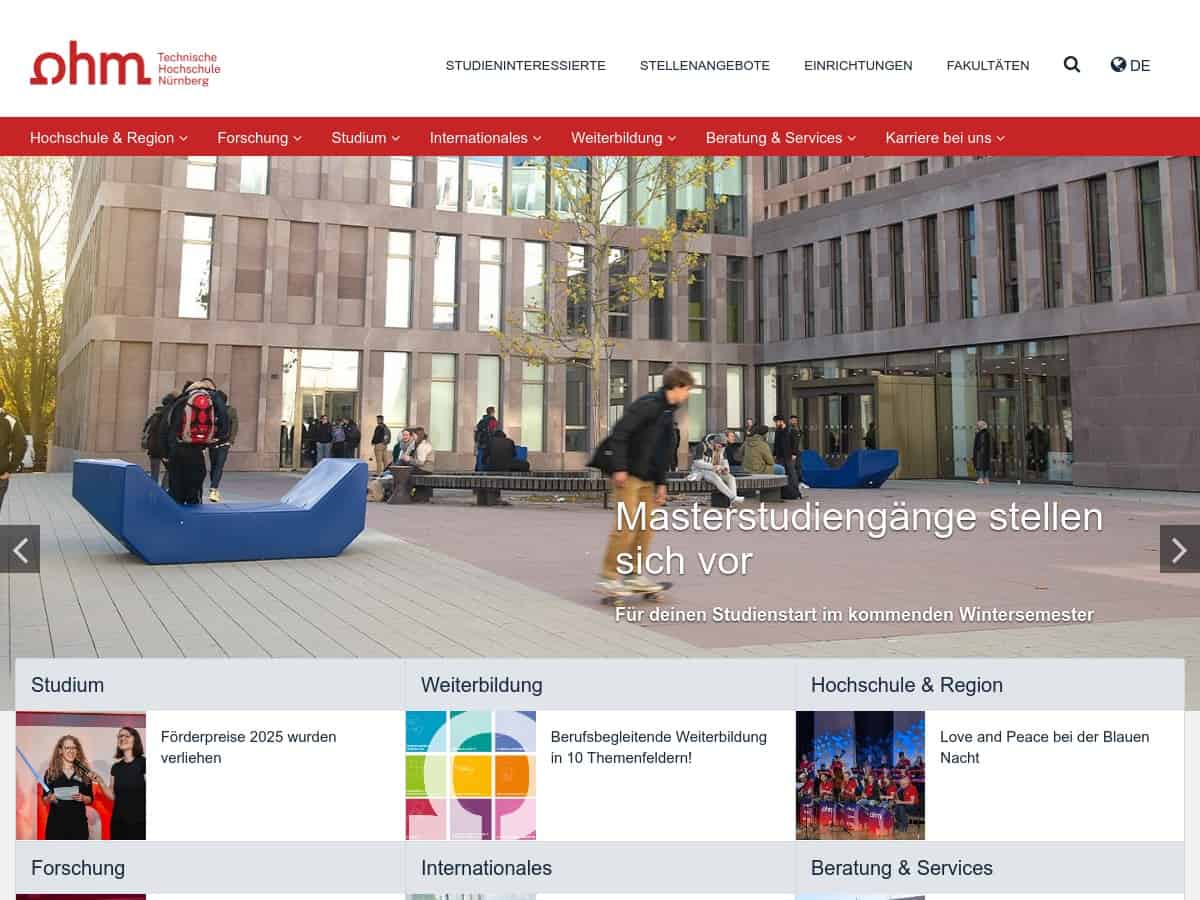
Nuremberg’s Technische Hochschule Nürnberg Georg Simon Ohm, commonly shortened to TH Nürnberg or simply the Ohm, carries the name of the physicist Georg Simon Ohm, who taught at one of its predecessor institutions and led it from 1839. The roots of the school go back to the Städtische Polytechnische Schule founded in Nuremberg in 1823.
The present institution was established in 1971. Over the years its title changed from Georg-Simon-Ohm-Fachhochschule to Georg-Simon-Ohm-Hochschule in 2007 and to its current Technische Hochschule designation in 2013. The main campus is at Keßlerplatz in Nuremberg.
Its faculties include Applied Chemistry, Architecture, Business Administration, Civil Engineering, Computer Science, Design, Process Engineering, Materials Engineering and Social Sciences. More than 12,000 students study there.
Domains taught:
Aerospace, AI and Machine Learning, Automation, Bioengineering, Bioinformatics, Chemistry, Civil Engineering, Computer Vision, Data Analytics, Ecology and Sustainability, Electrical and Electronics, Engineering, Ergonomics and UX, Fluid Dynamics, Industrial Design, Life Sciences, Manufacturing, Materials, Mathematics, Mechanical Engineering, Metrology, Optics, Physics, Process Control, Project Management, Quality, Robotics, Signal Processing, Software Engineering, Sound Engineering, Statistics, Structural Engineering, Telecommunications, Thermodynamics, Transportations
Diplomas*:
Bachelor, Master, MBA
Status:
Public
Partnerships:
One of the largest universities of applied sciences in Bavaria. Strong regional industry links in Nuremberg metropolitan area.
Research:
Automation and robotics, Energy technology and e-mobility, Software engineering and AI, Materials science and manufacturing.
Famous Alumnis:
N/A
International recognition**:
Number of staff***:
800
Current students***:
13000
Foreign students***:
10%
Cumulative former students***:
N/A
Pros
Wide range of applied engineering and IT programs, strong practical orientation, good career prospects in a major industrial region.
Cons
Focus on applied sciences.
Best For
Large university of applied sciences with diverse programs in engineering, IT, and applied sciences.
Ostbayerische Technische Hochschule Regensburg, in Regensburg, lists Mechanical Engineering & Automotive and Electrical Engineering & Information Technology, much like the Nuremberg profile.
Hochschule München University of Applied Sciences in München adds Computer Science & Geoinformatics to a similar engineering core.
Technische Hochschule Ingolstadt (Ingolstadt) is focused on Automotive Engineering & Mobility Systems besides Mechanical Engineering & Production Technology.
Mechanical Engineering & Mechatronics comes first among the specialties of Technische Hochschule Augsburg, located in Augsburg.
Technische Hochschule Deggendorf in Deggendorf is listed for Mechatronics & Cyber-Physical Systems and Electrical Engineering & Information Technology.
Most Similar Schools Abroad
France: INSA Rennes, based in Rennes, covers Electronics & Telecommunications.
In Troyes, Université de Technologie de Troyes is listed for Materials Science & Mechanical Systems, a second French institution with an engineering focus.
Hefei University of Technology in Hefei, China, lists Mechanical Engineering and Automotive Engineering among its main specialties.
A second Chinese comparison, Shenyang University of Technology in Shenyang, has Electrical Engineering & Automation first in its list.
In the United States, California Polytechnic State University, San Luis Obispo in San Luis Obispo lists Engineering, Architecture and Agriculture.
*our own picks (our criteria: a mix between domains, diploma delivered, reputation and size), but obviously too many criteria for an apple-to-apple ranking.
FAQ
Who was Georg Simon Ohm and why does the school carry his name?
Ohm was a physicist who taught at a Nuremberg polytechnic school that is a predecessor of today's institution and headed it from 1839. The university adopted his name in honour of that connection.
When was TH Nürnberg established?
It was established in 1971. Its oldest precursor, the Städtische Polytechnische Schule, dates from 1823.
How did the official name develop?
The first name was Georg-Simon-Ohm-Fachhochschule Nürnberg. It became a Hochschule in 2007 and received the Technische Hochschule title in 2013.
Where is the main campus?
The core site is Keßlerplatz in Nuremberg. Further university offices are located at other addresses in the city.
Which subject areas are offered?
Faculties cover applied chemistry, architecture, business administration, civil engineering, computer science, design, process engineering, materials engineering and social sciences. Electrical, mechanical and mathematical fields complete the range.
*: without any judgment of the quality, readers are strongly encouraged to check the official status of the exact diploma envisioned as many universities have a mix of recognized diplomas, not recognized, “co-delivered,” “equivalent to”, “some pathways” (…), can change over time, and can be named differently from one country to another.
**: international reputation: is based on some criteria that do not mean much in some domains or specialties (number of researchers, of scientific publications, on budget ….). Our approximate 1-4 scale:
known locally
known locally and internationally
is listed in some of the world university’s classifications
is listed among the 20 firsts in some of world university’s classifications
***: estimated numbers, based on online sources and/or feedbacks. The numbers can vary greatly depending on school organisation (ex.: school is part of a group, it employs internal staff or external consultants or has public staff without employing them …). Refer to all the links provided to have accurate and updated numbers.
Innovation.world is not affiliated with this school/university. We recommend to contact them directly on their website for any special request.
To complete or correct any information here or share your opinion, please comment below or > send us a direct message <.