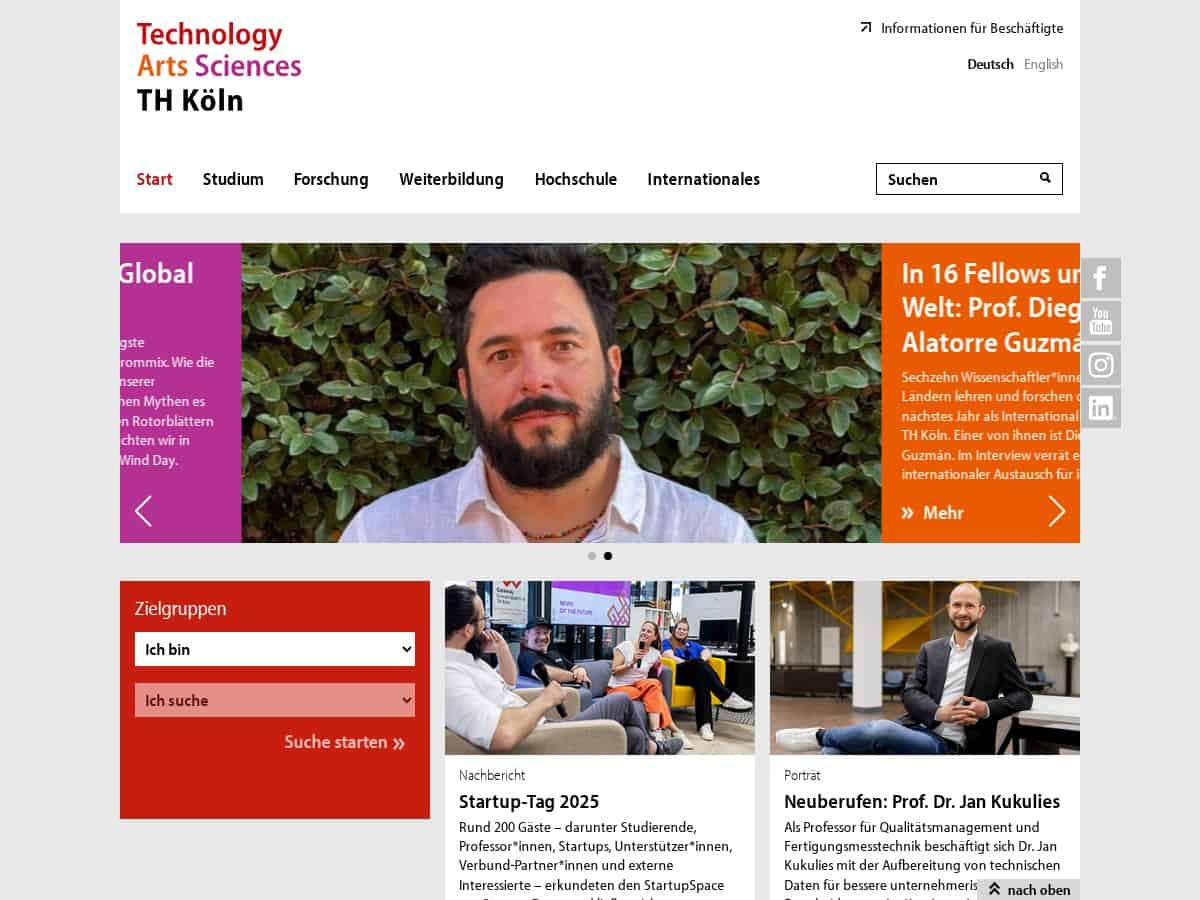
Automotive Engineering & Production, Computer Science & Media Technology, Renewable Energy Engineering
Known as Fachhochschule Köln until September 2015, TH Köln was founded in 1971 through the merger of several predecessor institutions. It is a university of applied sciences in Cologne, in North Rhine-Westphalia, and it also teaches in Gummersbach and Leverkusen.
It has twelve faculties: Applied Social Sciences; Cultural Sciences; Information Science and Communication Studies; Business, Economics and Law; Architecture; Civil Engineering and Environmental Technology; Information, Media and Electrical Engineering; Automotive Systems and Production; Process Engineering, Energy and Mechanical Systems; Computer Science and Engineering Science; Applied Natural Sciences; and Spatial Development and Infrastructure Systems. Campus Südstadt and the Deutz campus are the main Cologne locations, with further sites in Mülheim, Gummersbach and Leverkusen.
Automotive engineering and production, computer science and media technology, and renewable energy engineering are the specialities listed for it in this directory. Among its units is the Institute for Technology and Resources Management in the Tropics and Subtropics. More than 20,000 students study at the institution.
Domains taught:
Aerospace, AI and Machine Learning, Automation, Bioengineering, Bioinformatics, Chemistry, Civil Engineering, Computer Vision, Data Analytics, Ecology and Sustainability, Electrical and Electronics, Engineering, Ergonomics and UX, Fluid Dynamics, Food Science, Geotechnics, Industrial Design, Life Sciences, Logistics, Manufacturing, Materials, Mathematics, Mechanical Engineering, Metrology, Nanotechnologies, Optics, Physics, Process Control, Project Management, Quality, Robotics, Signal Processing, Software Engineering, Sound Engineering, Statistics, Structural Engineering, Telecommunications, Thermodynamics, Transportations
Diplomas*:
Bachelor, Doctor, Master
Status:
Public
Partnerships:
Germany’s largest university of applied sciences. Strong emphasis on applied research and internationalization.
Research:
Vehicle technology and e-mobility, AI and data science, Renewable energy and smart grids, Media technology and game development (technical aspects), Process engineering.
Famous Alumnis:
N/A
International recognition**:
Number of staff***:
1000
Current students***:
26000
Foreign students***:
20%
Cumulative former students***:
N/A
Pros
Very wide range of applied programs, strong practical orientation, located in Cologne, good industry links.
Cons
Very large institution, focus on applied sciences.
Best For
Germany’s largest university of applied sciences, offering diverse programs in engineering, IT, and applied sciences.
Bergische Universität Wuppertal teaches mechanical and safety engineering with electrical engineering, a technical profile comparable to Cologne's and also in North Rhine-Westphalia.
Technische Universität Dortmund stresses production and logistics, chemical and bioengineering and computer science, another technical institution in North Rhine-Westphalia.
Leibniz Universität Hannover lists mechanical engineering, civil engineering and geodesy, and electrical engineering, a spread similar to Cologne's engineering faculties.
Technische Universität Berlin combines mechanical engineering, computer science and electrical engineering, overlapping with Cologne's engineering and computer science faculties.
In Switzerland, Fachhochschule Nordwestschweiz lists engineering, life sciences, architecture and civil engineering at an applied-sciences institution.
In Finland, Turku University of Applied Sciences teaches information technology, mechanical engineering and life sciences.
In Norway, Western Norway University of Applied Sciences covers engineering, teacher education, health and social sciences in an applied-sciences setting.
In Ireland, Dundalk Institute of Technology offers engineering, health sciences and creative media.
*our own picks (our criteria: a mix between domains, diploma delivered, reputation and size), but obviously too many criteria for an apple-to-apple ranking.
FAQ
What was TH Köln called before 2015?
It was Fachhochschule Köln until it was renamed in September 2015.
When was it founded?
It was founded in 1971 through the merger of several predecessor institutions.
Where does it teach?
Campus Südstadt and the Deutz campus are in Cologne, with further sites in Mülheim, Gummersbach and Leverkusen.
Into how many faculties is it divided?
There are twelve, from Applied Social Sciences and Architecture to Automotive Systems and Production, Computer Science and Engineering Science, and Applied Natural Sciences.
Which engineering fields are covered?
Faculties address automotive systems and production, process engineering, energy and mechanical systems, civil engineering and environmental technology, and information, media and electrical engineering.
Is it a traditional research university?
No, it is a university of applied sciences, so programmes lean toward practice-based study and applied research.
*: without any judgment of the quality, readers are strongly encouraged to check the official status of the exact diploma envisioned as many universities have a mix of recognized diplomas, not recognized, “co-delivered,” “equivalent to”, “some pathways” (…), can change over time, and can be named differently from one country to another.
**: international reputation: is based on some criteria that do not mean much in some domains or specialties (number of researchers, of scientific publications, on budget ….). Our approximate 1-4 scale:
known locally
known locally and internationally
is listed in some of the world university’s classifications
is listed among the 20 firsts in some of world university’s classifications
***: estimated numbers, based on online sources and/or feedbacks. The numbers can vary greatly depending on school organisation (ex.: school is part of a group, it employs internal staff or external consultants or has public staff without employing them …). Refer to all the links provided to have accurate and updated numbers.
Innovation.world is not affiliated with this school/university. We recommend to contact them directly on their website for any special request.
To complete or correct any information here or share your opinion, please comment below or > send us a direct message <.