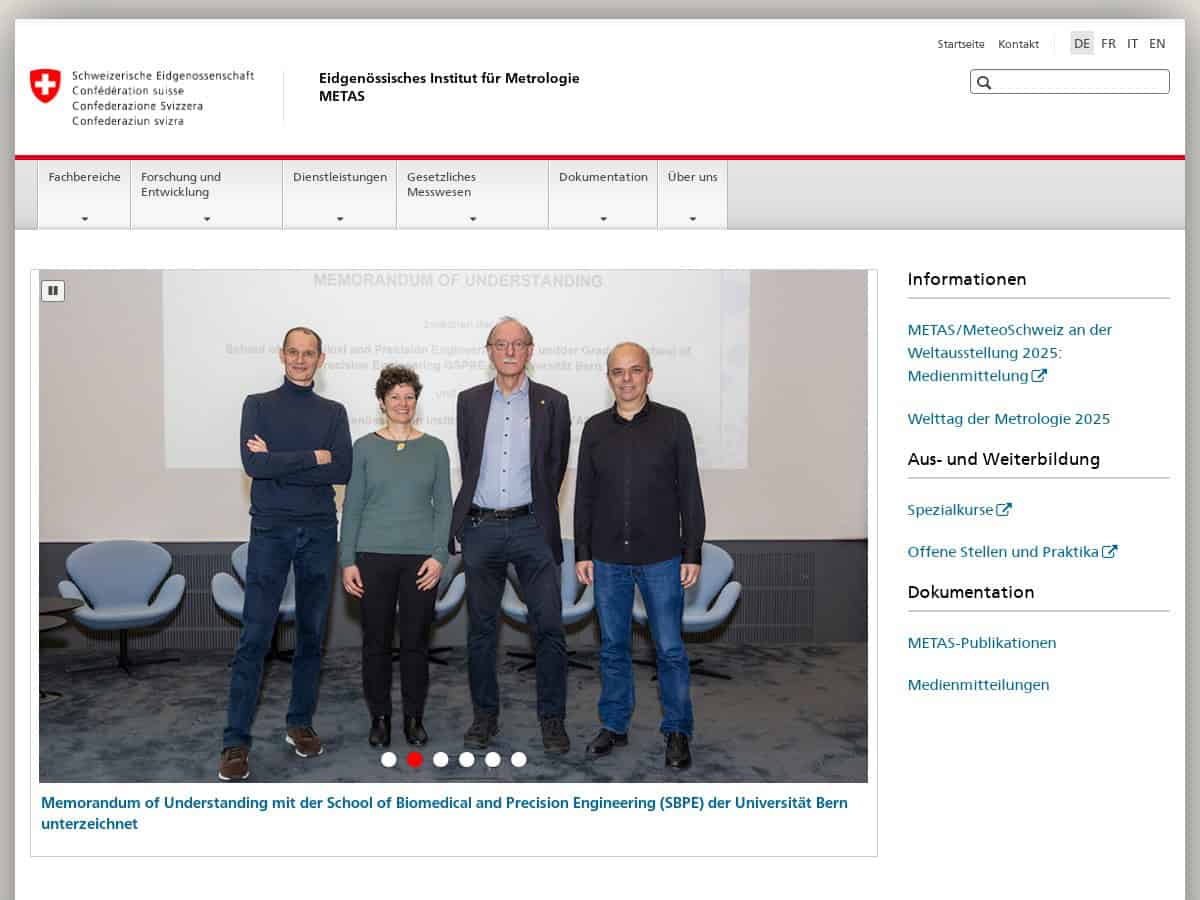
METAS is the Swiss national metrology institute. It is the federal center of competence for all issues related to measurement, measuring instruments, and measuring procedures, ensuring accuracy and traceability. It provides specialized expertise and collaborates on research.
Domains taught:
Chemistry, Electrical and Electronics, Engineering, Fluid Dynamics, Manufacturing, Materials, Mathematics, Mechanical Engineering, Metrology, Nanotechnologies, Optics, Physics, Process Control, Project Management, Quality, Signal Processing, Statistics, Thermodynamics
Diplomas*:
Diploma, Doctor
Status:
Public
Partnerships:
Swiss federal agency. Collaborates with international metrology organizations (BIPM, EURAMET), accredited laboratories, industry, and universities for research and dissemination of measurement standards.
Research:
Research and development in advanced measurement techniques across various physical quantities (mass, length, time, electricity, temperature, etc.), legal metrology, and calibration services.
Famous Alumnis:
N/A
International recognition**:
Number of staff***:
300
Current students***:
10
Foreign students***:
10%
Cumulative former students***:
100
Pros
National authority for metrology, ensuring high-precision measurement capabilities for Switzerland. Involved in cutting-edge measurement science.
Cons
Primarily a national standards and research body. Educational role is through specialized training and hosting researchers.
Best For
Scientists and engineers specializing in metrology, precision measurement, or calibration, often at a research or advanced technical level.
Institut für Solartechnik sits close to this institution on metrology, quality and signal processing; it is also a public institution and also offers master's and certificate programmes.
PMOD/WRC Physikalisch-Meteorologisches Observatorium Davos und Weltstrahlungszentrum follows much the same lines as this institution, with metrology, optics and signal processing as common ground, and it covers astroscience and computer vision as well, and has almost the same size, at about 10 students.
AO Research Institute Davos overlaps with this school on metrology, quality and nanotechnologies, so the two are easy to compare, and it is private, whereas this school is public, and does not run the diploma programmes found here.
In terms of fields, CEPTA Centre d'enseignement professionnel de Tavannes, École supérieure technique is the nearest neighbour, with metrology, quality and nanotechnologies again at the core; it covers industrial design and structural engineering as well, and is far larger, with about 120 students against roughly 10 here.
On content, École technique de la Vallée de Joux and this institution are close, as both teach metrology, quality and nanotechnologies; it does not run the doctoral programmes found here and covers industrial design and structural engineering as well.
Most Similar Schools Abroad
Istituto Tecnico Superiore per la Fotonica - Toscana, based in Italy, is built around metrology, quality and nanotechnologies much like this institution, and it is far larger, with about 80 students against roughly 10 here, and is also a public institution.
A foreign alternative with a similar emphasis on metrology, optics and signal processing is Instituto Nacional de Técnica Aeroespacial in Spain, and it is also a public institution and also offers master's programmes.
Seen from abroad, Centro de Investigaciones Energéticas, Medioambientales y Tecnológicas (Spain) is a close relative on subject matter, since metrology, nanotechnologies and fluid dynamics are central to both, and it is far larger, with about 100 students against roughly 10 here, and is also a public institution.
Hochschule für Gestaltung Offenbach am Main, based in Germany, is built around quality, nanotechnologies and signal processing much like this institution, and it runs the same doctoral and diploma programmes and covers sound engineering and ergonomics and UX as well.
Beyond national borders, Institut Polytechnique de Paris stands out as a comparable school for nanotechnologies, optics and signal processing; it is also a public institution and also offers master's programmes.
*our own picks (our criteria: a mix between domains, diploma delivered, reputation and size), but obviously too many criteria for an apple-to-apple ranking.
*: without any judgment of the quality, readers are strongly encouraged to check the official status of the exact diploma envisioned as many universities have a mix of recognized diplomas, not recognized, “co-delivered,” “equivalent to”, “some pathways” (…), can change over time, and can be named differently from one country to another.
**: international reputation: is based on some criteria that do not mean much in some domains or specialties (number of researchers, of scientific publications, on budget ….). Our approximate 1-4 scale:
known locally
known locally and internationally
is listed in some of the world university’s classifications
is listed among the 20 firsts in some of world university’s classifications
***: estimated numbers, based on online sources and/or feedbacks. The numbers can vary greatly depending on school organisation (ex.: school is part of a group, it employs internal staff or external consultants or has public staff without employing them …). Refer to all the links provided to have accurate and updated numbers.
Innovation.world is not affiliated with this school/university. We recommend to contact them directly on their website for any special request.
To complete or correct any information here or share your opinion, please comment below or > send us a direct message <.