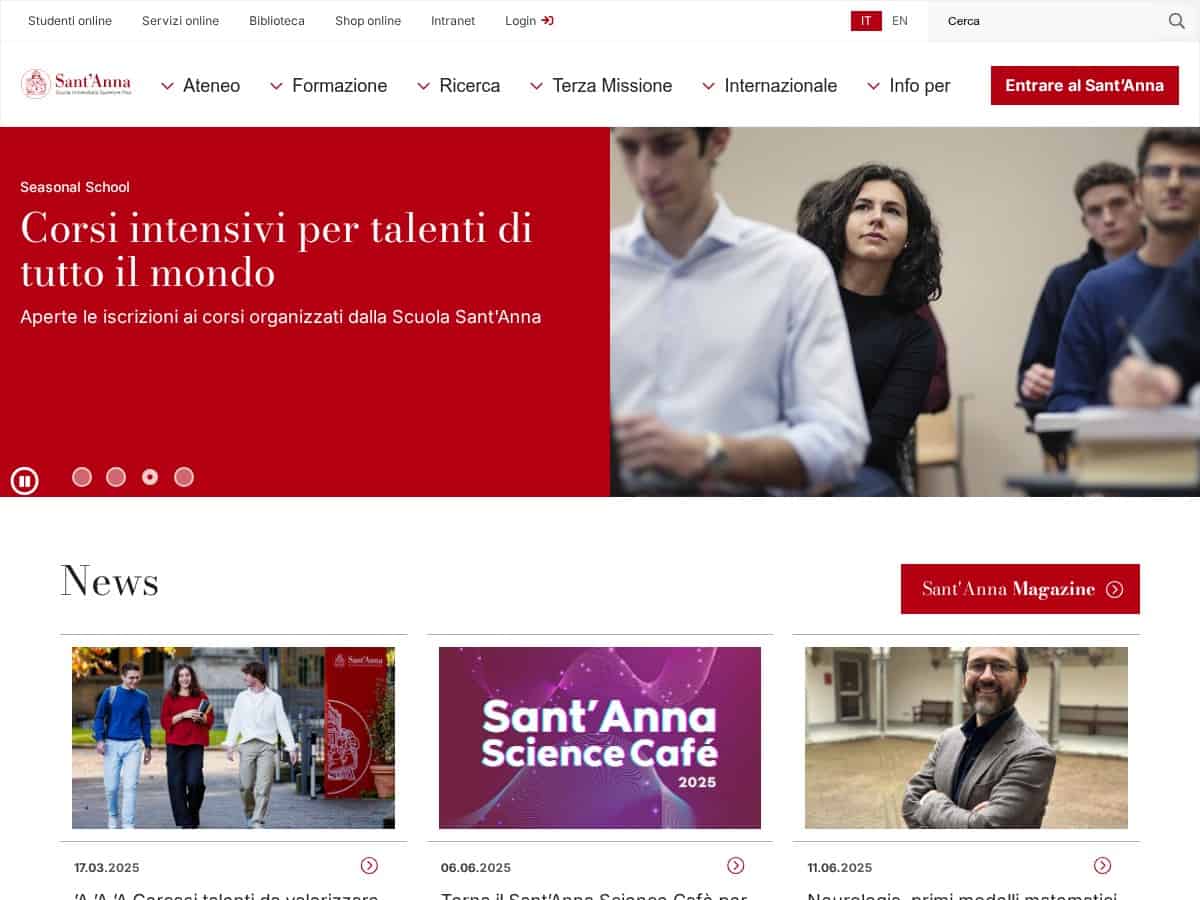
Scuola Superiore Sant’Anna is a public university institution of special status, focusing on applied sciences: engineering, medicine, agriculture, economics, law, and political sciences, with a strong emphasis on research and innovation.
The Scuola Superiore Sant’Anna in Pisa is a public university institution with a special status, focused on applied sciences. It was established in its present form in 1987 and has roots in earlier colleges of the city. It has about 1,000 students and 500 staff, and around 20 percent of students come from abroad. The seat is at Piazza Martiri della Libertà in Pisa, and further research sites are in Pontedera and other sites in Tuscany.
It teaches economics and management, law, political science, agricultural and life sciences, engineering, medicine and bioengineering. Students admitted to the ordinary courses are also enrolled at the University of Pisa and follow additional courses at Sant’Anna. They receive free tuition and lodging in the residence, in exchange for strong academic results. The school also offers doctoral programmes, master’s courses and advanced training for professionals.
Research at Sant’Anna is applied and interdisciplinary. The BioRobotics Institute, based in Pontedera, works on rehabilitation robots, prosthetic hands and soft robotics. Other institutes cover plant science, economics and governance, management and innovation, and the law of the European Union. The school is close to the University of Pisa and the Scuola Normale, and the three institutions form a federation in the city.
Admission to the ordinary courses is through a selective competition with written and oral exams, and places are limited. International students can apply, with exams in Italian or English depending on the programme. Doctoral candidates are recruited through public calls with grants. Check the current call for applications and the scholarship rules.
The school is small, which means close contact with teachers and a lot of project work. Pisa is affordable, and the surrounding area has research centres, hospitals and companies that offer internships. Graduates work in research, public administration, companies and international organisations, and many continue to doctoral programmes in Italy and abroad.
Domains taught:
Aerospace, Agriculture, AI and Machine Learning, Automation, Bioengineering, Bioinformatics, Chemistry, Computer Vision, Data Analytics, Electrical and Electronics, Engineering, Food Science, Industrial Design, Life Sciences, Manufacturing, Materials, Mechanical Engineering, Microbiology and Genetics, Nanotechnologies, Optics, Physics, Process Control, Robotics, Software Engineering, Statistics, Telecommunications
Diplomas*:
Bachelor, Doctor, Master
Status:
Public
Partnerships:
Part of the Pisa university system. Strong national and international research collaborations, spin-off generation.
Research:
Biorobotics and biomedical engineering, Photonics and advanced materials, Sustainable agriculture and plant biotechnology, AI and data science.
Famous Alumnis:
Giuliano Amato, Enrico Letta, Maria Chiara Carrozza
International recognition**:
Number of staff***:
500
Current students***:
1000
Foreign students***:
20%
Cumulative former students***:
8000
Pros
Excellence in applied sciences and research, strong links with industry, high-level interdisciplinary projects, international environment.
Cons
Highly selective, demanding programs, focus on specific areas of applied science.
Best For
Elite institution for research and education in applied sciences, particularly robotics and photonics.
Where this school leans on nanotechnologies, chemistry and physics, Scuola Normale Superiore di Pisa does the same, and it is also a public institution, and runs the same bachelor's, master's and doctoral programmes.
Both schools build their programmes around aerospace, food science and bioinformatics, and Università di Pisa is the one to compare first within the country, since it covers astroscience and marine science as well, and is far larger, with about 50,000 students against roughly 1,000 here.
A good alternative in the same country is Università degli Studi di Firenze, which likewise covers aerospace, agriculture and food science; it covers astroscience and geotechnics as well, and is far larger, with about 55,000 students against roughly 1,000 here.
A good alternative in the same country is Università degli Studi di Roma La Sapienza, which likewise covers aerospace, bioinformatics and nanotechnologies; it is also a public institution, and teaches at the same levels, namely bachelor's, master's and doctoral.
On content, Campus Bio-Medico di Roma and this institution are close, as both teach food science, nanotechnologies and microbiology and genetics; it teaches at the same levels, namely bachelor's, master's and doctoral, and covers thermodynamics and mathematics as well.
Most Similar Schools Abroad
École Normale Supérieure Paris-Saclay, in France, takes a similar route through aerospace, bioinformatics and nanotechnologies; it teaches at the same levels, namely bachelor's, master's and doctoral, and covers signal processing and fluid dynamics as well.
The closest overseas parallel on bioinformatics, nanotechnologies and microbiology and genetics is Nara Institute of Science and Technology, located in Japan; it is also a public institution and does not run the bachelor's programmes found here.
Students considering a move abroad can look at École Normale Supérieure de Rennes in France, where bioinformatics, nanotechnologies and microbiology and genetics also form the core, and it covers signal processing and fluid dynamics as well, and is smaller, enrolling about 500 students against roughly 1,000 here.
A foreign alternative with a similar emphasis on aerospace, bioinformatics and nanotechnologies is Kochi University of Technology in Japan, and it is larger, enrolling about 2,000 students against roughly 1,000 here, and is also a public institution.
Zhejiang University offers an international parallel to this institution, with aerospace, agriculture and food science as common ground; it is far larger, with about 60,000 students against roughly 1,000 here, and is also a public institution.
*our own picks (our criteria: a mix between domains, diploma delivered, reputation and size), but obviously too many criteria for an apple-to-apple ranking.
FAQ
Where is Scuola Superiore Sant'Anna?
At Piazza Martiri della Libertà 33 in Pisa, Tuscany, Italy.
When was it established?
In its present form in 1987.
How large is it?
About 1,000 students and 500 staff, with around 20 percent of students from abroad.
What does it teach?
Economics and management, law, political science, life sciences, engineering and medicine.
What is the BioRobotics Institute?
A research institute based in Pontedera that works on rehabilitation robots, prosthetic hands and soft robotics.
Do students also attend the University of Pisa?
Students in the ordinary courses are enrolled at both institutions.
Is it free?
Admitted ordinary students receive free tuition and lodging in exchange for strong academic results.
How do you get in?
Through a selective competition with written and oral exams. Check the current call for applications.
Can foreign students apply?
Yes, with exams in Italian or English depending on the programme.
How is it linked to other Pisa institutions?
It forms a federation with the University of Pisa and the Scuola Normale Superiore.
Artificial Intelligence (AI), Bioengineering, Biomedical Sensors, Innovation, Photonics, Research and Development, Robotics, Sustainable Practices
*: without any judgment of the quality, readers are strongly encouraged to check the official status of the exact diploma envisioned as many universities have a mix of recognized diplomas, not recognized, “co-delivered,” “equivalent to”, “some pathways” (…), can change over time, and can be named differently from one country to another.
**: international reputation: is based on some criteria that do not mean much in some domains or specialties (number of researchers, of scientific publications, on budget ….). Our approximate 1-4 scale:
known locally
known locally and internationally
is listed in some of the world university’s classifications
is listed among the 20 firsts in some of world university’s classifications
***: estimated numbers, based on online sources and/or feedbacks. The numbers can vary greatly depending on school organisation (ex.: school is part of a group, it employs internal staff or external consultants or has public staff without employing them …). Refer to all the links provided to have accurate and updated numbers.
Innovation.world is not affiliated with this school/university. We recommend to contact them directly on their website for any special request.
To complete or correct any information here or share your opinion, please comment below or > send us a direct message <.