Product Design, Manufacturing & Innovation Resources
Home » Royal Military College of Canada (RMC)

Royal Military College of Canada (RMC)

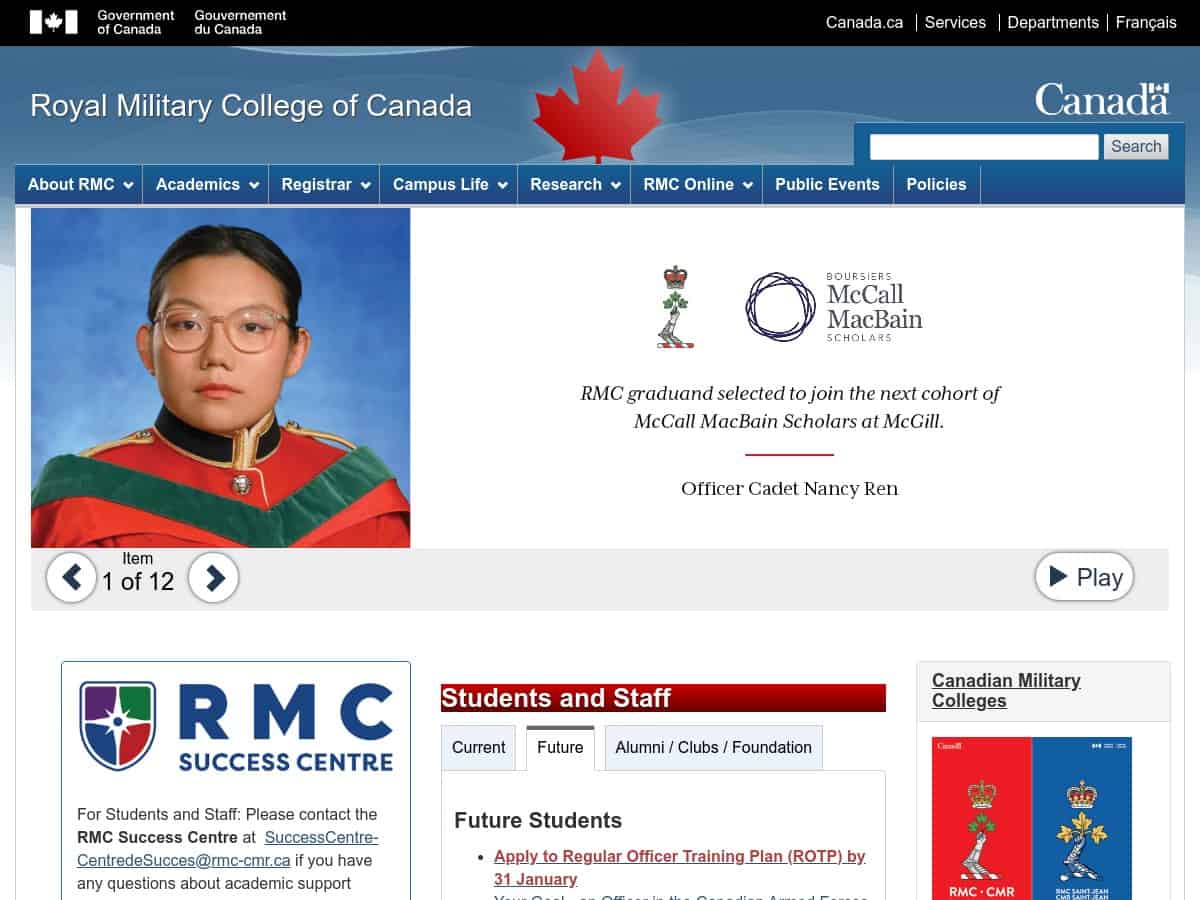
Royal Military College of Canada (RMC)
Address: 13 General Crerar Crescent, K7K 7B4 Kingston, Ontario, Canada
Engineering, Military and Strategic Studies, Science

Canada’s military university, offering undergraduate and graduate programs in arts, science, and engineering to officer cadets of the Canadian Armed Forces and other students.

Domains taught:

Diplomas*:

Status:

Partnerships:

Operates under the Department of National Defence. Partnerships with other military academies worldwide and research collaborations with defence agencies.

Research:

Research focused on defence and security issues, military technology, leadership, and strategic studies. Often classified or applied research for DND.

Famous Alumnis:

Chris Hadfield (also UW), Marc Garneau, John de Chastelain, Billy Bishop (attended predecessor)

International recognition**:

Number of staff***:

500

Current students***:

1500

Foreign students***:

2%

Cumulative former students***:

20000

Pros

Provides a fully subsidized degree for officer cadets, strong focus on leadership development, small class sizes, guaranteed employment post-graduation (for ROTP).

Cons

Highly structured military environment, significant service obligation after graduation for officer cadets, limited program choice compared to civilian universities.

Best For

Officer cadets of the Canadian Armed Forces and other students interested in a rigorous, disciplined education in engineering, science, or arts with a military focus.

Most Similar Schools Locally

  • Polytechnique Montréal follows much the same lines as this school, with aerospace, mechanical engineering and electrical and electronics as common ground, and it is also a public institution and also offers certificate programmes.
  • Anyone who wants a second school in the same country with a similar spread of aerospace, mechanical engineering and electrical and electronics can consider École de technologie supérieure, and it is far larger, with about 11,000 students against roughly 1,500 here, and is also a public institution.
  • Also strong in mathematics, software engineering and engineering, University of Waterloo makes a sensible second look at home; it is far larger, with about 42,500 students against roughly 1,500 here, and is also a public institution.
  • Think of Carleton University when aerospace, software engineering and engineering is the priority: it covers telecommunications and life sciences as well, and is far larger, with about 32,000 students against roughly 1,500 here.
  • Laval University follows much the same lines as this school, with engineering as common ground, and it covers finance and agriculture as well, and is far larger, with about 38,000 students against roughly 1,500 here.

Most Similar Schools Abroad

  • Beyond national borders, Military Institute of Engineering stands out as a comparable school for military, mechanical engineering and electrical and electronics; it is also a public institution, and runs the same bachelor's, master's and doctoral programmes.
  • École Royale Militaire in Belgium shares the military, aerospace and physics orientation of this school, and it covers optics and signal processing as well, and is smaller, enrolling about 900 students against roughly 1,500 here.
  • A foreign alternative with a similar emphasis on military, aerospace and mathematics is Nederlandse Defensie Academie in the Netherlands, and it is also a public institution and does not run the doctoral programmes found here.
  • For physics, mechanical engineering and electrical and electronics outside the home country, Indian Institute of Technology Indore in India is a natural reference; it is also a public institution, and runs the same bachelor's, master's and doctoral programmes.
  • Abroad, Technion - Israel Institute of Technology (Israel) covers aerospace, physics and mathematics in a comparable way, and it covers chemistry and materials as well, and is far larger, with about 13,703 students against roughly 1,500 here.

*our own picks (our criteria: a mix between domains, diploma delivered, reputation and size), but obviously too many criteria for an apple-to-apple ranking.

*: without any judgment of the quality, readers are strongly encouraged to check the official status of the exact diploma envisioned as many universities have a mix of recognized diplomas, not recognized, “co-delivered,” “equivalent to”,  “some pathways” (…), can change over time, and can be named differently from one country to another.


**: international reputation: is based on some criteria that do not mean much in some domains or specialties (number of researchers, of scientific publications, on budget ….). Our approximate 1-4 scale: 

  1. known locally
  2. known locally and internationally
  3. is listed in some of the world university’s classifications
  4. is listed among the 20 firsts in some of world university’s classifications

***: estimated numbers, based on online sources and/or feedbacks. The numbers can vary greatly depending on school organisation (ex.: school is part of a group, it employs internal staff or external consultants or has public staff without employing them …). Refer to all the links provided to have accurate and updated numbers.

Innovation.world is not affiliated with this school/university.
We recommend to contact them directly on their website for any special request.


To complete or correct any information here or share your opinion, please comment below or > send us a direct message <.

10th year anniversary

Full size images and downloads are only available, 100% free, for registered members.

> Login <















