One of Canada’s leading engineering schools, affiliated with Université de Montréal. Offers a comprehensive range of engineering programs and is renowned for its research and innovation.
Polytechnique Montréal was founded in 1873 as the École polytechnique de Montréal, the first engineering school in Canada to teach in French. In 1970 it became affiliated with the Université de Montréal, while keeping its own governance and degrees. It is today one of the largest engineering schools in Canada by research funding and by the number of students, with about 9,000 students and 1,200 staff. The campus is located on the north slope of Mount Royal, in the Cote-des-Neiges area, next to the main campus of the university.
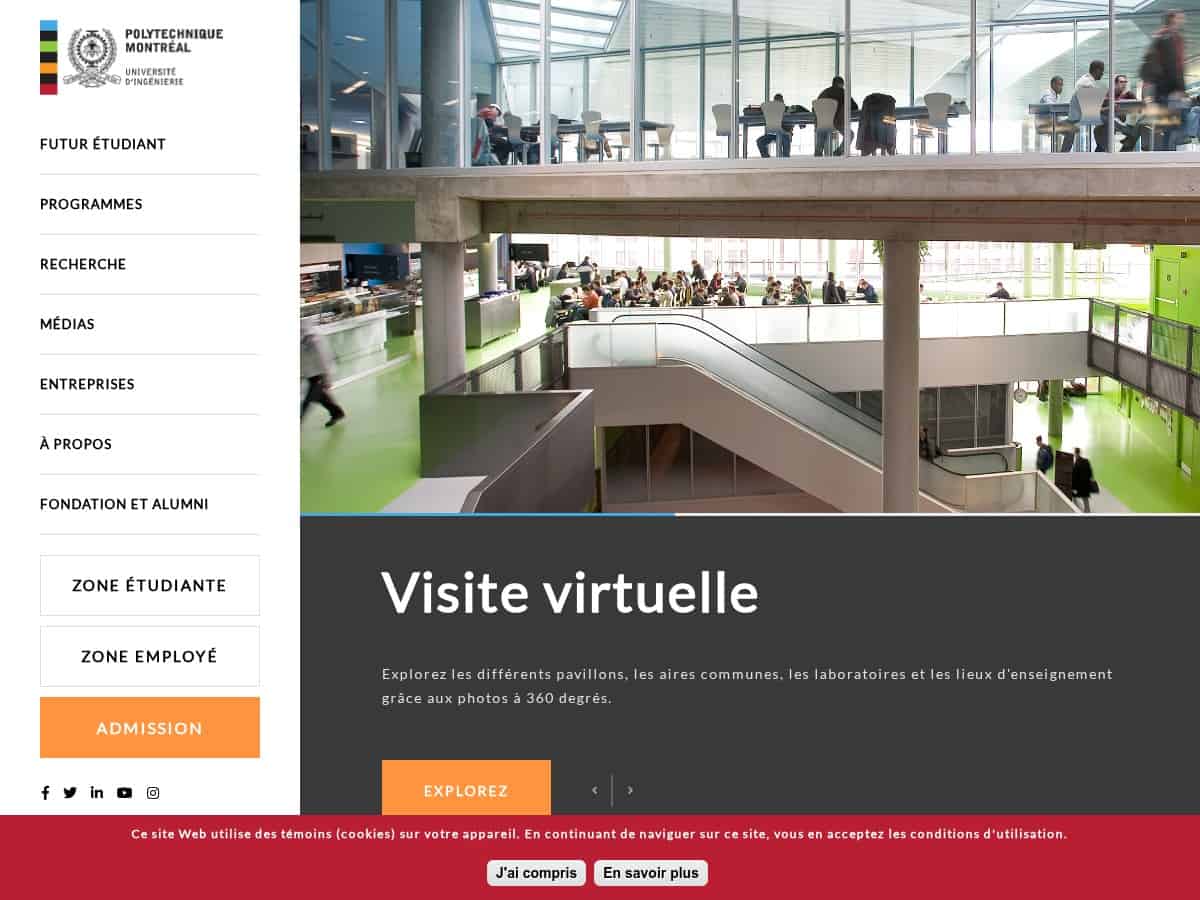
The school offers engineering degrees in aerospace, biomedical, chemical, civil, computer, electrical, geological, industrial, mechanical, mining, materials and physics engineering, as well as software engineering and computer science. Programmes are known for their link to industry, and many include internships, so students graduate with practical experience. The Lassonde Pavilion, which houses laboratories and teaching spaces, belongs to the modern campus.
Research areas include artificial intelligence, aerospace, energy, advanced materials, transport, the environment, biomedical technology and data science. The school cooperates with Mila, the Quebec artificial intelligence institute, with local aerospace firms such as those of the Montreal cluster, and with hospitals. Several research chairs support work on topics such as mining engineering, pollution control and bioengineering. The school has produced numerous start-ups.
On 6 December 1989, a gunman killed fourteen women at the school in an act of violence against women. The event led to the creation of the National Day of Remembrance and Action on Violence Against Women in Canada, and the school keeps a memorial and takes part in the annual remembrance.
Courses are mainly in French, with some in English. Tuition differs for Quebec residents, other Canadians and international students. Check the current tariff. The Université-de-Montréal metro station on line 5 serves the campus.
Domains taught:
Aerospace, AI and Machine Learning, Electrical and Electronics, Engineering, Materials, Mechanical Engineering, Software Engineering
Diplomas*:
Bachelor, Certificate, Doctor, Master
Status:
Public
Partnerships:
Affiliated with Université de Montréal. Strong partnerships with industry, particularly in aerospace, energy, materials, and IT. Member of U15 through UdeM.
Research:
Extensive research in various engineering fields including aerospace, biomedical engineering, advanced materials, data science, AI applications in engineering, and sustainable development.
Famous Alumnis:
Justin Trudeau (studied engineering, did not complete degree here), Julie Payette, David Saint-Jacques, Pierre Lassonde
International recognition**:
Number of staff***:
1200
Current students***:
9500
Foreign students***:
20%
Cumulative former students***:
55000
Pros
Prestigious engineering school, strong research programs, wide range of specializations, located on UdeM campus in Montreal.
French-speaking students aspiring to become engineers, seeking a top-tier engineering education with strong research opportunities and industry connections.
École de technologie supérieure takes a similar route through aerospace, mechanical engineering and electrical and electronics, and it runs the same bachelor's, master's, doctoral and certificate programmes, and covers telecommunications and manufacturing as well.
Université de Montréal follows much the same lines as this institution, with AI and machine learning and software engineering as common ground, and it is far larger, with about 67,500 students against roughly 9,500 here, and is also a public institution.
Among national alternatives, University of Windsor stands out for its focus on mechanical engineering, AI and machine learning and software engineering, and it is larger, enrolling about 16,000 students against roughly 9,500 here, and is also a public institution.
Think of University of Waterloo when AI and machine learning, software engineering and engineering is the priority: it also offers graduate diploma programmes and covers nanotechnologies and robotics as well.
Toronto Metropolitan University shares the core fields of this school, namely aerospace, AI and machine learning and software engineering; it covers industrial design and manufacturing as well, and is far larger, with about 48,000 students against roughly 9,500 here.
Most Similar Schools Abroad
Students considering a move abroad can look at Indian Institute of Technology Kanpur in India, where aerospace, mechanical engineering and electrical and electronics also form the core, and it is slightly smaller, at about 8,000 students against roughly 9,500 here, and is also a public institution.
Seen from abroad, South Ural State University (Russia) is a close relative on subject matter, since aerospace, mechanical engineering and electrical and electronics are central to both, and it is larger, enrolling about 27,000 students against roughly 9,500 here, and is also a public institution.
Indian Institute of Technology Delhi in India shares the mechanical engineering, electrical and electronics and materials orientation of this school, and it covers telecommunications as well, and is slightly larger, at about 11,000 students against roughly 9,500 here.
Missouri University of Science and Technology in the United States shares the aerospace, mechanical engineering and materials orientation of this institution, and it is slightly smaller, at about 8,000 students against roughly 9,500 here, and is also a public institution.
*our own picks (our criteria: a mix between domains, diploma delivered, reputation and size), but obviously too many criteria for an apple-to-apple ranking.
FAQ
Where is Polytechnique Montréal?
On the north slope of Mount Royal in the Côte-des-Neiges area of Montreal, Quebec, next to the Université de Montréal.
When was it founded?
In 1873, as the École polytechnique de Montréal.
What was special about its founding?
It was the first engineering school in Canada to teach in French.
Is it part of the Université de Montréal?
It has been affiliated since 1970 but keeps its own governance and degrees.
How large is it?
About 9,000 students and 1,200 staff.
What engineering fields does it teach?
Aerospace, biomedical, chemical, civil, computer, electrical, geological, industrial, mechanical, mining, materials and physics engineering, and software engineering.
What does it research?
Artificial intelligence, aerospace, energy, advanced materials, transport, the environment, biomedical technology and data science.
What happened on 6 December 1989?
Fourteen women were killed at the school, which led to the National Day of Remembrance and Action on Violence Against Women.
What language are courses in?
Mainly French, with some in English.
What does it cost?
Tuition differs for Quebec residents, other Canadians and international students. Check the current tariff.
*: without any judgment of the quality, readers are strongly encouraged to check the official status of the exact diploma envisioned as many universities have a mix of recognized diplomas, not recognized, “co-delivered,” “equivalent to”, “some pathways” (…), can change over time, and can be named differently from one country to another.
**: international reputation: is based on some criteria that do not mean much in some domains or specialties (number of researchers, of scientific publications, on budget ….). Our approximate 1-4 scale:
known locally
known locally and internationally
is listed in some of the world university’s classifications
is listed among the 20 firsts in some of world university’s classifications
***: estimated numbers, based on online sources and/or feedbacks. The numbers can vary greatly depending on school organisation (ex.: school is part of a group, it employs internal staff or external consultants or has public staff without employing them …). Refer to all the links provided to have accurate and updated numbers.
Innovation.world is not affiliated with this school/university. We recommend to contact them directly on their website for any special request.
To complete or correct any information here or share your opinion, please comment below or > send us a direct message <.