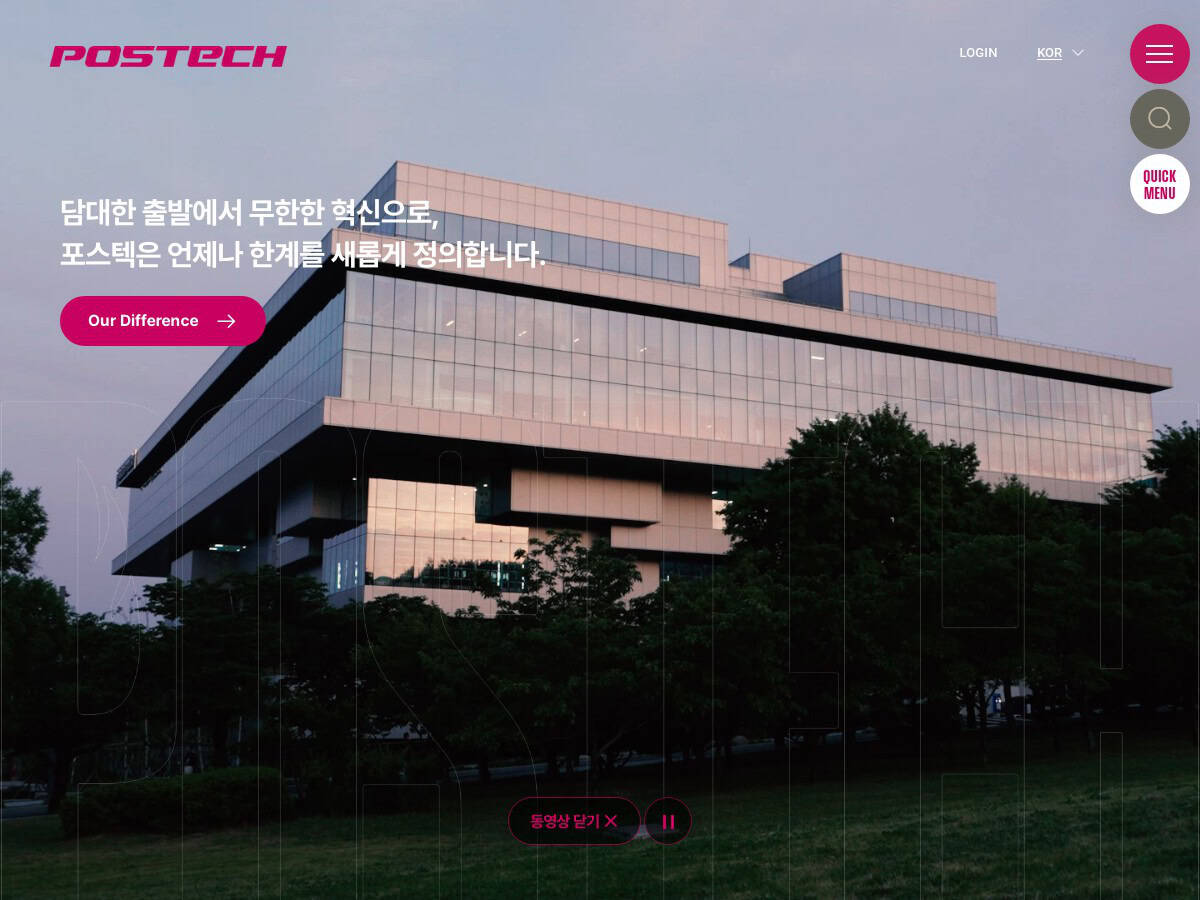
Address: 77 Cheongam-ro, Nam-gu, Pohang, Gyeongbuk 37673, South Korea
Materials;Mechanical Engineering;Physics
Founded in 1986 by POSCO, POSTECH is a research-oriented university focusing on science and technology, ranked among Asia’s top.
Pohang University of Science and Technology, POSTECH, is a small research university in Pohang, a steel city on the south-eastern coast of South Korea. The steel company POSCO founded it in 1986, with the aim of building a world-class institute for science and engineering in the region. It has about 3,500 students and 700 staff, and roughly a quarter of the students come from abroad. The campus on Cheongam-ro is compact and green, and almost all students and professors live on or near it.
POSTECH is organised in a small number of departments, including mathematics, physics, chemistry, life sciences, materials science and engineering, mechanical engineering, electrical engineering, computer science and engineering, chemical engineering, industrial and management engineering, and creative IT engineering. The student body is selected from the top of the national exams, and the faculty-to-student ratio is among the best in Korea. First-year undergraduates join the university without declaring a major, and they choose a department after a year of broad study.
The institute is known for its large research facilities. The Pohang Accelerator Laboratory operates the Pohang Light Source and an X-ray free-electron laser, PAL-XFEL, which opened in 2016 and is used by scientists from many countries for studies of materials and biological molecules. Research is strong in materials science, nanotechnology, batteries and energy, artificial intelligence, robotics and biotechnology, and the university works with POSCO and other industrial firms on steel and energy technology.
Admission for Korean students is selective and uses the national exam and the university’s own screening, while international applicants apply directly with academic records and tests. A large share of the courses is taught in English, and Korean language courses are offered. Tuition is lower than at the large private universities, and many students receive scholarships. Check the current tariff and the aid available for foreign students.
Pohang is a medium-sized city with a beach and a quiet atmosphere. Students live in dormitories on campus, and Seoul can be reached by the high-speed train in about two and a half hours.
Sungkyunkwan University sits close to this university on materials and engineering; it is far larger, with about 31,000 students against roughly 3,500 here, and is also a private institution.
Ulsan National Institute of Science and Technology is the closest domestic counterpart for materials and engineering; it covers nanotechnologies as well, and is larger, enrolling about 5,500 students against roughly 3,500 here.
The comparison with Hanyang University is straightforward on subjects, since both focus on mechanical engineering and engineering, and it is also a private institution, and runs the same bachelor's, master's and doctoral programmes.
Both schools build their programmes around mechanical engineering and engineering, and Yeungnam University is the one to compare first within the country, since it is far larger, with about 18,000 students against roughly 3,500 here, and is also a private institution.
Among national alternatives, Ajou University stands out for its focus on mechanical engineering and engineering, and it is also a private institution, and runs the same bachelor's, master's and doctoral programmes.
Most Similar Schools Abroad
For a study option in Brazil with a comparable spread of physics, materials and engineering, Federal University of Rio Grande do Sul is the reference point: it is public, whereas this institution is private, and teaches at the same levels, namely bachelor's, master's and doctoral.
California Institute of Technology in the United States shares the physics, materials and engineering orientation of this institution, and it is also a private institution, and teaches at the same levels, namely bachelor's, master's and doctoral.
Seen from abroad, University of Science and Technology Beijing (China) is a close relative on subject matter, since physics, mechanical engineering and materials are central to both, and it is public, whereas this institution is private, and runs the same bachelor's, master's and doctoral programmes.
The closest overseas parallel on physics, mechanical engineering and materials is Peter the Great St. Petersburg Polytechnic University, located in Russia; it is far larger, with about 33,000 students against roughly 3,500 here, and is public, whereas this university is private.
National Metallurgical Academy of Ukraine, in Ukraine, takes a similar route through physics, mechanical engineering and materials; it is public, whereas this institution is private, and teaches at the same levels, namely bachelor's, master's and doctoral.
*our own picks (our criteria: a mix between domains, diploma delivered, reputation and size), but obviously too many criteria for an apple-to-apple ranking.
FAQ
Where is POSTECH?
At 77 Cheongam-ro, Nam-gu, in Pohang, North Gyeongsang Province, South Korea.
When was it founded?
In 1986, by the steel company POSCO.
How large is it?
About 3,500 students and 700 staff, with around a quarter of students from abroad.
What is it best known for?
Materials science, physics, chemistry, engineering, artificial intelligence and biotechnology.
What is PAL-XFEL?
An X-ray free-electron laser at the Pohang Accelerator Laboratory, opened in 2016, used for studies of materials and biological molecules.
Do first-year students choose a major?
Undergraduates join without declaring a major and choose a department after a year of broad study.
Are courses taught in English?
A large share of courses is taught in English, and Korean language courses are offered.
What does it cost?
Tuition is lower than at the large private universities, and many students receive scholarships. Check the current tariff and the aid available for foreign students.
How do international students apply?
They apply directly with academic records and tests.
How far is Pohang from Seoul?
About two and a half hours by high-speed train.
Additive Manufacturing, Advanced Product Quality Planning (APQP), Innovation, Materials, Mechanical Engineering, Physics, Research and Development, Sustainable Development
*: without any judgment of the quality, readers are strongly encouraged to check the official status of the exact diploma envisioned as many universities have a mix of recognized diplomas, not recognized, “co-delivered,” “equivalent to”, “some pathways” (…), can change over time, and can be named differently from one country to another.
**: international reputation: is based on some criteria that do not mean much in some domains or specialties (number of researchers, of scientific publications, on budget ….). Our approximate 1-4 scale:
known locally
known locally and internationally
is listed in some of the world university’s classifications
is listed among the 20 firsts in some of world university’s classifications
***: estimated numbers, based on online sources and/or feedbacks. The numbers can vary greatly depending on school organisation (ex.: school is part of a group, it employs internal staff or external consultants or has public staff without employing them …). Refer to all the links provided to have accurate and updated numbers.
Innovation.world is not affiliated with this school/university. We recommend to contact them directly on their website for any special request.
To complete or correct any information here or share your opinion, please comment below or > send us a direct message <.