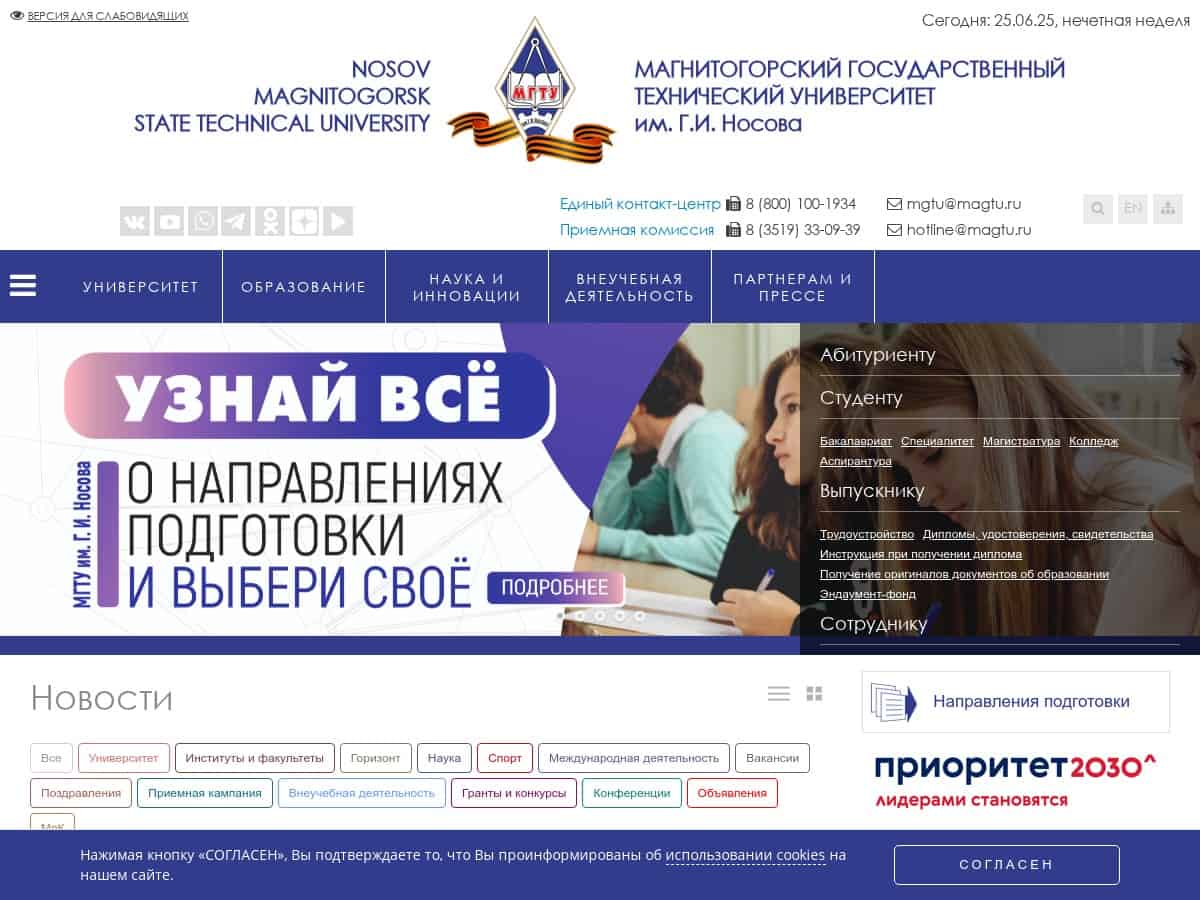
Magnitogorsk, a city in the Chelyabinsk region of Russia, is the home of Nosov Magnitogorsk State Technical University. Its official founding date is 1934, when the Magnitogorsk Institute of Mining and Metallurgy opened; the institute was formed from branches of higher-education institutions of the Urals that had existed in the city since 1932.
In 1951 the institute was named after Grigory Nosov, a long-serving director of the Magnitogorsk Iron and Steel Works, which reflects the close link between the institution and the local steel industry. It has carried its present name, Nosov Magnitogorsk State Technical University, since 1998.
Mining and metallurgy gave the institution its original profile, and the founding name still shows how closely the school was bound to the region’s industry. As a technical university it now offers engineering study at several levels. Programme lists, admission rules and tuition are published by the university and differ by level and applicant category.
Domains taught:
Automation, Chemical Engineering, Electrical and Electronics, Engineering, Geotechnics, Materials, Mechanical Engineering
Diplomas*:
Bachelor, Doctor, Master
Status:
Public
Partnerships:
Strong partnership with Magnitogorsk Iron and Steel Works (MMK) and other industrial enterprises; collaborations with some international technical universities.
Research:
Research in ferrous metallurgy, metal forming, materials science, mining technologies, automation of industrial processes, and industrial ecology.
Famous Alumnis:
N/A
International recognition**:
Number of staff***:
1000
Current students***:
12000
Foreign students***:
0%
Cumulative former students***:
70000
Pros
Key university for the metallurgical industry, direct collaboration with one of Russia s largest steel producers.
Cons
Highly specialized and tied to a specific industrial complex, regional focus.
Siberian State Industrial University lists Metallurgy, Mining Engineering and Materials Science among its specialties, close to the profile of the Magnitogorsk institute.
South Ural State University, in Chelyabinsk, lists Mechanical Engineering, Metallurgy and Information Technology as specialties.
Lipetsk State Technical University names Metallurgy, Mechanical Engineering and Automation among its listed specialties.
Cherepovets State University lists Metallurgy, Mechanical Engineering and Information Technology as specialties.
Most Similar Schools Abroad
China's University of Science and Technology Beijing lists Materials Science and Engineering, Metallurgy and Mechanical Engineering among its specialties.
Luleå University of Technology in Sweden lists Mining and Metallurgical Engineering and Space Science among its specialties.
The National Metallurgical Academy of Ukraine lists Metallurgy, Materials Science and Chemical Technology as specialties.
*our own picks (our criteria: a mix between domains, diploma delivered, reputation and size), but obviously too many criteria for an apple-to-apple ranking.
FAQ
When was Nosov Magnitogorsk State Technical University established?
The official founding date is 1934, when it opened as the Magnitogorsk Institute of Mining and Metallurgy.
Who is the university named after?
The name honours Grigory Nosov, a long-time director of the Magnitogorsk Iron and Steel Works, and has been used since 1951.
What existed in Magnitogorsk before 1934?
Branches of Ural higher-education institutions operated in the city from 1932, and the institute was formed from them.
Where is the university located?
It is located in Magnitogorsk, in Russia's Chelyabinsk Oblast.
Since when has it used its present name?
The present name has been in use since 1998.
Which industry is the university closely linked with?
Its history is tied to the Magnitogorsk Iron and Steel Works and to the mining and metallurgical sector.
Industrial Automation, Materials, Materials Science, Mechanical Engineering, Metallurgy, Process Improvement, Process Optimization, Research and Development
*: without any judgment of the quality, readers are strongly encouraged to check the official status of the exact diploma envisioned as many universities have a mix of recognized diplomas, not recognized, “co-delivered,” “equivalent to”, “some pathways” (…), can change over time, and can be named differently from one country to another.
**: international reputation: is based on some criteria that do not mean much in some domains or specialties (number of researchers, of scientific publications, on budget ….). Our approximate 1-4 scale:
known locally
known locally and internationally
is listed in some of the world university’s classifications
is listed among the 20 firsts in some of world university’s classifications
***: estimated numbers, based on online sources and/or feedbacks. The numbers can vary greatly depending on school organisation (ex.: school is part of a group, it employs internal staff or external consultants or has public staff without employing them …). Refer to all the links provided to have accurate and updated numbers.
Innovation.world is not affiliated with this school/university. We recommend to contact them directly on their website for any special request.
To complete or correct any information here or share your opinion, please comment below or > send us a direct message <.