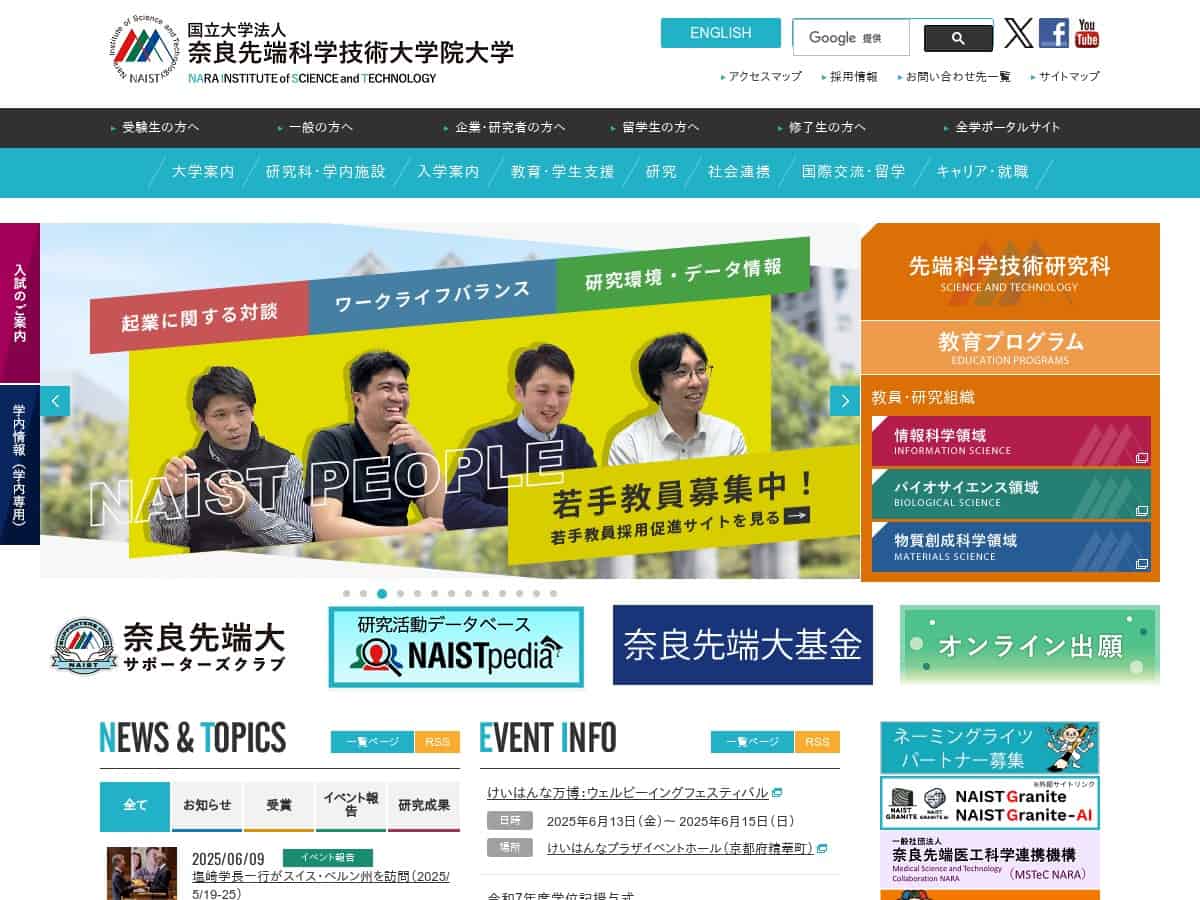
Nara Institute of Science and Technology was founded on 1 October 1991 as a national university without undergraduate programmes. It stands in Ikoma, in the Kansai Science City area, and abbreviates its name as NAIST.
The institute was built up from three graduate schools: Information Science in 1991, Biological Sciences in 1992 and Materials Science in 1996. In April 2018 the three were merged into a single Graduate School of Science and Technology, which organises education in information science, biological science and materials science, with data science and digital green-innovation added as interdisciplinary programmes.
NAIST is small by university standards: roughly 1,200 students (1,242 in November 2023 and 1,203 in May 2025) and around 200 academic staff. About a quarter of the students are from abroad. Because there is no undergraduate level, admission is to master’s and doctoral courses, and the institute publishes the conditions and deadlines in its guidebook and on its English pages.
Domains taught:
AI and Machine Learning, Automation, Bioengineering, Bioinformatics, Chemistry, Computer Vision, Data Analytics, Ecology and Sustainability, Electrical and Electronics, Engineering, Fluid Dynamics, Life Sciences, Manufacturing, Materials, Mathematics, Mechanical Engineering, Microbiology and Genetics, Nanotechnologies, Optics, Physics, Process Control, Project Management, Robotics, Signal Processing, Software Engineering, Statistics, Structural Engineering, Telecommunications, Thermodynamics
Diplomas*:
Doctor, Master
Status:
Public
Partnerships:
Exclusively graduate-level research university. Strong international collaborations and industry partnerships.
Research:
AI and robotics, Bioinformatics and genomics, Advanced materials and nanotechnology, Photonics and quantum science.
Famous Alumnis:
Shinya Yamanaka (former professor)
International recognition**:
Number of staff***:
400
Current students***:
1200
Foreign students***:
20%
Cumulative former students***:
N/A
Pros
Excellence in graduate research and education, cutting-edge facilities, strong focus on interdisciplinary research.
Cons
Postgraduate only, highly specialized.
Best For
Leading graduate research university in information science, biological sciences, and materials science.
Japan Advanced Institute of Science and Technology is a public graduate institute in Nomi, Ishikawa, working in information science, materials science and knowledge science.
Private and located in Okinawa, Okinawa Institute of Science and Technology Graduate University combines neuroscience, physics, chemistry and marine science.
A public graduate-only university in Hayama, The Graduate University for Advanced Studies trains doctoral students at national research institutes.
Tokyo Tech (public, Tokyo) covers engineering, materials science and computer science.
In South Korea, Pohang University of Science and Technology is private, located in Pohang, with materials, mechanical engineering and physics as main fields.
Skolkovo Institute of Science and Technology (Russia), a private institute near Moscow, teaches data science, advanced manufacturing and energy systems.
EPFL, a public technical university in Lausanne, Switzerland, has engineering, computer science and life sciences.
Also Swiss, Idiap Research Institute is a private research institute in Martigny working on artificial intelligence, machine learning and human-computer interaction.
Israel's Weizmann Institute of Science in Rehovot is a public science institute with mathematics, computer science, physics and chemistry.
*our own picks (our criteria: a mix between domains, diploma delivered, reputation and size), but obviously too many criteria for an apple-to-apple ranking.
FAQ
When was NAIST established?
The institute was founded on 1 October 1991. It was created as a graduate-only national university.
Does it accept undergraduates?
No. Study begins at the master's level, and the student body consists of master's and doctoral students.
What fields are taught?
Information science, biological science and materials science are the founding fields, and the education programmes now also include data science and digital green-innovation. Since 2018 they sit within a single Graduate School of Science and Technology.
Where is the campus?
It lies in Ikoma, Nara Prefecture, within Kansai Science City, an area developed for research and education.
How large is the community?
Roughly 1,200 students (1,242 in November 2023, 1,203 in May 2025) and around 200 academic staff. International students represent about a quarter of the total.
What is the best way to learn about admissions?
The institute's English guidebook and website describe entry requirements and schedules for master's and doctoral courses. Applicants should read the latest edition for their intake.
Artificial Intelligence (AI), Innovation, Robotics, Sustainable Development
*: without any judgment of the quality, readers are strongly encouraged to check the official status of the exact diploma envisioned as many universities have a mix of recognized diplomas, not recognized, “co-delivered,” “equivalent to”, “some pathways” (…), can change over time, and can be named differently from one country to another.
**: international reputation: is based on some criteria that do not mean much in some domains or specialties (number of researchers, of scientific publications, on budget ….). Our approximate 1-4 scale:
known locally
known locally and internationally
is listed in some of the world university’s classifications
is listed among the 20 firsts in some of world university’s classifications
***: estimated numbers, based on online sources and/or feedbacks. The numbers can vary greatly depending on school organisation (ex.: school is part of a group, it employs internal staff or external consultants or has public staff without employing them …). Refer to all the links provided to have accurate and updated numbers.
Innovation.world is not affiliated with this school/university. We recommend to contact them directly on their website for any special request.
To complete or correct any information here or share your opinion, please comment below or > send us a direct message <.