Address: Anderson Hall, 66506 Manhattan, Kansas, United States
Agriculture, Veterinary Medicine, Engineering
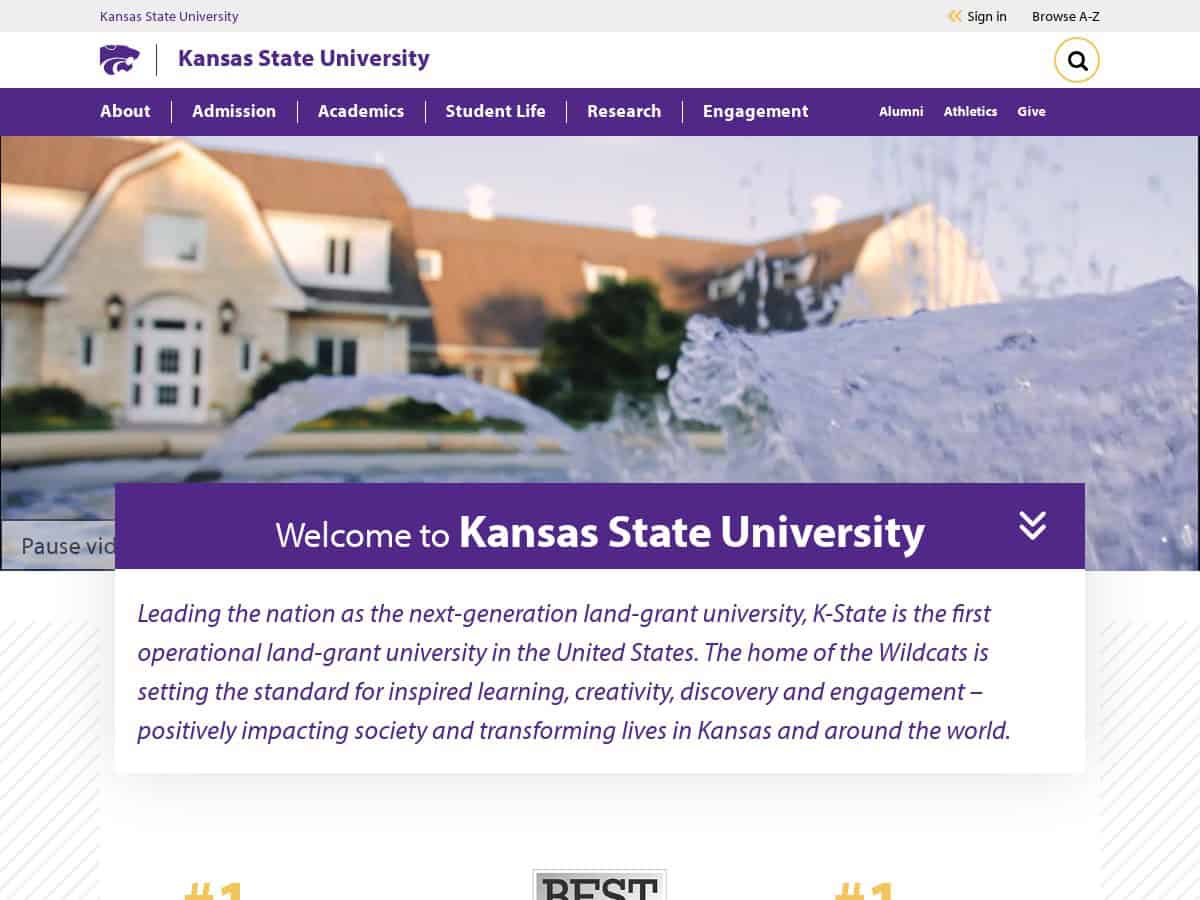
Kansas State University grew out of Bluemont Central College, a private school in Manhattan, Kansas, and was reorganized in 1863 as the state’s land-grant college after the federal Morrill Act of 1862. The university describes itself as the nation’s first operational land-grant university.
From the beginning the college taught agriculture, science and military science. Its name changed in 1931 to Kansas State College of Agriculture and Applied Science and again in 1959 to Kansas State University of Agriculture and Applied Science.
Today K-State operates from three physical campuses: the flagship campus in Manhattan, the Salina campus, home to aviation and technology programs, and the Olathe campus, an innovation campus in the Kansas City area, with K-State Online supplementing them. The university reports more than 21,000 students, and its fall 2025 enrollment was 21,213.
Domains taught:
Agriculture, AI and Machine Learning, Data Analytics, Engineering, Life Sciences, Software Engineering
Diplomas*:
Bachelor, Doctor, Master
Status:
Public
Partnerships:
Land-grant university. Strong focus on agricultural research, animal health (Biosecurity Research Institute), and engineering. Home to the National Bio and Agro-Defense Facility (NBAF).
Research:
A research university with strengths in agricultural sciences, veterinary medicine, food safety and security, engineering, and plant sciences.
Famous Alumnis:
Earl Woods, Sam Brownback, Jordy Nelson, Erin Brockovich (attended briefly)
International recognition**:
Number of staff***:
5000
Current students***:
20000
Foreign students***:
5%
Cumulative former students***:
180000
Pros
Leading programs in agriculture and veterinary medicine, strong research in biosecurity, friendly campus community in a classic college town.
Cons
Located in a smaller city in Kansas, some programs less nationally prominent than KU, state funding challenges.
Best For
Students seeking strong programs in agriculture, veterinary medicine, or engineering at a major land-grant university with a focus on research relevant to food systems and biosecurity.
Washington State University in Pullman lists agriculture, veterinary medicine and engineering.
Agriculture, aerospace engineering and water research are among the specialties at Utah State University in Logan.
Most Similar Schools Abroad
University of Guelph in Canada lists agriculture and food science, veterinary medicine and environmental science.
Also in Canada, University of Saskatchewan is listed for agriculture and bioresources and water security.
Swedish University of Agricultural Sciences focuses on agricultural sciences, forestry and veterinary medicine.
Norwegian University of Life Sciences in Norway covers life sciences, environmental sciences and veterinary studies.
University of Reading in England lists agriculture and meteorology, with Henley business.
*our own picks (our criteria: a mix between domains, diploma delivered, reputation and size), but obviously too many criteria for an apple-to-apple ranking.
FAQ
When was Kansas State University founded?
It was reorganized in 1863 as the state's land-grant college, growing out of the earlier Bluemont Central College. It was the first college created under the Morrill Act of 1862.
What does land-grant mean for K-State?
The university grew out of the federal Morrill Act of 1862, which created land-grant colleges focused on agriculture and science. K-State describes itself as the nation's first operational land-grant university.
Where are the campuses located?
The flagship campus is in Manhattan, Kansas, and additional campuses are in Salina and Olathe. K-State Online supplements the physical campuses.
What happens at the Salina and Olathe campuses?
Salina is the home of the aviation and technology programs, while Olathe is an innovation campus in the Kansas City area.
How many students attend?
The university reports more than 21,000 students, and its fall 2025 enrollment was 21,213. Current figures are published by the university.
How did the university's name change?
It was Kansas State Agricultural College until 1931, then Kansas State College of Agriculture and Applied Science, and since 1959 Kansas State University of Agriculture and Applied Science.
How can I find tuition and admission information?
The official K-State website lists tuition, scholarships and entry requirements for each campus and degree program.
*: without any judgment of the quality, readers are strongly encouraged to check the official status of the exact diploma envisioned as many universities have a mix of recognized diplomas, not recognized, “co-delivered,” “equivalent to”, “some pathways” (…), can change over time, and can be named differently from one country to another.
**: international reputation: is based on some criteria that do not mean much in some domains or specialties (number of researchers, of scientific publications, on budget ….). Our approximate 1-4 scale:
known locally
known locally and internationally
is listed in some of the world university’s classifications
is listed among the 20 firsts in some of world university’s classifications
***: estimated numbers, based on online sources and/or feedbacks. The numbers can vary greatly depending on school organisation (ex.: school is part of a group, it employs internal staff or external consultants or has public staff without employing them …). Refer to all the links provided to have accurate and updated numbers.
Innovation.world is not affiliated with this school/university. We recommend to contact them directly on their website for any special request.
To complete or correct any information here or share your opinion, please comment below or > send us a direct message <.