Address: Technopôle Brest Iroise, CS 83818, 29238 Brest, Bretagne, France
Digital Technologies & Computer Science, Energy & Environmental Engineering, Industrial & Nuclear Engineering
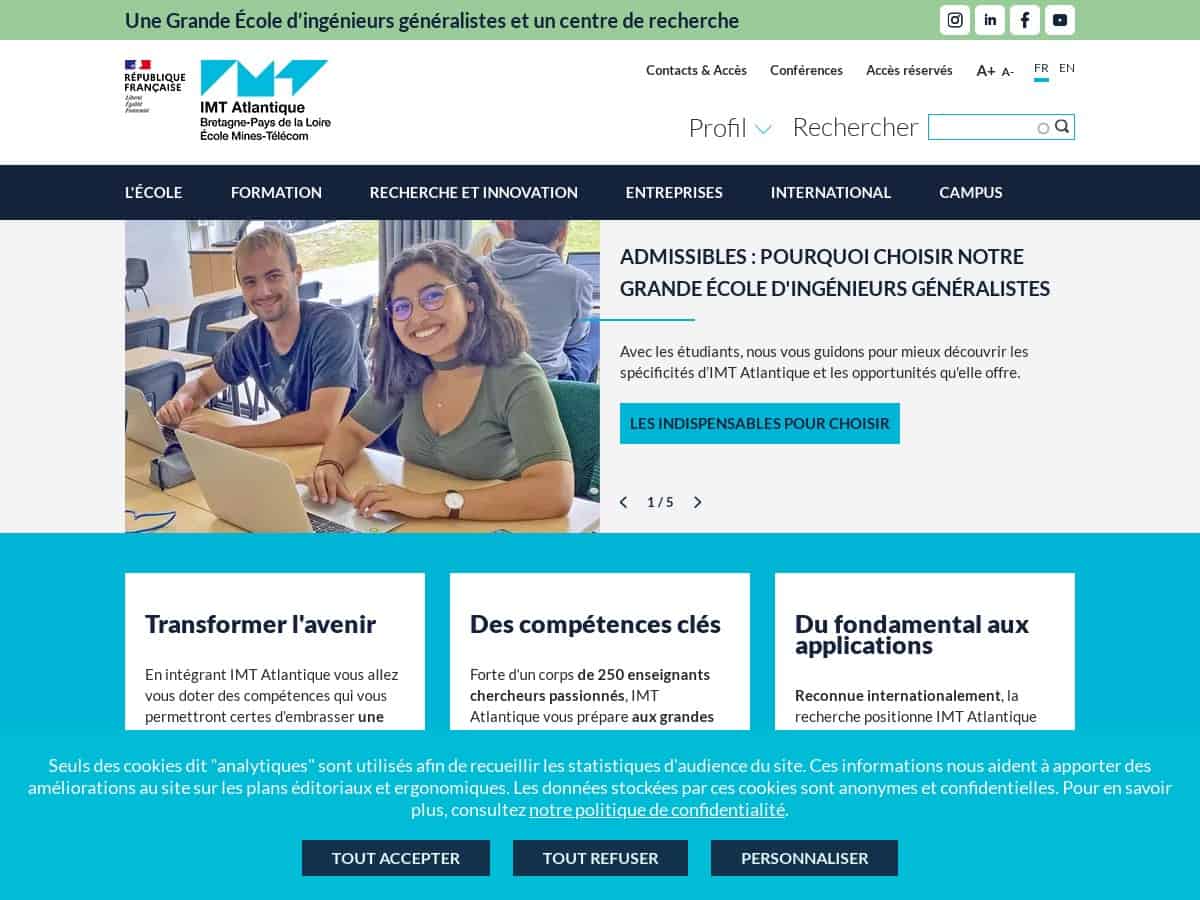
IMT Atlantique is a French grande école d’ingénieurs created in 2017 by merging the École nationale supérieure des mines de Nantes and Télécom Bretagne. It belongs to the Institut Mines-Télécom and works on three campuses in western France: Brest (Plouzané), Nantes (La Chantrerie) and Rennes (Cesson-Sévigné).
The school trains engineers, master’s students and doctoral candidates, and describes its fields as digital technology, energy and the environment. Its research departments cover subjects such as computer science, data science, optics, microwaves, network systems and cybersecurity, and the Subatech laboratory. It works with joint research units such as IRISA, Lab-STICC and LS2N and offers 30 doctoral specialities.
Télécom Bretagne, one of the two founding schools, was the workplace of Claude Berrou, who with Alain Glavieux developed turbo codes, a family of error-correction codes, and received the Marconi Prize in 2005. In the L’Étudiant ranking of engineering schools IMT Atlantique placed third in 2026.
Domains taught:
Aerospace, AI and Machine Learning, Automation, Bioengineering, Bioinformatics, Chemistry, Computer Vision, Data Analytics, Ecology and Sustainability, Electrical and Electronics, Engineering, Fluid Dynamics, Industrial Design, Life Sciences, Logistics, Manufacturing, Marine Science, Materials, Mathematics, Mechanical Engineering, Microbiology and Genetics, Nanotechnologies, Optics, Physics, Process Control, Project Management, Quality, Robotics, Signal Processing, Software Engineering, Statistics, Structural Engineering, Telecommunications, Thermodynamics, Transportations
Diplomas*:
Doctor, Master, MBA
Status:
Public
Partnerships:
Part of IMT. Numerous international partnerships and industrial collaborations (e.g., Orange, EDF, Naval Group).
Research:
Cybersecurity and AI, IoT and networks, Nuclear engineering and energy transition, Marine renewable energies, Environmental engineering.
Famous Alumnis:
N/A
International recognition**:
Number of staff***:
800
Current students***:
2300
Foreign students***:
30%
Cumulative former students***:
N/A (Recent merger)
Pros
Top-tier engineering school in digital, energy, and environment, strong research focus, multiple campuses with specific expertises.
Télécom SudParis, a public school in Évry-Courcouronnes, works in networks and telecommunications and in computer science and software engineering.
In Saint-Étienne, Mines Saint-Étienne is public and combines materials science and engineering with industrial engineering and manufacturing.
Mines Paris - PSL, a public school in Paris, covers energy engineering, materials science, and applied mathematics and computer science.
CentraleSupélec in Gif-sur-Yvette is a public school offering generalist engineering, energy and computer science.
Grenoble INP - Institut d'ingénierie et de management is public, in Grenoble, with various engineering specialties and nanosciences and microelectronics.
Most Similar Schools Abroad
Technische Universiteit Delft in the Netherlands is listed for aerospace, civil and computer engineering.
Aalto University, in Espoo, Finland, focuses on engineering and information and computer science.
The Technical University of Denmark, in Kongens Lyngby, adds wind energy and biotechnology to engineering.
Norwegian University of Science and Technology in Trondheim, Norway, covers engineering, technology and natural sciences.
EPFL, in the canton of Vaud, Switzerland, offers engineering, computer science and life sciences.
*our own picks (our criteria: a mix between domains, diploma delivered, reputation and size), but obviously too many criteria for an apple-to-apple ranking.
FAQ
How was IMT Atlantique formed?
It was created in 2017 through the merger of the École nationale supérieure des mines de Nantes and Télécom Bretagne.
Where are the campuses?
There are three: Brest in Plouzané, Nantes at La Chantrerie, and Rennes in Cesson-Sévigné. Each site hosts teaching and research departments.
Which network does the school belong to?
IMT Atlantique is a member of the Institut Mines-Télécom, a group of engineering and technological schools. It also takes part in research through joint units with partners.
What research is carried out?
Departments cover themes such as computer science, data science, optics, microwaves, network systems and cybersecurity, plus the Subatech laboratory. Joint research units include IRISA, Lab-STICC and LS2N.
Can students prepare a doctorate there?
Yes, the school lists 30 doctoral specialities. Doctoral work is linked to the research departments and joint laboratories.
What notable research came out of the predecessor schools?
Claude Berrou of Télécom Bretagne co-developed turbo codes with Alain Glavieux and received the Marconi Prize in 2005.
How is IMT Atlantique ranked?
In the L'Étudiant ranking of engineering schools it placed third in 2026. Rankings use different criteria, so applicants should compare several sources.
Artificial Intelligence (AI), Cybersecurity, Energy, Environmental Engineering, Internet of Things (IoT), Renewable Energy
*: without any judgment of the quality, readers are strongly encouraged to check the official status of the exact diploma envisioned as many universities have a mix of recognized diplomas, not recognized, “co-delivered,” “equivalent to”, “some pathways” (…), can change over time, and can be named differently from one country to another.
**: international reputation: is based on some criteria that do not mean much in some domains or specialties (number of researchers, of scientific publications, on budget ….). Our approximate 1-4 scale:
known locally
known locally and internationally
is listed in some of the world university’s classifications
is listed among the 20 firsts in some of world university’s classifications
***: estimated numbers, based on online sources and/or feedbacks. The numbers can vary greatly depending on school organisation (ex.: school is part of a group, it employs internal staff or external consultants or has public staff without employing them …). Refer to all the links provided to have accurate and updated numbers.
Innovation.world is not affiliated with this school/university. We recommend to contact them directly on their website for any special request.
To complete or correct any information here or share your opinion, please comment below or > send us a direct message <.