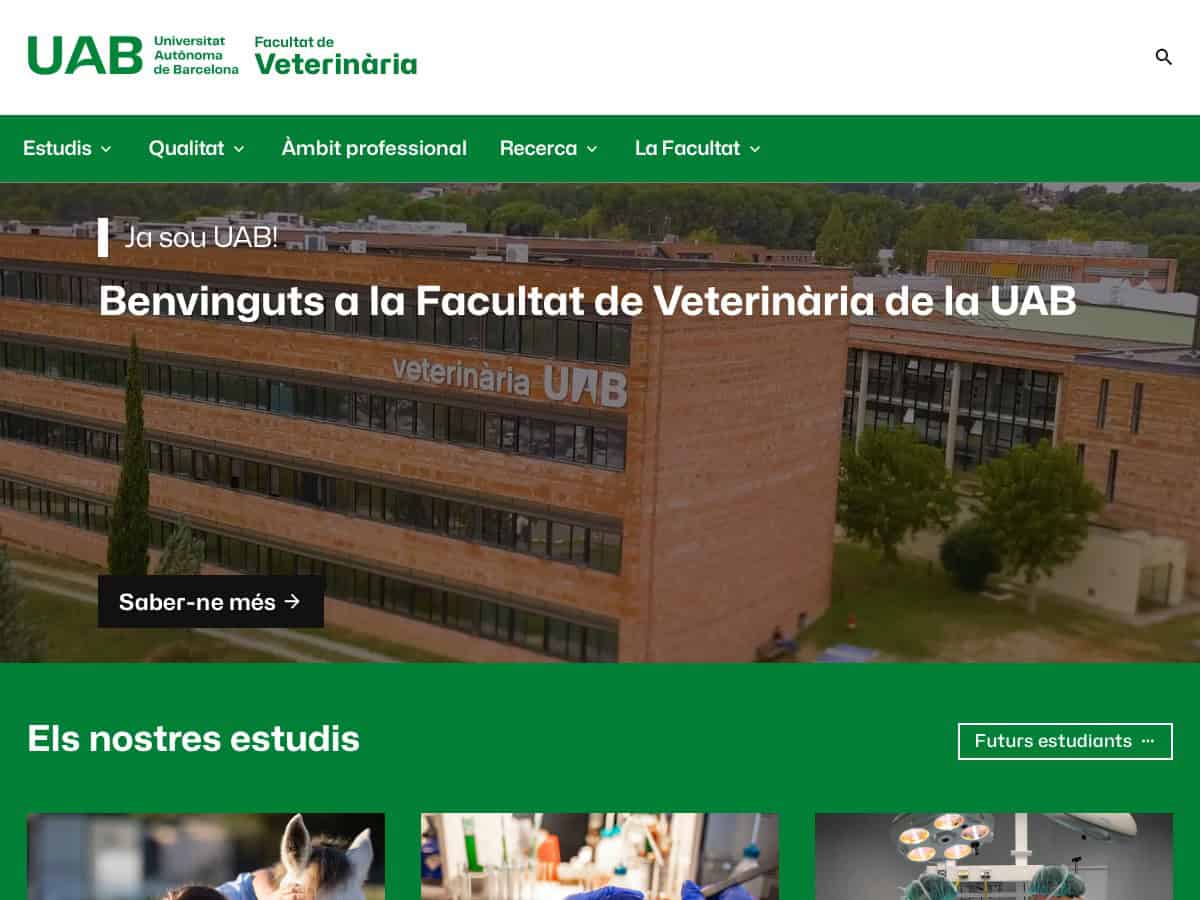
Address: Campus de la UAB, Edifici V, Travessera dels Turons, 08193 Bellaterra (Cerdanyola del Vallès), Barcelona, Spain
Food Science and Technology, Animal Health
The Faculty of Veterinary Medicine of the Autonomous University of Barcelona (UAB) is a leading center for veterinary education and research. While primarily focused on animal health, it offers a degree in Food Science and Technology, which has strong scientific and technical components relevant to engineering and applied sciences.
Domains taught:
Agriculture, Bioengineering, Bioinformatics, Chemistry, Food Science, Microbiology and Genetics, Process Control, Quality
Diplomas*:
Bachelor, Doctor, Master
Status:
Public
Partnerships:
Part of UAB. Collaborations with food industries, agri-food research centers (e.g., IRTA), and veterinary hospitals. International agreements for student and staff mobility. EAEVE accredited.
Research:
Research in animal health, food safety, food processing technology, animal nutrition, and biotechnology related to food production.
Famous Alumnis:
N/A
International recognition**:
Number of staff***:
250
Current students***:
1500
Foreign students***:
10%
Cumulative former students***:
10000
Pros
Offers a highly-regarded Food Science and Technology program within a prestigious veterinary faculty with excellent facilities (e.g., pilot plants).
Cons
Primary focus of the faculty is veterinary medicine. The Food Science program is one of several.
Best For
Students interested in Food Science and Technology with a strong scientific and research basis.
Facultad de Ciencias Biológicas y Ambientales sits close to this institution on agriculture, food science and bioinformatics; it is also a public institution, and teaches at the same levels, namely bachelor's, master's and doctoral.
A good alternative in the same country is Escola d'Enginyeria Agroalimentària i de Biosistemes de Barcelona, which likewise covers agriculture, food science and bioengineering; it covers ecology and sustainability and engineering as well, and is smaller, enrolling about 800 students against roughly 1,500 here.
Facultad de Ciencias Agrarias y Ambientales follows much the same lines as this university, with agriculture, food science and microbiology and genetics as common ground, and it covers geotechnics and ecology and sustainability as well, and is smaller, enrolling about 900 students against roughly 1,500 here.
Barcelona School of Telecommunications Engineering takes a similar route through bioengineering, and it teaches at the same levels, namely bachelor's, master's and doctoral, and covers nanotechnologies and optics as well.
Consejo Superior de Investigaciones Científicas follows much the same lines as this university, with agriculture, food science and quality as common ground, and it is slightly larger, at about 2,000 students against roughly 1,500 here, and is also a public institution.
Most Similar Schools Abroad
If this university is on your list for agriculture, food science and bioinformatics, Wageningen University & Research in the Netherlands deserves a comparison, because it teaches at the same levels, namely bachelor's, master's and doctoral, and covers marine science and nanotechnologies as well.
VetAgro Sup in France is the nearest foreign match on agriculture, food science and quality; it covers logistics and thermodynamics as well, and is slightly larger, at about 1,800 students against roughly 1,500 here.
Kumamoto Prefectural University in Japan shares the agriculture, food science and quality orientation of this university, and it covers thermodynamics and project management as well, and has almost the same size, at about 1,500 students.
Swedish University of Agricultural Sciences offers an international parallel to this institution, with agriculture, food science and bioinformatics as common ground; it is also a public institution, and runs the same bachelor's, master's and doctoral programmes.
If this university is on your list for agriculture, food science and microbiology and genetics, Norwegian University of Life Sciences in Norway deserves a comparison, because it is far larger, with about 6,000 students against roughly 1,500 here, and is also a public institution.
*our own picks (our criteria: a mix between domains, diploma delivered, reputation and size), but obviously too many criteria for an apple-to-apple ranking.
*: without any judgment of the quality, readers are strongly encouraged to check the official status of the exact diploma envisioned as many universities have a mix of recognized diplomas, not recognized, “co-delivered,” “equivalent to”, “some pathways” (…), can change over time, and can be named differently from one country to another.
**: international reputation: is based on some criteria that do not mean much in some domains or specialties (number of researchers, of scientific publications, on budget ….). Our approximate 1-4 scale:
known locally
known locally and internationally
is listed in some of the world university’s classifications
is listed among the 20 firsts in some of world university’s classifications
***: estimated numbers, based on online sources and/or feedbacks. The numbers can vary greatly depending on school organisation (ex.: school is part of a group, it employs internal staff or external consultants or has public staff without employing them …). Refer to all the links provided to have accurate and updated numbers.
Innovation.world is not affiliated with this school/university. We recommend to contact them directly on their website for any special request.
To complete or correct any information here or share your opinion, please comment below or > send us a direct message <.