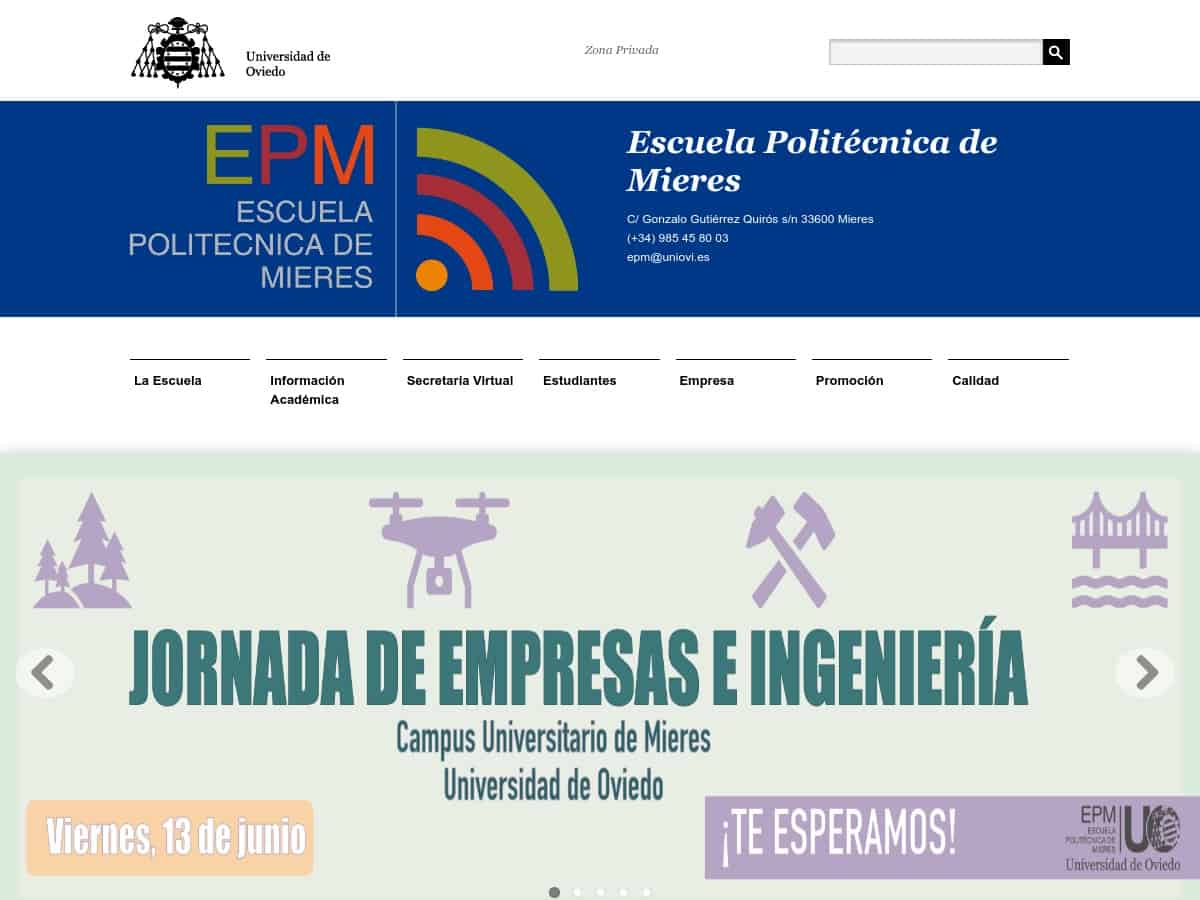
Mining and Energy Resources Engineering, Forestry and Natural Environment Engineering, Civil Engineering
The Polytechnic School of Mieres is part of the University of Oviedo (UNIOVI), strategically located in a historic Asturian mining basin. It offers degrees in mining and energy resources engineering, forestry and natural environment engineering, civil engineering, and geomatics.
Domains taught:
Agriculture, Civil Engineering, Ecology and Sustainability, Engineering, Geotechnics
Diplomas*:
Bachelor, Doctor, Master
Status:
Public
Partnerships:
Part of UNIOVI, with international exchange programs. Strong links to regional industries related to mining, forestry, civil works, geomatics, and environmental services.
Research:
Research in areas like sustainable mining, forest management and certification, civil infrastructure planning, geomatics technologies for resource management, and environmental restoration.
Famous Alumnis:
N/A
International recognition**:
Number of staff***:
120
Current students***:
900
Foreign students***:
10%
Cumulative former students***:
4000
Pros
Offers a unique combination of engineering programs relevant to resource management and territorial development in a historically industrial area. Modern campus facilities.
Cons
Smaller campus school. Recognition linked to UNIOVI and specific fields. Might be perceived as geographically isolated by some.
Best For
Students seeking engineering degrees related to natural resources, forestry, civil works, or geomatics in Asturias.
In terms of fields, Escuela Técnica Superior de Ingeniería de Montes, Forestal y del Medio Natural is the nearest neighbour, with agriculture, geotechnics and civil engineering again at the core; it covers project management and materials as well, and is larger, enrolling about 1,500 students against roughly 900 here.
Think of Escuela Superior y Técnica de Ingenieros de Minas when geotechnics, civil engineering and engineering is the priority: it covers materials as well, and is slightly smaller, at about 700 students against roughly 900 here.
Where this school leans on geotechnics, civil engineering and engineering, Escuela Politécnica Superior de Belmez does the same, and it is smaller, enrolling about 400 students against roughly 900 here, and is also a public institution.
Think of Escola Politécnica Superior de Enxeñaría when agriculture, geotechnics and civil engineering is the priority: it covers food science and chemistry as well, and is larger, enrolling about 2,000 students against roughly 900 here.
Also strong in geotechnics, civil engineering and ecology and sustainability, Escola de Enxeñaría de Minas e Enerxía makes a sensible second look at home; it is also a public institution and does not run the doctoral programmes found here.
Most Similar Schools Abroad
For agriculture, geotechnics and civil engineering outside the home country, Tuva State University in Russia is a natural reference; it is also a public institution, and teaches at the same levels, namely bachelor's, master's and doctoral.
In India, School of Planning and Architecture Bhopal teaches much the same core subjects, geotechnics, civil engineering and ecology and sustainability, and it is also a public institution, and runs the same bachelor's, master's and doctoral programmes.
If this school is on your list for geotechnics, civil engineering and ecology and sustainability, School of Planning and Architecture Vijayawada in India deserves a comparison, because it is also a public institution, and teaches at the same levels, namely bachelor's, master's and doctoral.
For geotechnics, civil engineering and ecology and sustainability outside the home country, École Nationale Supérieure d'Architecture et de Paysage de Bordeaux in France is a natural reference; it has almost the same size, at about 900 students, and is also a public institution.
The closest overseas parallel on agriculture, geotechnics and ecology and sustainability is National University of Life and Environmental Sciences of Ukraine, located in Ukraine; it covers food science and bioengineering as well, and is far larger, with about 26,000 students against roughly 900 here.
*our own picks (our criteria: a mix between domains, diploma delivered, reputation and size), but obviously too many criteria for an apple-to-apple ranking.
*: without any judgment of the quality, readers are strongly encouraged to check the official status of the exact diploma envisioned as many universities have a mix of recognized diplomas, not recognized, “co-delivered,” “equivalent to”, “some pathways” (…), can change over time, and can be named differently from one country to another.
**: international reputation: is based on some criteria that do not mean much in some domains or specialties (number of researchers, of scientific publications, on budget ….). Our approximate 1-4 scale:
known locally
known locally and internationally
is listed in some of the world university’s classifications
is listed among the 20 firsts in some of world university’s classifications
***: estimated numbers, based on online sources and/or feedbacks. The numbers can vary greatly depending on school organisation (ex.: school is part of a group, it employs internal staff or external consultants or has public staff without employing them …). Refer to all the links provided to have accurate and updated numbers.
Innovation.world is not affiliated with this school/university. We recommend to contact them directly on their website for any special request.
To complete or correct any information here or share your opinion, please comment below or > send us a direct message <.