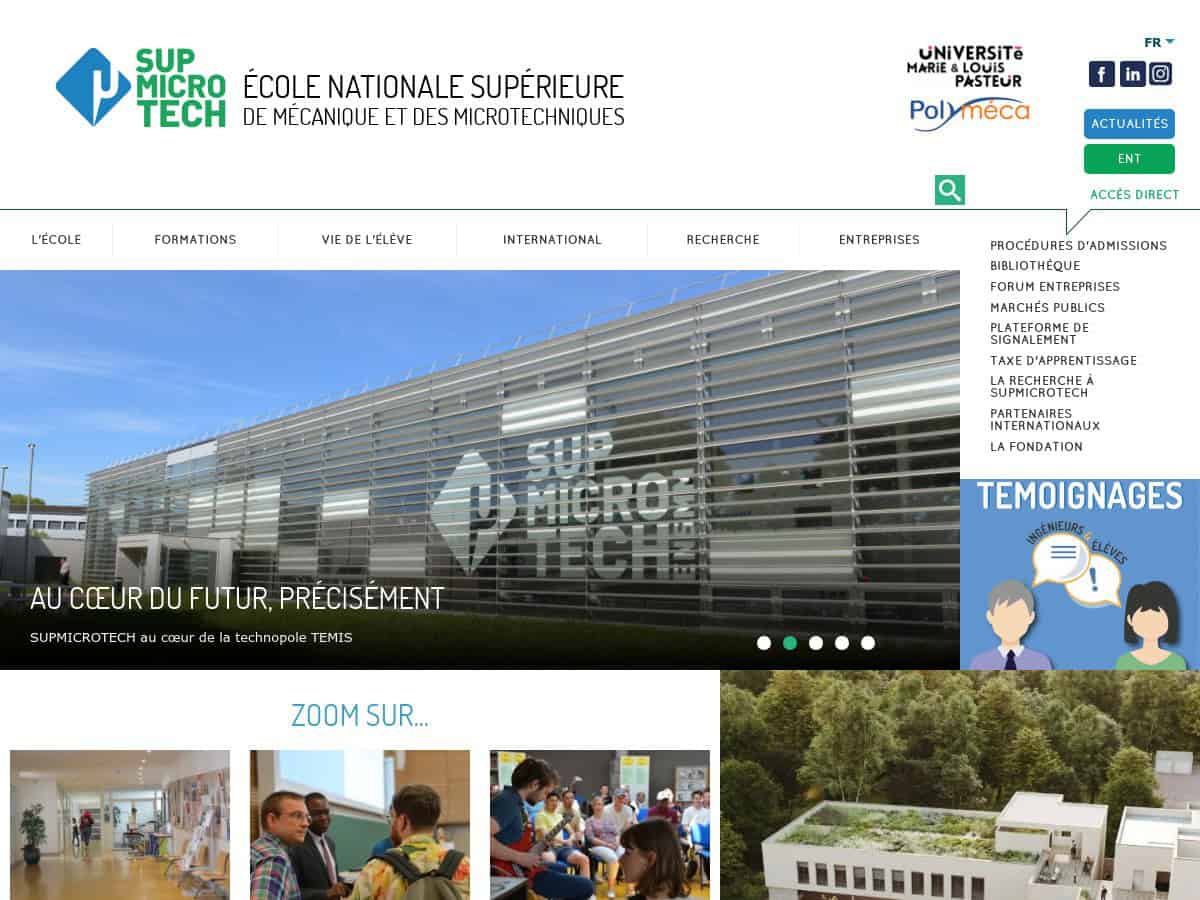
A chronometry laboratory set up in Besançon, in eastern France, in 1902 is the origin of the school now known as Supmicrotech-ENSMM, officially the École Nationale Supérieure de Mécanique et des Microtechniques. It took the ENSMM name in 1980, became a public establishment of a scientific, cultural and professional character in 2018, and was renamed Supmicrotech-ENSMM in 2022.
The school offers engineering degrees, including through apprenticeship routes, along with several master’s programmes. Its fields combine mechanics, mechatronics and microsystems, and its training covers areas such as materials science and micromechanics.
The school stands in the Temis microtechnology district of Besançon and hosts research teams of the FEMTO-ST institute. It belongs to the Polyméca network of mechanical engineering schools and to the n+i network of international engineering schools.
Domains taught:
AI and Machine Learning, Automation, Bioengineering, Computer Vision, Data Analytics, Electrical and Electronics, Engineering, Fluid Dynamics, Industrial Design, Life Sciences, Manufacturing, Materials, Mathematics, Mechanical Engineering, Metrology, Nanotechnologies, Optics, Physics, Process Control, Project Management, Quality, Robotics, Signal Processing, Software Engineering, Statistics, Structural Engineering, Telecommunications, Thermodynamics
Diplomas*:
Doctor, Master
Status:
Public
Partnerships:
Associated with Université de Franche-Comté. Strong links with the microtechnology and watchmaking industries in the region (FEMTO-ST research institute).
Research:
Microsystems and nanodevices, Robotics and automation, Advanced manufacturing, Biomedical engineering, Time-frequency metrology.
Famous Alumnis:
N/A
International recognition**:
Number of staff***:
250
Current students***:
900
Foreign students***:
10%
Cumulative former students***:
10000
Pros
Leading institution in microtechnology and mechatronics, strong research (FEMTO-ST), good industry connections in precision engineering.
Cons
Highly specialized, located in Besançon.
Best For
Leading engineering school for mechanics, microtechnology, mechatronics, and robotics.
Université de Technologie de Compiègne, in Compiègne, lists bioengineering, computer engineering and AI, and mechanical engineering and design among its specialties.
Université Savoie Mont Blanc, in Chambéry, lists mountain environment and engineering together with mechatronics and industrial engineering.
INSA Strasbourg, in Strasbourg, lists civil engineering and architecture, mechanical engineering, and surveying and geomatics.
Grenoble INP - Institut d'ingénierie et de management, in Grenoble, lists nanosciences and microelectronics among its specialties.
École Centrale de Lyon, based in Écully, lists general engineering, mechanical engineering and acoustics.
Most Similar Schools Abroad
Switzerland: CSEM - Centre Suisse d'Electronique et de Microtechnique, in Neuchâtel, lists microtechnology, systems engineering and photonics.
Spain: Mondragon Unibertsitatea - Goi Eskola Politeknikoa / Escuela Politécnica Superior lists mechanical engineering, industrial electronics and computer engineering.
Netherlands: Universiteit Twente, in Enschede, lists biomedical engineering and robotics.
Germany: Technische Universität Chemnitz, in Chemnitz, lists mechanical engineering and lightweight construction, microelectronics and mechatronics.
Japan: Ritsumeikan University, in Kusatsu, lists information science and engineering, mechanical engineering, and robotics and mechatronics.
*our own picks (our criteria: a mix between domains, diploma delivered, reputation and size), but obviously too many criteria for an apple-to-apple ranking.
FAQ
What was the starting point of the school?
A chronometry laboratory created in Besançon in 1902, from which the later engineering school developed.
Under which names is the school known?
Its official name is École Nationale Supérieure de Mécanique et des Microtechniques (ENSMM), and since 2022 it uses the name Supmicrotech-ENSMM.
Which engineering fields does it cover?
Mechanics, mechatronics and microsystems, with training in areas such as materials science and micromechanics.
Can the engineering degree be earned through apprenticeship?
Yes. The school presents an apprenticeship route to becoming an engineer.
How is research connected to the school?
Research teams of the FEMTO-ST institute are housed at the school.
Does the school belong to any networks?
Yes: Polyméca, the national network of mechanical engineering schools, and the international n+i network.
Where does a visitor find the campus?
In Besançon, in the Temis microtechnology district.
Additive Manufacturing, Design for Additive Manufacturing (DfAM), Micro-electromechanical Systems (MEMS), Robotics
*: without any judgment of the quality, readers are strongly encouraged to check the official status of the exact diploma envisioned as many universities have a mix of recognized diplomas, not recognized, “co-delivered,” “equivalent to”, “some pathways” (…), can change over time, and can be named differently from one country to another.
**: international reputation: is based on some criteria that do not mean much in some domains or specialties (number of researchers, of scientific publications, on budget ….). Our approximate 1-4 scale:
known locally
known locally and internationally
is listed in some of the world university’s classifications
is listed among the 20 firsts in some of world university’s classifications
***: estimated numbers, based on online sources and/or feedbacks. The numbers can vary greatly depending on school organisation (ex.: school is part of a group, it employs internal staff or external consultants or has public staff without employing them …). Refer to all the links provided to have accurate and updated numbers.
Innovation.world is not affiliated with this school/university. We recommend to contact them directly on their website for any special request.
To complete or correct any information here or share your opinion, please comment below or > send us a direct message <.