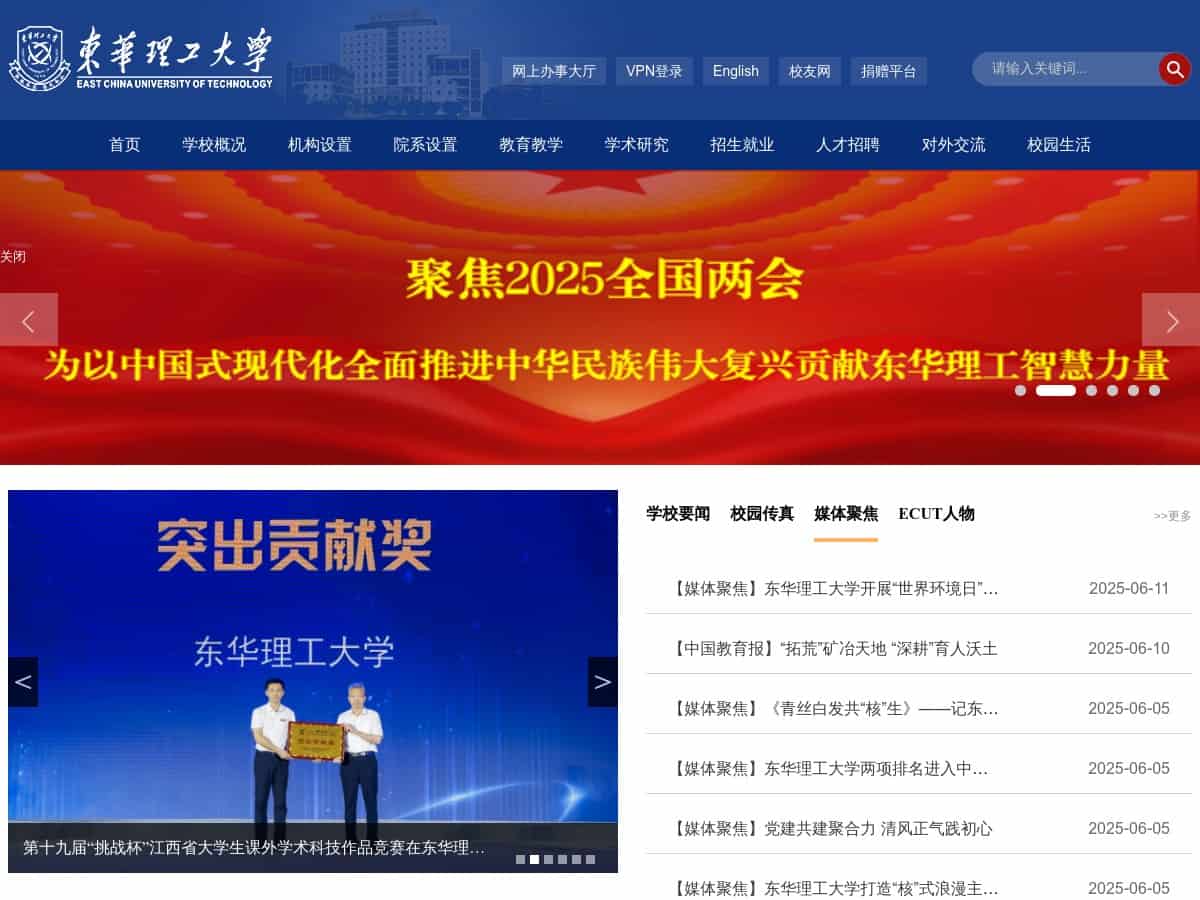
East China University of Technology (东华理工大学) is a university in Jiangxi Province, with its main campus in Nanchang and a second campus in Fuzhou. Its history begins in 1956, and it describes itself as the first higher-education institution of China’s nuclear industry.
The university is jointly supported by the Jiangxi provincial government and national bodies connected to the nuclear and geological sectors. Its profile combines geoscience and nuclear science with a broader science and engineering curriculum, and teaching units include colleges of earth sciences, nuclear science and engineering, surveying and geoinformatics, and chemistry and materials.
Alongside its nuclear and geoscience specialisms, the university has developed programmes in economics, management, humanities, law, education and the arts, so that it operates as a comprehensive institution with a distinct nuclear and geological identity.
Domains taught:
AI and Machine Learning, Automation, Bioengineering, Chemistry, Civil Engineering, Computer Vision, Data Analytics, Ecology and Sustainability, Electrical and Electronics, Engineering, Fluid Dynamics, Geotechnics, Life Sciences, Manufacturing, Materials, Mathematics, Mechanical Engineering, Microbiology and Genetics, Nanotechnologies, Optics, Physics, Process Control, Project Management, Robotics, Signal Processing, Software Engineering, Statistics, Structural Engineering, Telecommunications, Thermodynamics, Transportations
Diplomas*:
Bachelor, Doctor, Master
Status:
Public
Partnerships:
Key university for nuclear science and geology in Jiangxi. Strong collaborations with nuclear industry and geological survey agencies.
CUG, a public university in Wuhan, lists geology and geological engineering, geophysics and geomatics, and environmental science and engineering.
CUGB in Beijing is a public geoscience university with the same list of geology, geophysics and environmental fields.
East China Jiaotong University is also based in Nanchang and lists railway transportation, civil engineering and mechanical and electrical engineering.
Chang'an University, a public institution in Xi'an, lists road and railway engineering, automotive engineering and geological engineering.
Kunming University of Science and Technology in Kunming, public, offers metallurgical, materials and mining engineering.
Most Similar Schools Abroad
Technische Universität Bergakademie Freiberg in Germany, located in Freiberg, joins geosciences and mining engineering with materials science and metallurgy.
Russian State Geological Prospecting University, in Moscow, Russia, teaches geology, geophysical methods and hydrogeology.
Ural State Mining University in Yekaterinburg, Russia, lists mining engineering, geology and mineral processing.
*our own picks (our criteria: a mix between domains, diploma delivered, reputation and size), but obviously too many criteria for an apple-to-apple ranking.
FAQ
When was East China University of Technology founded?
The university dates its origin to 1956. It is described as the first higher-education institution established for China's nuclear industry.
Where are the campuses of ECUT?
The main campus is in Nanchang, Jiangxi Province, and a second campus is in Fuzhou, also in Jiangxi. The two sites are in different cities of the province.
Which Chinese characters spell the university's name?
It is called 东华理工大学 in Chinese. The abbreviation ECUT is used in English.
Which subjects give the university its character?
Nuclear science and technology and the geosciences define its profile. Surveying, chemistry, materials and environmental engineering support these core fields.
Who supports the university financially and administratively?
The Jiangxi provincial government is involved in running the institution. National bodies tied to the nuclear industry and natural resources co-sponsor it as well.
What other disciplines does ECUT teach besides science and engineering?
Programmes in economics, management, law, education and the arts are taught as well. The university thus presents itself as a comprehensive institution.
*: without any judgment of the quality, readers are strongly encouraged to check the official status of the exact diploma envisioned as many universities have a mix of recognized diplomas, not recognized, “co-delivered,” “equivalent to”, “some pathways” (…), can change over time, and can be named differently from one country to another.
**: international reputation: is based on some criteria that do not mean much in some domains or specialties (number of researchers, of scientific publications, on budget ….). Our approximate 1-4 scale:
known locally
known locally and internationally
is listed in some of the world university’s classifications
is listed among the 20 firsts in some of world university’s classifications
***: estimated numbers, based on online sources and/or feedbacks. The numbers can vary greatly depending on school organisation (ex.: school is part of a group, it employs internal staff or external consultants or has public staff without employing them …). Refer to all the links provided to have accurate and updated numbers.
Innovation.world is not affiliated with this school/university. We recommend to contact them directly on their website for any special request.
To complete or correct any information here or share your opinion, please comment below or > send us a direct message <.