Address: The Palatine Centre, Stockton Road, Durham, DH1 3LE, England, United Kingdom
Arts and Humanities, Sciences, Social Sciences
A collegiate public research university founded in 1832. One of England’s oldest universities, known for its historic campus, academic excellence, and collegiate system. Member of Russell Group.
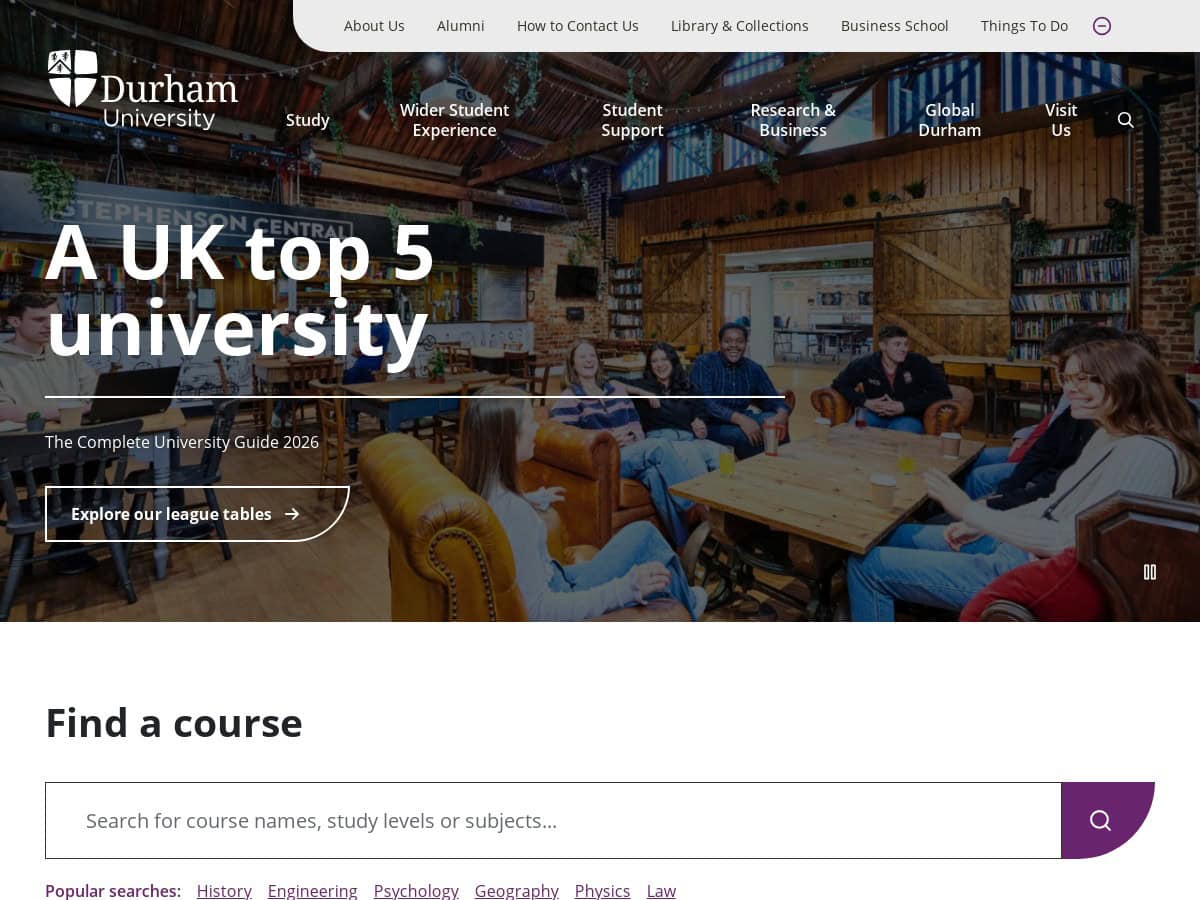
Durham University was founded in 1832 by an Act of Parliament, promoted by Bishop William Van Mildert and the cathedral chapter, and it was the third university in England after Oxford and Cambridge. The setting is exceptional. Durham Castle, a Norman fortress on a rocky peninsula, and Durham Cathedral, a masterpiece of Romanesque architecture, form a World Heritage Site that the university has inhabited since 1837, when University College moved into the castle. About 20,500 students attend, and 4,600 staff work there.
Durham is a collegiate university in the manner of Oxford and Cambridge, with about seventeen colleges. Each college has its own residences, dining hall, bar and teams, and students belong to one for the whole degree. The colleges range from the castle and Hatfield College to modern ones such as Collingwood and Josephine Butler. Formal dinners in gowns and the strong rowing tradition on the River Wear are part of student life.
The academic departments sit on the Science Site, in the south of the city, and across the historic centre. Durham is well known in physics and astronomy, with the Institute for Computational Cosmology and the Centre for Extragalactic Astronomy, and in the earth sciences, theology, history, law, anthropology, geography and business. The Oriental Museum holds Egyptian and Asian collections, and the Palace Green Library displays medieval manuscripts, including some of the Cathedral treasures.
Until 1963, the university included King’s College in Newcastle, which later became Newcastle University, and in the twentieth century Durham grew into a research university and a member of the Russell Group. The writer Bill Bryson served as chancellor from 2005 to 2011. Undergraduate applications go through UCAS. Tuition for home students is capped by the government at about nine and a half thousand pounds a year, while international students pay much higher fees. Check the current tariff.
Durham is a small city with a medieval centre, and London can be reached by direct train in about three hours. Colleges provide housing for many first-year students.
Domains taught:
AI and Machine Learning, Astroscience, Chemistry, Engineering, Life Sciences, Mathematics, Physics
Diplomas*:
Bachelor, Doctor, Master
Status:
Public
Partnerships:
Member of the Russell Group. Global academic partnerships. Research collaborations with industry (e.g. P&G, IBM) and public sector.
Research:
World-leading research across a wide range of disciplines, including physics (cosmology), archaeology, theology, geography, and social sciences.
Famous Alumnis:
George Alagiah, Andrew Strauss, Gabby Logan, Justin Welby, Sir Harold Evans
International recognition**:
Number of staff***:
4600
Current students***:
20500
Foreign students***:
30%
Cumulative former students***:
155000
Pros
Prestigious historic university, collegiate system offering strong student support, strong academic reputation across most subjects, beautiful cathedral city setting.
Cons
Highly competitive admissions, can be perceived as traditional or elitist by some, limited diversity in some colleges.
Best For
High-achieving students seeking a traditional, research-intensive university with a collegiate atmosphere, strong academic standing, and a historic setting.
Anyone who wants a second school in the same country with a similar spread of chemistry, physics and mathematics can consider University of York, and it covers ecology and sustainability and software engineering as well, and has almost the same size, at about 21,000 students.
University of Glasgow takes a similar route through chemistry, physics and mathematics, and it covers software engineering as well, and is larger, enrolling about 36,000 students against roughly 20,500 here.
In terms of fields, University of Cambridge is the nearest neighbour, with chemistry, physics and mathematics again at the core; it covers software engineering as well, and is slightly larger, at about 24,500 students against roughly 20,500 here.
University of Oxford sits close to this institution on chemistry, physics and mathematics; it is slightly larger, at about 26,500 students against roughly 20,500 here, and is also a public institution.
University of St Andrews offers a comparable education in astroscience, chemistry and physics: it covers marine science and data analytics as well, and is smaller, enrolling about 11,645 students against roughly 20,500 here.
Most Similar Schools Abroad
In China, Nanjing University teaches much the same core subjects, astroscience, chemistry and physics, and it is larger, enrolling about 35,700 students against roughly 20,500 here, and is also a public institution.
For chemistry, physics and mathematics outside the home country, University of Innsbruck in Austria is a natural reference; it is slightly larger, at about 28,106 students against roughly 20,500 here, and is also a public institution.
University of Granada brings a Spain setting to the same core fields, astroscience, chemistry and physics, and it is larger, enrolling about 60,000 students against roughly 20,500 here, and is also a public institution.
If this institution is on your list for astroscience, chemistry and physics, University of Cape Town in South Africa deserves a comparison, because it covers finance and civil engineering as well, and is slightly larger, at about 28,233 students against roughly 20,500 here.
On content, University of Oslo in Norway and this institution are close, as both teach astroscience, chemistry and physics; it runs the same bachelor's, master's and doctoral programmes, and covers geotechnics and software engineering as well.
*our own picks (our criteria: a mix between domains, diploma delivered, reputation and size), but obviously too many criteria for an apple-to-apple ranking.
FAQ
Where is Durham University?
In the city of Durham, north-east England.
When was it founded?
In 1832, by an Act of Parliament.
Why is the setting special?
Durham Castle and Cathedral form a World Heritage Site, and the university has used the castle since 1837.
How large is it?
About 20,500 students and 4,600 staff.
How does the college system work?
Students belong to one of about seventeen colleges with its own residences, dining hall and teams for the whole degree.
What is it known for?
Physics and astronomy, earth sciences, theology, history, law, anthropology, geography and business.
What was the link with Newcastle?
Until 1963, the university included King's College in Newcastle, which later became Newcastle University.
Who served as chancellor from 2005 to 2011?
The writer Bill Bryson.
How do you apply?
Undergraduate applications go through UCAS.
What does it cost?
Home tuition is capped at about nine and a half thousand pounds a year. International fees are much higher. Check the current tariff.
*: without any judgment of the quality, readers are strongly encouraged to check the official status of the exact diploma envisioned as many universities have a mix of recognized diplomas, not recognized, “co-delivered,” “equivalent to”, “some pathways” (…), can change over time, and can be named differently from one country to another.
**: international reputation: is based on some criteria that do not mean much in some domains or specialties (number of researchers, of scientific publications, on budget ….). Our approximate 1-4 scale:
known locally
known locally and internationally
is listed in some of the world university’s classifications
is listed among the 20 firsts in some of world university’s classifications
***: estimated numbers, based on online sources and/or feedbacks. The numbers can vary greatly depending on school organisation (ex.: school is part of a group, it employs internal staff or external consultants or has public staff without employing them …). Refer to all the links provided to have accurate and updated numbers.
Innovation.world is not affiliated with this school/university. We recommend to contact them directly on their website for any special request.
To complete or correct any information here or share your opinion, please comment below or > send us a direct message <.