Address: 11 rue Pierre et Marie Curie, 75005 Paris, Île-de-France, France
Chemical Engineering, Materials Chemistry, Molecular Chemistry
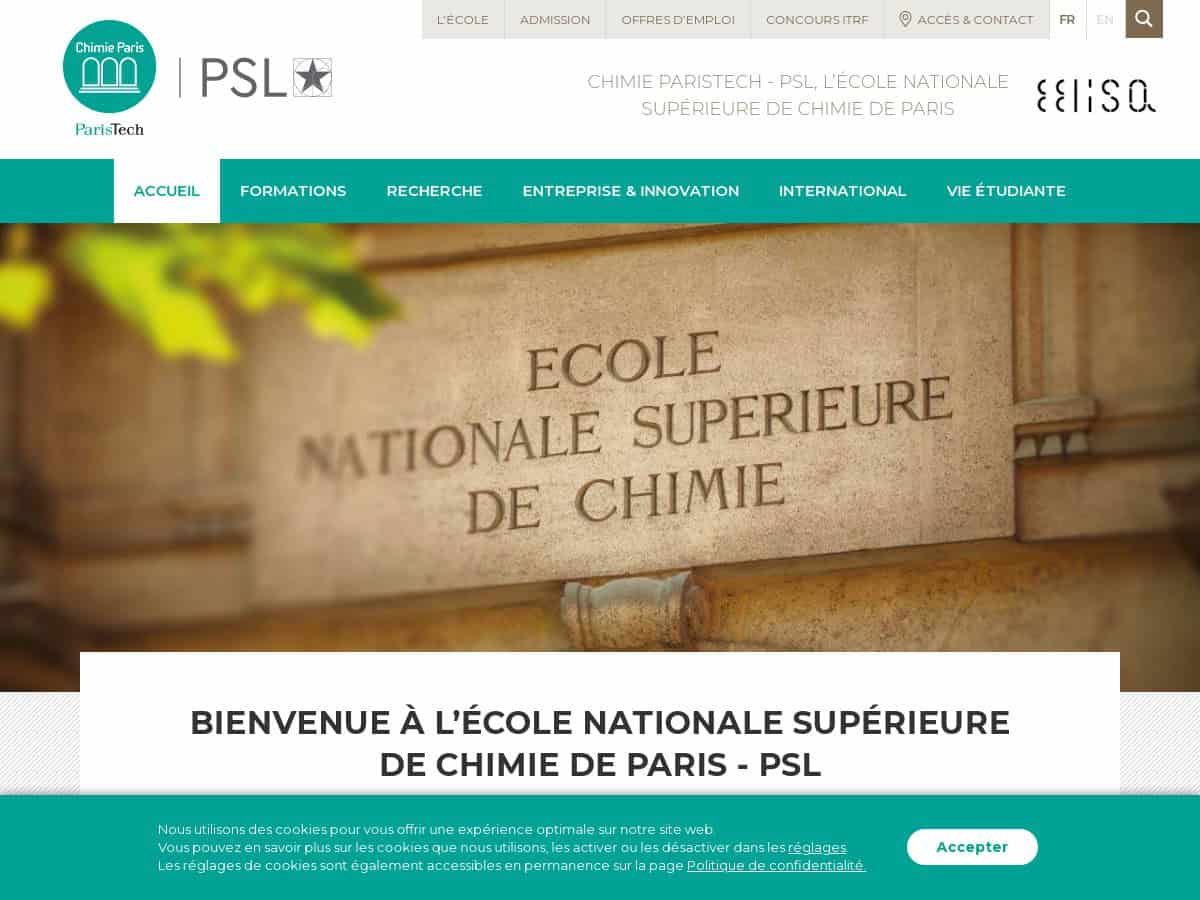
Charles Friedel, a chemist, is named as the founder of Chimie ParisTech – PSL, a grande école devoted to chemistry whose origins go back to 1896. Over the decades the school carried several names, and for much of its history it was known as the École nationale supérieure de chimie de Paris. It is today one of the constituent colleges of Université PSL.
The school stands at 11 rue Pierre et Marie Curie in the 5th arrondissement of Paris, a street where it has been based since 1923. Its main course is a three-year engineering cycle leading to the diplôme d’ingénieur, complemented by master’s programmes and doctoral training in chemistry and related fields.
Research takes place in laboratories hosted by the school, among them the Institut de Recherche de Chimie Paris (IRCP) and the photovoltaic research institute IPVF, which is carried out together with the CNRS.
Domains taught:
Bioengineering, Chemistry, Engineering, Fluid Dynamics, Manufacturing, Materials, Mathematics, Microbiology and Genetics, Nanotechnologies, Optics, Physics, Process Control, Project Management, Quality, Thermodynamics
Diplomas*:
Doctor, Master
Status:
Public
Partnerships:
Constituent college of Université PSL. Part of ParisTech and Gay-Lussac Federation. Partnerships with chemical and pharmaceutical industries (e.g., Solvay, L’Oréal, Sanofi).
Research:
Catalysis & Process Engineering, Materials for Energy & Health, Organic & Bioorganic Chemistry, Physical Chemistry & Analytical Chemistry.
Famous Alumnis:
Eugène Schueller, Georges Claude, Paul Sabatier (taught)
International recognition**:
Number of staff***:
200
Current students***:
500
Foreign students***:
20%
Cumulative former students***:
8000
Pros
Excellence in chemical sciences, strong research focus, located in the Latin Quarter, good career prospects in chemical industry.
Cons
Highly specialized in chemistry, very selective, small institution.
Best For
Elite grande école for chemical sciences and engineering.
ESPCI Paris - PSL is another public school in Paris 5e, built around physics, chemistry and bioengineering.
Mines Paris - PSL, a public school in Paris, teaches energy engineering and materials science alongside applied mathematics and computer science.
For a comparable engineering route outside the capital, Institut National des Sciences Appliquées de Lyon is a public school working in mechanical engineering, computer science and materials science.
AgroParisTech covers food science and engineering together with agronomy and environmental sciences, and is also publicly funded.
Grenoble INP - Institut d'ingénierie et de management adds nanosciences and microelectronics to a broad engineering offer.
Most Similar Schools Abroad
Philipps-Universität Marburg (Germany) is a public university whose profile centres on chemistry, materials science and physics.
In Israel, Weizmann Institute of Science combines chemistry with mathematics, computer science and physics in a research-focused setting.
Universität Konstanz (Germany) is public and pairs chemistry and nanoscience with physics and materials science.
Students interested in chemical sciences could also consider Indian Institute of Science Education and Research Pune (India), which teaches biological, chemical and physical sciences.
*our own picks (our criteria: a mix between domains, diploma delivered, reputation and size), but obviously too many criteria for an apple-to-apple ranking.
FAQ
Who founded Chimie ParisTech - PSL, and when did it begin?
Charles Friedel is credited as its founder, and the school's origins date to 1896. It has since changed names several times and was long called the École nationale supérieure de chimie de Paris.
Where in Paris can the school be found?
It occupies 11 rue Pierre et Marie Curie, in the 5th arrondissement, and has been established on that street since 1923.
Which university grouping is it part of?
Chimie ParisTech is a constituent college of Université PSL, the Paris-based university that gathers several grandes écoles and research institutions. Students and researchers therefore work within the PSL framework while keeping the school's own identity.
What kind of qualification does a student earn there?
The central programme is a three-year engineering cycle that ends with the French engineering diploma. The school also runs master's programmes and doctoral training for those who want a research path.
Which research units are connected with the school?
Its laboratories include the Institut de Recherche de Chimie Paris (IRCP), and the school also hosts the IPVF photovoltaic research institute, run with the CNRS. Together they give students direct contact with research in chemistry and energy.
Where should applicants look for admission rules and tuition fees?
The official website of the school describes the entry routes into the engineering cycle, the master's programmes and the doctorate. Fees and application calendars can change, so they should be checked there for the current year.
*: without any judgment of the quality, readers are strongly encouraged to check the official status of the exact diploma envisioned as many universities have a mix of recognized diplomas, not recognized, “co-delivered,” “equivalent to”, “some pathways” (…), can change over time, and can be named differently from one country to another.
**: international reputation: is based on some criteria that do not mean much in some domains or specialties (number of researchers, of scientific publications, on budget ….). Our approximate 1-4 scale:
known locally
known locally and internationally
is listed in some of the world university’s classifications
is listed among the 20 firsts in some of world university’s classifications
***: estimated numbers, based on online sources and/or feedbacks. The numbers can vary greatly depending on school organisation (ex.: school is part of a group, it employs internal staff or external consultants or has public staff without employing them …). Refer to all the links provided to have accurate and updated numbers.
Innovation.world is not affiliated with this school/university. We recommend to contact them directly on their website for any special request.
To complete or correct any information here or share your opinion, please comment below or > send us a direct message <.